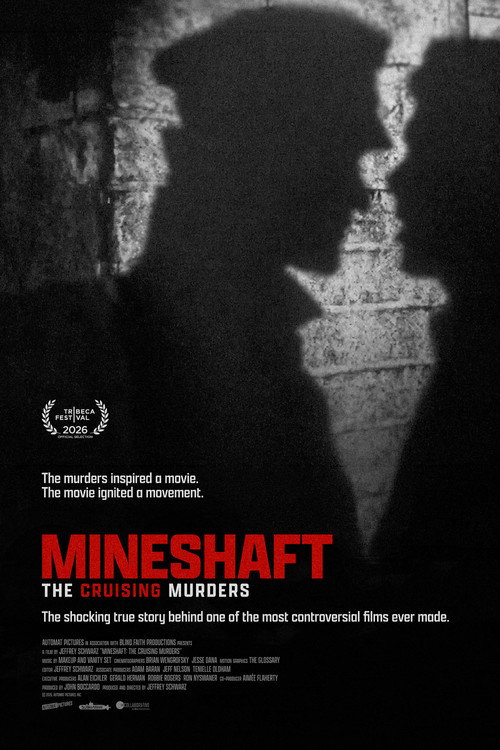




Arguably no major gay-themed film has ever been as polarizing within the queer community as 1980’s Cruising, the gritty William Friedkin crime thriller set against the backdrop of New York’s leather-bar scene. Documentarian Jeffrey Schwarz takes a three-pronged approach to the subject in Mineshaft: The Cruising Murders, examining the real-life homicide that inspired the story, the development and filming on New York locations, and the controversies that dogged the shoot, with massive protest crowds of LGBTQ rights activists disrupting production and rattling the star, Al Pacino.Schwarz has an excellent track record as a chronicler of queer pop culture — the Hollywood hunk both pre- and post-coming out in Tab Hunter Confidential; John Waters’ muse in I Am Divine; gay activist and scholar Vito Russo, author of The Celluloid Closet, the definitive study of queer representation in movies, in Vito; and Wrangler: Anatomy of an Icon, a portrait of gay porn hall-of-famer Jack Wrangler. That’s just to name a few.The lore around Cruising proves somewhat harder to distill, making the new film discursive, its focus shifting throughout in ways that are not always fluid. Schwarz (also serving as editor) is careful to contextualize Friedkin’s thriller in a time when gay men rarely saw themselves portrayed by Hollywood with any kind of complexity. That no doubt heightened sensitivities, causing gay activist groups to speculate that depicting the allure of danger and violence within the S&M subculture of the 1970s might provoke homophobic hate crimes. (David Rooney, The Hollywood Reporter review, 2026)2026 Tribeca Film Festival #1Tonight, I was in the audience at the SVA Theatre for the world premiere of Mineshaft: The Cruising Murders, an experience that I trusted in the hands of Jeffrey Schwarz. Having seen William Friedkin's Cruising and well-steeped in the takes on it that are positive, negative and everything in between, and considering myself also an appreciator of Schwarz's Tab Hunter Confidential and Wrangler: Anatomy of an Icon documentaries, I knew that Schwarz would find a multitude of perspectives through which to contextualize the controversies surrounding Friedkin's film and how it could have both admirers (of which Schwarz is one) and vehement detractors.The driving force in understanding Friedkin's motivation to make the film and the extreme opposition by so many in the LGBTQ+ community circa the late 70s/early 80s is the murder of Variety reporter and film critic Addison Verrill by another gay man, Paul Bateson, after a chance meeting at the Badlands bar, subsequent time spent that night at the Mineshaft club, then a sexual encounter that ended in Bateson killing Verrill in an alcohol-and-drugs-fueled rage apparently over Verrill not returning the desire to be in a relationship. It's chilling to know that Bateson, who had been a radiological technician, appears in a small role in The Exorcist, which Verrill and then-partner Bob Geary saw at the time of its release; who could ever fathom watching a movie and then a random actor from the cast ends up being their murderer? What if Verrill and Bateson hadn’t crossed paths on that night in September 1977, would Bateson still have killed other men?Schwarz can't answer the still unanswerable questions, like knowing for sure whether Bateson was also responsible for the unsolved "bag murders" that had many in NYC's queer community concerned about the possibility of a serial killer targeting them in the 70s, nor the identities of those six men who were victims. Nevertheless, Schwarz assembles such an interesting array of interviews here, including the aforementioned Geary, several gay rights activists/authors including Richard Berkowitz, Andy Humm, Charles Kaiser, Arnie Kantrowitz, Ken Kidd and Michael Schiavi, members of the S&M leather community including Darkqwolf and Thom Kam, Village Voice journalist Michael Musto, NYPD cop and Cruising consultant Randy Jurgensen, former NYC assistant district attorney William K. Hoyt, Cruising cast member Don Scardino and background extras John Burke and Rob Urbinati, Cruising editor Bud S. Smith, sex columnist Dan Savage, film historian David Del Valle, directors Frank Henenlotter, Jim Hubbard (he made the excellent United in Anger: A History of ACT UP) and Todd Verow, former Democratic District Leader Ken Sherrill (the first openly gay person to win elected office in the state of New York) and most touchingly, Addison Verrill's sister, Pamela Verrill Walker, who never even knew her brother was gay until after his death and gained insight into his personal life that she wished she could have had while he was alive. I was also fascinated by the role that Village Voice journalist Arthur Bell played in this saga, which ultimately suggests that part of his vitriol for Cruising was incited by anger that Friedkin never involved him in the project by crediting his reporting as inspiration, and found it interesting that Schwarz also included one of Bateson's friends to show that at least one person supported him.Schwarz was present to introduce the screening and also took part in a Q&A afterward with extra-special guest Verrill Walker; by chance, she had been standing right in front of me in the line outside the theater earlier in the evening, and Schwarz greeted her on his way into the building. Both spoke eloquently (Verrill Walker mentioned that one of the details she'd learned from her brother's group of gay friends was that his first gay sexual experience had been while serving with the Peace Corps in Nigeria; also, she enjoyed our hearty laughter at a particularly funny moment of naïveté expressed in the doc regarding handkerchief symbolism) and by coincidence, one of the audience questions came from one of my brother's college English professors, who acted with him in local theater.Mineshaft actually wasn't my first Tribeca event of the year, though; earlier in the afternoon, I was at Borough of Manhattan Community College's Tribeca Performing Arts Center to see the Survivor 50th Season Anniversary Panel, in which three Old School superstars (Rob Cesternino, Cirie Fields and Jonathan Penner) and three New Era players (Kyle Fraser, Kamilla Karthigesu and Teeny Chirichillo) gathered to reflect on the show's 25-year evolution, cultural legacy, how the outside world has affected the show's developing attitudes and ways in which the contestants have been changed by their experiences.There were some fantastic conversations especially from Teeny and Kyle, along with the golden opportunity to see Penner, who I'm tempted to call my all-time favorite Survivor player for his time in the franchise, acting career (forever a fan of The Last Supper), all the work he has done to raise ALS awareness in honor of his wife, the late, great Stacy Title, and just what a compelling speaker Penner is in general. He and everyone else gave such beautiful answers about why it matters for Survivor to be a place for storytelling to offer a diversity in represented voices, and that emphasis on representation was still echoing in my mind during Mineshaft and afterward.To think “Mineshaft” will premiere at Tribeca, probably walking distance from Addison’s apartment and all those gay leather bars from the ‘70s…You could walk from the theater where we’re playing in to Julius’, where Addison met Bob. You can walk to the Meatpacking District where the Mineshaft was on Washington Street. Part of why I love “Cruising” is that you get to see a lot of those streets. Telling Addison’s story was a way to explore what was available to gay men then. But also when you look at the film now, it’s painful to watch because you know it was filmed in the summer of 1979 and the first cases of HIV were reported in ‘81. We know for a fact that a lot of guys who had the virus had it for years before any symptoms would appear. If you look at the bar scenes in “Cruising,” you have to wonder how many of those guys would be alive a year or two or five years later because Friedkin cast real men in the leather scene and porn stars as extras. Friedkin very consciously cast it with gay porn stars. The guy in the first murder scene in the beginning of movie who is tied up in the bed and gets stabbed in the back, he was a very well-known porn star called Malo. He ended up staying friends with Pacino. He’s the bodyguard in “Scarface” that gets chainsawed in the bathroom. (Marc Malkin and Jeffrey Schwarz, Variety interview, 2026)2026 in Film: Ranked (So Far)