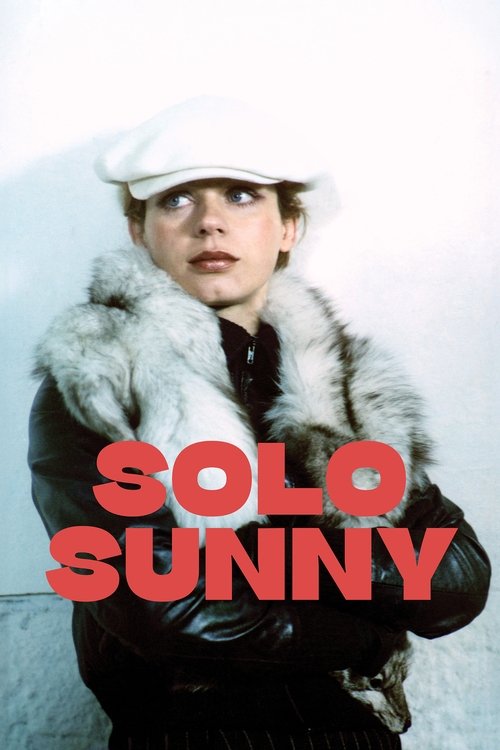
A rock & roll fable filtered through the shadow lens of the GDR. More a brooding slice-of-life than a conventional drama, at its heart is Renate Krossner’s quietly rebellious diva, her defiant fatalism never far away. Yet the film's tempered with a polished, familiar style, more Hollywood than East Berlin (or maybe a downbeat Streets of Fire minus the neon violence). The music? Unfocused and weirdly conceived, not in a good way: poorly lip-synced, from Benatar-lite to hippie jazz to perplexing circus cabaret.
Wonderful to look at and moving as an expression of the frustration of a fierce individualist in a society that frowns upon such a thing, Solo Sunny offers a glimpse into youth culture in a GDR in the throes of physical change. It was a great success in Germanies both East and West, the product of a brief period of increased cultural freedom that came to an end while the film was still very much on the minds of the public.Its title refers not only to its lead character's desire for a solo singing career, but also to her attitude toward life. Though Sunny (the stage name of a former factory worker named Ingrid, wonderfully played Renate Krößner, who emigrated to West Germany five years after Solo Sunny was released) is not a great singer, and doesn't have a clear path forward, she is determined to be the one who dictates the direction of her life, and chafes against even the slightest suggestion of conformity.Sunny has chosen to live in a building scheduled for demolition (the scenes in her apartment were shot in just such a building) rather than in one of the newly constructed symbols of progress, and battles with her conformist neighbors on principle, playing loud music, bringing men into her apartment, and refusing to respect the judgemental older woman who is the community's default leader. Sunny sleeps around, something which is an expression of both carnal desire and defiance of convention, and is unafraid of fighting back violently against any man who forces his attentions upon her or betrays her.A complex character and a difficult woman to deal with, Sunny is also one who refuses to change herself, whether it is for the comfort of others or to ease her way through the world. And she is deeply unhappy, something which renders the challenges caused by her combativeness even great burdens to carry forward.Stuck in a touring band that offers her no advancement and survives by the skin of its teeth, Sunny throws herself into a relationship with a deadpan philosopher-saxophonist (Alexander Lang as Ralph) she meets when he sits in with her band one night. Neither of them is remotely suited for a conventional relationship, but she finds value in being wanted and is grasping for something positive in her life, so she pins her unformed hopes awkwardly to a man both of them know is ill-suited to wear them.There's a sense that Sunny clings to Ralph because he represents her opportunity to find conventional happiness. She does not want to be conventional and Ralph is anything but that, squatting in a rundown building with a useless degree and an apartment full of books, but in the face of her constant disappointment, Sunny is increasingly desperate for even the smallest win. And, when she's kicked out of the band and runs back to Ralph in mixed triumph and fear, only to find him in bed with another woman, her unhappiness explodes outward in a semi-accidental suicide attempt.Her subsequent time in a sanitarium fails to restore Sunny and, when she leaves, she returns to life as Ingrid, back in the factory she'd put in her rear view mirror when she embraced her dream of musical stardom. In the factory, there is no sign of Sunny: Ingrid dresses and carries herself completely differently from the woman we've come to know, and her depression is grim and palpable.Though there are moments of humor in Solo Sunny, as a whole the GDR it reveals is drab and hopeless; those with a spark, like Sunny, are worn down by their constant swimming against the tide for decidedly limited reward. It is telling that her happy ending is merely a successful return to more of the same: she enters another rundown building and joins a new band full of men who look just like those in the one from which she has broken. Nothing will change, but Sunny has again found the strength she needs for the fight, which for her is a triumph.(There's a lot of Rainer Werner Fassbinder here, in the grim world, the flawed characters, and in the attention to set design and styling. I bet Fassbinder loved, or at least strongly approved of, this movie.)I'm blunt, [I] sleep with whoever I want …. I'm Sunny.