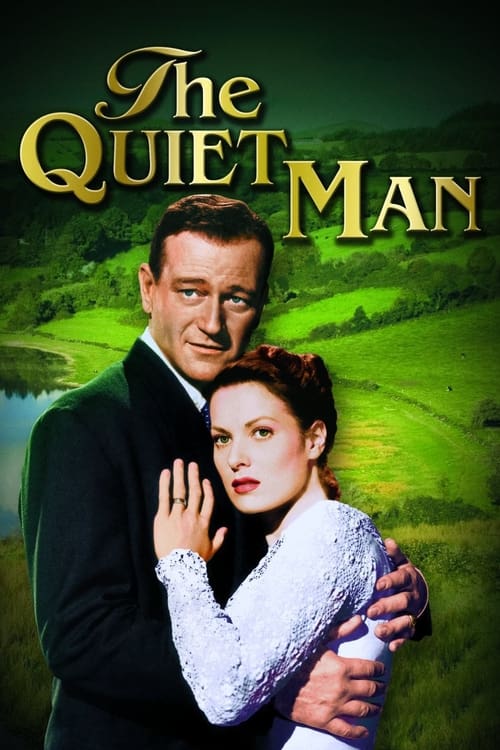
Honestly not sure what to make of this? For my whole life I’ve heard my parents complain about it as this obnoxious cartoon presentation of Ireland full of bad stereotypes and bad accents (relevant info: my mom is from Ireland and I’ve spent a lot of time there), but for much of the movie I actually found it pretty lovely? Like, sure, it’s not realistic but it’s such a staggeringly gorgeous fairy tale place, such a clearly idealized presentation made by someone not from there, that it gets away with painting with a broad brush.But then there’s just the way John Wayne handles Maureen O’Hara physically: throwing her around roughly, breaking in doors she’s locked, dragging her by the arm for five miles while she keeps falling down. It seems like the movie means it to be charming and funny but I just kept thinking “uhhh this is a bad marriage and she should get away.” The whole movie Wayne is resisting the urge to be violent and then in the end he’s violent and it makes everything better and they’re all happy.Look so much of this is so good and entertaining and incredibly well made and I want to love it, there’s just also that stuff that really doesn’t work for me. Maybe I’m missing something! I want to watch it again to see if it plays differently.Anyway this and Straw Dogs would make a good double feature.
This is probably the Ford film which has taken me the longest to get around to - I've always been aware of it's subtext and critique, but it never fully clicked with me until now. Maybe it was the poor quality of previous home video versions of the movie, coupled with the jarring jump to this new one. But under this viewing I found it to be among one of Ford's most complex and audacious films - more than mere Irish "blarney," this is another film on issues of representation, and if it is not quite as successful as something like Fort Apache in this regard, it's merely because it's not as jarring, and dares to be entertaining at times without any need or cause for subtext. But this is also a film filled with pain - I sense this in the films opening credits - a realization that one cannot escape their history, that happiness is not totally achievable, but also that perhaps better than excaping past mistakes is taking account for them.As Straub said regarding the aforementioned 'Fort Apache,' Ford is "more Brechtian than Brecht," though for me it takes quite some time to enter this mode, and for me this might be a flaw as because of how enjoyable the movie actually is, the film seems perhaps a bit too complicit in it's actions. Then again, this may be an aspect of it's innate complexity - that we as a viewer are complicit in the actions of the characters that the absurdity of the films final 20 minutes does not feel as jarring as it should. But at the same time perhaps it is a consequence of the surprising amount of sophistication in Sean and Mary-Kate's relationship (as this is Ford, this should not be at all surprising - but I simply did not catch it on previous viewings) - and it is romantic as it is because of the films approach to the repressive energy of social customs and traditions. This is no different than many of Ford's post-48 works, however strangely enough it's directness in it's satirical bent made it seem more oblique for me! The film opens in a storybook, fairy-tale world, with grass greener than the grass Renoir painted in The River. Horse-drawn carriages & leprechaun-esque matchmakers abound, meanwhile there is political unrest, a wealthy landowner who takes down names in a blackbook to later discredit his enemies, and a fiercely oppressive society which deprives its women of their rights and values. But then how can Wayne's Sean Thornton see the place he had dreamed of as a child, told stories about from his dead mother, any different? A dialogue between idealization and authenticity, the films primary dramatic weight stems from Sean and Mary-Kate's desire for authentic love in the face of the codes of this society - and furthermore for Sean to see that Mary-Kate is a fully adult person with their own desires, values, and belongings. For such a 'romantic' film, there is a considerable amount of talk about legalities and ownership of property! But though Mary-Kate is almost as much as a protagonist as Sean is, the film remains in Sean's perspective, which is the only way the films theatrical aspect can take precedence. This one reason why Ford will always remain one of the greatest - he doesn't necessarily aestheticize emotions as aestheticize states of mind, while remaining omniscient and outside of the narrative - there is always an author. Rather than so many piss-poor critiques and analysis's have described (and have certainly done more harm than good regarding this) Ford is always reminding us not to get lost in the story. Sure, even Ford has contradicted this himself - but this is also the same guy who told Peter Bogdanovich that he thought American heroes were good for the country, and then told a French interviewer that Fort Apache was a critique of American Imperialism within the same month. According to Joseph McBride's 'Searching for John Ford,' Ford's research assistant, Katherine Clifton, suggested Robert Ryan as a potential replacement for Wayne. Ford immediately scoffed at this idea, but over twenty years later in 1973 JF turned to Clifton out of nowhere and said "you know, Ryan would have been good." This is very interesting, because without Wayne in this role a key component of this film is missing! Wayne's character in this film is everything the actor had been established as not being - "a quiet, peace loving man," as an IRA fighter says. It's only in the films final 20 minutes that we see the Wayne 'persona' come into play! So here too is another dialectic regarding representation (this idea will be further developed in The Searchers), - what is 'real', and what is it that a mass audience wishes to see? Everyone in the town crowds around to see the climatic fight, even a man on his deathbed!The film shifts formal tones as it progresses, from the soothing, vibrant greenery of Sean's arrival in Innisfree to the more realistic cloudy & rainy Ireland as Sean and Mary-Kate become more and more engaged with each other. But there is also a gorgeous sense of 'coming home' which persists until the relationship becomes more and more 'real.' A soothing river and soft music from this wonderful score by Victor Young (the great hero of Republic Pictures) overtake more of the frame than Sean himself on his first walk to his birthplace which he is too young to remember and has only been told about. One must make mention of the Sean and Mary-Kate first lying eyes on each other as well - Wayne/Thornton never has a shot-reverse shot with anyone in the film prior - we are in storybook land and everything is on the same plane as him - presentational, because that is the world the way Sean wishes to see it. It's only with this first look that an SRS is established, as though the authenticity of O'Hara's gaze breaks the spell Sean has cast over his perception. The only aspect breaking the Brechtian theatricality of the films back-quarter is O'Hara's gesture of opening the fire-pit to destroy the money from the dowery. This is hugely key - it confirms that Mary-Kate/O'Hara did not care about the money in-itself, only what it represented - that Sean finally see her as a person! "There's 300 years of dreaming in those things..." she tearfully exclaims the night after their wedding! Because she realizes that Sean's values are little different than the values of this rigidly patriarchal society, and that her will and femininity will continue to be stifled. She becomes aware that she will move from the role of repressed Irish woman to repressed American wife. With the destruction of the money, O Hara/Mary-Kate can now see that Sean sees her as an equal. It's also worth mentioning here that Maureen O'Hara gives one of the greatest performances of all time in this movie. It's as though she is able to convey every emotion possible with immaculate nuance, yet with enough animation to accentuate that nuance. She manifests emotion more physically than the best of the silent actors.Technically, the film should end here as all key-conflicts in the film have been tied up. However - there is the climatic fight. And it is key that it happens after the destruction of the money, because that establishes its futility. It has no meaning beyond upholding the codes and mores of both this society and no-doubt the audiences that made this Ford's last huge critical and box-office success. (note - Ford films still very well money-wise until Cheyenne Autumn, but following this film it seems most mainstream American critics had determined Ford was now or was becoming a has-been). Something enormously key about this last section - the film reverts to it's vivid greens & presentational style of it's opening section. What makes these last twenty or so minutes so provocative is that Wayne/Sean & O'Hara/Mary-Kate reject every resentment they have had so far and choose to become part of society as statement. So Wayne drags O'Hara through actual fields of shit to her brother, and is even given a stick by an older woman "to beat the lovely lady," before engaging in a fistfight - revealing the codes of both this barbaric paternalistic society as much as the barbaric codes of what Wayne's persona was becoming. And the barbaric codes of what a Cold War-era America wanted to see. "Peace is returned to Innisfree," because the codes are upheld - why is this movie (or rather, this sequence in particular) provocative? Because it reveals the primitive savagery upon which a repressive and paternalistic system sustains itself on.
93Bonnets swaying in the wind. Booze and greenery and ritual. A man of violence returns to his homeland in order to reckon with himself and the possibility of a romantic future. Maybe, just maybe, on a sheer compositional level, the most beautiful picture in the history of the cinema. I might be saying that a bit loud but gosh just look at those images! On a big screen, the fantastical trials and tribulations of John Ford's Ireland manifest in a mythic register. Larger than life.