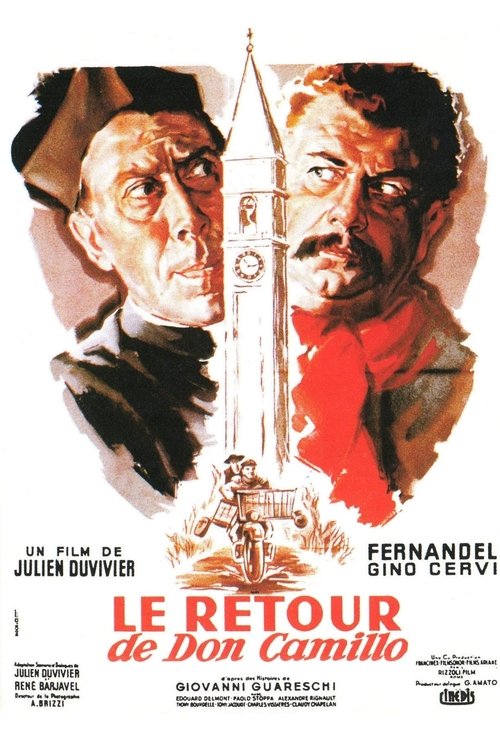
I have Italian origins, but my grandfather could not get on well with the fascist regime. Maybe this is the reason why I inherited a strong aversion to powerful people in charge, an inclination to lasagnas and the veneration for the films starring Don Camillo. Set in a small village in Northern Italy and adapted from the novels written by Giovanni Guareschi, this series of black and white, almost expressionist films represent the fight between the local parish priest (the French Fernandel who even seemed to be more Italian than my grandfather) and the communist major Peppone (Gino Cervi, my grandmother was absolutely in love with him) and their ideological contrasts often led to physical fights typical of Italian comedies: punches and slaps that were louder than painful and clubs the two characters hit their backs with. They are amazing, funny and melodramatic films: there are sub-plots about floods, young people who face their parents’ deafness, kids abandoned by their old and greedy fathers and there is an extraordinary spiritual tension: Don Camillo always chats with his conscience and the cross and Jesus (and his conscience) replies, telling him that he must make the right choice. “The Return of Don Camillo” is the second episode of the series and starts with a powerful sequence: sent to another abode in compliance with his duties, Don Camillo climbs a mountain while there is a snowstorm, dragging the big Christ in wood belonging to his parish that no longer answers his questions, and when the cross starts replying again, Christ tells him “But I have always answered your questions, Don Camillo, you were not listening to me”. I am not a religious person but I respect (and I am a little bit afraid of) compassionate religions and I believe that this sequence has the same need and the same seriousness of the questions Bresson and Bergman asked themselves and today Malick chases in a way that is a little bit confused and I do not think that this sequence is less noble because it appears in a film where we laugh at our pettiness.
Don Camillo & Peppone Special Edition 2.) Film - Don Camillos RückkehrUnter meinem Kreuze gehen sonderbare Dinge vor sich. Es gehen wieder unter meinem Kreuze sonderbare Dinge vor sich, heißt es wohl eher. Dieses Mal gehen sich nicht nur Don Camillo und Peppone gegenseitig an den Kragen, nein, nein, sondern selbst Mutternatur mischt kräftig mit, doch von vorne bitte und ich erzähle Euch was im beschaulichen, ländlichen Brescello alles geschieht. Der es durchaus gut meinende Don Camillo und dessen Bärenkräften haben den Bischof selbst erzürnt, ihn gezwungen dieses fromme, trinkfreudige, gütige Sprachrohr unseres Herren auf den Berge jenseits der Wolkendecke, aus den Augen der unter ihm liegenden knallroten Weinberge großer Feierlichkeiten, fern seines treusten und innigsten Freundes Widerwillen und sowieso dessen Eingeständnis Peppone zu verbannen. Dort haust Camillo nun, einsam über die Häupter seiner Gemeinschaft wie die dem Hirten abhanden gegangene Herde von Lämmern und Schäffchen. Indessen bricht der Bürgermeister des beschaulichen, ländlichen Brescello, Giuseppe Bottazzi alias Peppone, ein Kleinkrieg um den dringend benötigten Damm mit dem Großgrundbesitzer des an den Hängen erblühenden Weingebietes vom Zaun. Don Camillos gesandte Vertretung, wird ebenso zum klagenden Widerhall der nicht minder wichtigen und benötigten Restaurierung des von Rissen durchzogenen Kirchturms mit ihren jahrzehntealten und Jahrhunderte überdauernden Glocken.Fronten und sich anbahnende Katastrohen die diese zwei hier an einem Strang ziehende Hitzköpfe abermals vereint, sie bindet zum wohle des beschaulichen, ländlichen Dorfes Brescello.Der Humor bleibt dieses Mal deutlich im Hintergrund, ebenso die Gifteleien zwischen diesem großen, europäischen Filmduo weit vor dem Beginn und dem Siegeszug von „Bud Spencer und Terence Hill“, was ich in allen Punkten vermisst habe und hier zum Vorgängervergleich einen halben Stern abziehen muss. Don Camillo & Peppone-Ranking - boxd.it/fERwK
Evidence of our less secular cinematic past, when a parish priest could somehow be passed off as the hero of a six-film franchise. In this entry (the second, and last, directed by Julien Duvivier) we return to a small Italian village in which an odd couple — a rural clergyman and a communist politician — bicker (and co-conspire). The returning leads — the French Fernandel and the Italian Gino Servi — provide most of the charm, the peasants all coming from the stock of poor, country folk.