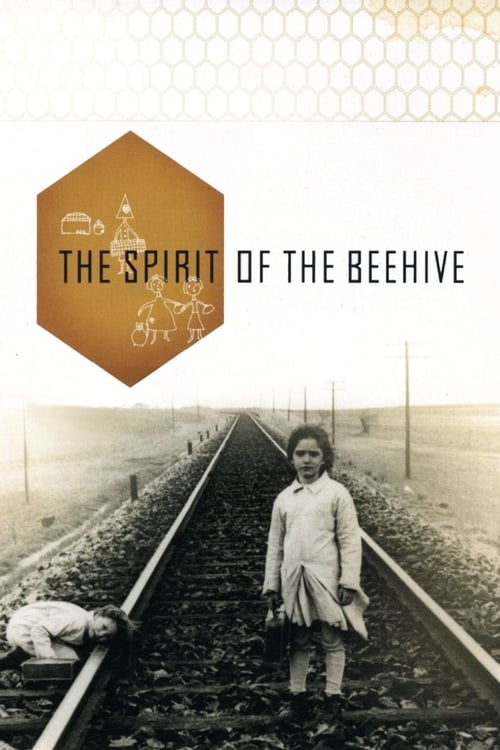




The aural elements of the film are introduced by the score, whimsical and mostly comprised of woodwinds, emerging over a series of children’s drawings that gradually make up the opening credit sequence. Abruptly being dropped into such a fantastical and “innocent” audiovisual experience definitely contributes to the idea of a childlike perspective, which will be the point-of-view of the audience for most of the film (Ana’s POV). The score of The Spirit of the Beehive also contains strings, and possibly even an organ, but the introductory sequence is enveloped in a fairytale-esque tone mostly due to the recurring flute motif. Indeed, most of the dialogue (and sound, for that matter) in the film is synchronized. The director, Victor Erice, isn’t attempting to create a surrealist atmosphere here so much as an atmosphere of magical realism. Unsynchronized dialogue is relatively common in surrealism, but not as much in realism (unless for good reason), so he’ll have to insert magic or peculiarity into his film through the use of other techniques.One of the most common and powerful ways to utilize sound is in the creation of offscreen space or, in other words, a world outside of the frame. Most of the interior scenes in The Spirit of the Beehive are silent and, thus, rather claustrophobic. Conversely, the majority of the exterior scenes are filled with naturalistic sounds, conveying a sort of spacial depth meant to challenge the lack of free space in the interior world. The naturalistic sounds that Erice utilizes in his exteriors are mostly just heavy wind and the sounds of various animals including dogs, horses, and birds of all sorts.Right from the beginning of the narrative, you get a sense that, although Ana and her family live in a rather large building, most of their community isn’t very wealthy. Visually, the town appears poor but the villagers' exchanges with one another (at least towards the beginning of the film) give way to a disparate, more playful sort of tone — gritty, but simultaneously acknowledging the potential for wonder. "Few films have had greater impact all over the world,” a man explains during the introductory portion of the 1931 Frankenstein, the movie brought to Ana’s village for a screening, “but I would advise you, not to take it too seriously.”A few minutes later comes one of my favorite moments in the film. Ana’s father stands, staring at a honeycomb saturated with bees, as the sound of the buzzing is slowly replaced by the wonderful score, which is next overlaid with voiceover. Suddenly we are dropped into his wife Teresa’s world, as she writes a letter to her lover. For a moment, we think that this may be a flashback to the early stages of the husband and wife’s relationship before it is reinforced that we remain in the present, and Teresa is certainly writing to another man. This notion of instability or a lack of health in the familial structure is drilled in by the sheer absence of communication between the four family members throughout the entirety of the film.It’s interesting how, when you force yourself to focus on a very particular element of an artistic creation (e.g. sound), your attention is so devoted to comprehending the aural elements of the piece that you’re more effortlessly able to pay attention to how much work goes into the structuring of audio. You’re unable to ignore the way that sound moves throughout the space of a scene, from right to left, from the background to the foreground (or vice versa), and the way that this movement has to be absolutely perfected in order to recreate reality as intended. In a way, I almost want to say that The Spirit of the Beehive is a film which transports its viewers through its imagery, and keeps them grounded (or keeps them from floating too far off into its magic) through its audio. “What if we never went beyond the limits of the known?,” the dialogue from Frankenstein inquires, almost in the same way that a man preparing a volunteer for hypnosis would inquire. The soundscape, rather than disorienting the viewer (e.g. surrealism), succeeds in transporting the viewer through careful tonal manipulations, sporadic philosophical questioning and the way certain aural structures are juxtaposed with the film’s undeniably mesmerizing imagery.For instance, there is a scene in the film where Ana’s sister is taking advantage of her gullibility, and supposedly calling upon the spirit of Frankenstein’s monster, as they lay in their beds beside one another. As soon as her sister has finished calling upon the spirit, the sound of their father’s footsteps (abstracted via omitting context) reveals itself and, for a moment, the audience believes that a spirit may really be present, before Erice cuts to the father pacing in his study and the synchronization of the audio resumes itself. Another one of my favorite moments in the film comes in the following scene when the father simply sits down to listen to a shortwave radio. He takes his seat, places a pair of headphones over his head and allows an odd tune to overtake him. Prior to this, the frame was identical but the lack of audio produced an image without a tone defined by the aural elements of the scene; it’s fascinating how an image can be altered through the introduction of aural elements, whether it be the shortwave radio, the score or merely the sound of birds chirping.In the end, although The Spirit of the Beehive isn’t a film typically praised for its utilization of audio — it’s a film commonly praised for the stunning nature of its imagery — the structure of its soundscape takes on a variety of meanings, from being the dimension of existence in which its adult characters can speak to themselves and reflect on their experiences, to the repetition of particular sounds (e.g. the noises of animals) which contrasts the feelings associated with interiors and exteriors, and how exterior spaces contain a much greater potential for magic or “unknownness” than the lack of imaginativeness in the interior world. The film closes by presenting us with an image of a dog barking in the darkness through the aural construction of the scene's offscreen space, and not only are we left wondering what could have possibly caught this creatures attention (is it Frankenstein’s monster?), we’re left pondering the very notion of the uncertain, the mysterious, and all that inhabits it.