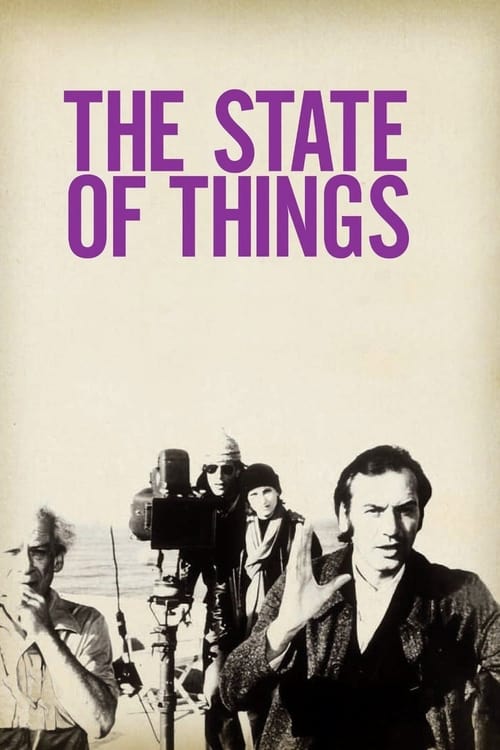
Portuguese & English reviewPortuguese-The State of Things (1982) de Wim Wenders, por Guilherme Pinheiro. Wim Wenders filma o impasse do próprio cinema num registo a preto e branco melancólico que reflete a desintegração de uma rodagem em Sintra, Portugal. A narrativa acompanha uma equipa de cinema encravada num hotel à beira-mar depois de a película e os fundos financeiros do produtor americano simplesmente acabarem, o tempo deixa de ser dramático para passar a ser estático, capturando a transição dolorosa entre a ambição artística europeia e a lógica estritamente comercial da indústria de Hollywood.O realizador constrói a narrativa a partir desse vazio produtivo, transformando a espera pela chegada do dinheiro numa reflexão sobre a própria utilidade de contar histórias quando o suporte material falha. A câmara de Henri Alekan passeia pelas ruínas da praia e pelos corredores silenciosos do hotel, focando o isolamento do cineasta Friedrich Munro (Patrick Bauchau) e a apatia da equipa perante o fim iminente do projeto. O contraste visual acentua a cisão entre o preto e branco contemplativo da Europa e a urgência colorida e violenta de Los Angeles, para onde o realizador acaba por viajar na tentativa desesperada de confrontar o produtor em fuga.O Estado das Coisas vale essencialmente pela sua crueza metacinematográfica e pelo retrato sincero do colapso de uma produção. A viagem final pelas ruas americanas a bordo de um motorhome fecha a obra com um tom de film noir desencantado, onde o cinema deixa de ser um meio de ilusão para se tornar no próprio alvo da câmara. Um registo frio e melancólico sobre a morte das narrativas clássicas e a resistência da imagem num mundo movido pelo capital.English-The State of Things (1982) by Wim Wenders, by Guilherme Pinheiro.Wim Wenders films the impasse of cinema itself in a melancholic black and white shot that reflects the disintegration of a film shoot in Sintra, Portugal. The narrative follows a film crew trapped in a seaside hotel after the film stock and the financial resources from the American producer simply run out; time ceases to be dramatic and becomes static, capturing the painful transition between European artistic ambition and the strictly commercial logic of the Hollywood industry.The director constructs the narrative from this productive void, transforming the wait for the money to arrive into a reflection on the very usefulness of storytelling when the material support fails. Henri Alekan's camera wanders through the beach ruins and the silent corridors of the hotel, focusing on the isolation of filmmaker Friedrich Munro (Patrick Bauchau) and the apathy of the crew in the face of the project's imminent end. The visual contrast accentuates the split between the contemplative black and white of Europe and the colorful and violent urgency of Los Angeles, where the director ends up traveling in a desperate attempt to confront the fleeing producer.The State of Things is essentially valuable for its meta-cinematic rawness and sincere portrayal of the collapse of a production. The final journey through the American streets aboard a motorhome closes the work with a disenchanted film noir tone, where cinema ceases to be a means of illusion and becomes the very target of the camera. A cold and melancholic record of the death of classic narratives and the resistance of the image in a world driven by capital.
Superior cinema. Absolutely astonishing, poetic, with a gloomy, supernatural ambience despite the seeming naturalism of the environment, ethereal interactions rich in character development. The sea is a juggernaut prophet of inner cataclysmic clashes, of intertwined conflicts, cinema as an imitation of human psychology instead of an imitation of life. Unspeakably haunting, experimental and playful soundtrack (Jürgen Knieper is truly a genius), and soliloquies like streams of consciousness, both literal and literary. Samuel Fuller oozes coolness if he feels like it. And to think that Jarmusch shot Stranger than Paradise (1984) with film left over by Wenders after making this phenomenal hybrid."Life is in colour, but black and white is more realistic."My senses are completely overwhelmed and shattered. I am shocked by the accuracy of the transitions and the psychological interactions. The entire product is 100% auteuristic! I wouldn't have minded at all if this had been an entire remake of Corman's low-budget, scary post-apocalyptic vision of the 50s, but this has depicted metafilm from an alternate experimental perspective where people are moving spaces and the landscapes are paintings made entirely of lighting and darkness. This was a dream... a dream which cacophonic stimula left me confused, and it is a beautiful confusion, concluding with an unexpected slice of neo-noir ferocity!And just when I thought the film couldn't get any better, Los Angeles by X is played during the L.A. sequence, one of my favorite songs of my teenage years.Remove Der Himmel Über Berlin (1987), and this would be Wender's masterpiece. It's incredible! To state that this reminded me of Raoul Ruiz at times should be enough to make you reconsider your film-watching priorities!98/100
What would you do if, in the middle of your shoot, your executive producer (Francis Ford Coppola) suspended production so he could poach your star (Frederick Forrest) to appear in his movie (One From the Heart), all of this on top of ongoing hassles with your studio (Zoetrope) and their financial backer (Orion Pictures/MGM) which would eventually need you to reshoot most of your film?This is the situation that confronted director Wim Wenders in 1981 when he was making Hammett, his American debut feature. I would have provided the catchphrase that Eric Cartman would make famous 15 or so years later: “Screw you guys, I’m going home”. Wenders is clearly made of sterner stuff. He took off to Portugal to help out friend and fellow director, Raoul Ruiz with the film stock he needed to complete The Territory (1981). While he was there, he knocked out a screenplay with Robert Kramer and Joshua Wallace, borrowed cast and crew from Ruiz, supplemented them with a few friends of his own, and made a satirical film that took precisely targeted aim at Coppola and the US studio system. The film opens with a sepia toned B&W sci-fi film set in a post-apocalyptic world with the characters trudging through a barren landscape. I was sitting watching and doing my best imitation of an oxygen-deprived goldfish. All of the actors are wearing face masks and eye protection!!!The shoot is running out of time with that day’s magic hour and the image returns to regular B&W as the film’s director, Friedrich Munro (Patrick Bauchau), juggles his shooting schedule to get in one last scene before the light fades. However, the film’s cameraman, Joe Corby (Samuel Fuller) tells him that they do not have enough film for that scene and have been shooting for the last three days on end portions from their film reels. Frederich uses his final footage on a different, shorter scene.The cast and crew hang out in a dilapidated motel on the Portuguese Atlantic coast as Friedrich tries to make phone contact with the film’s producer, Gordon (Alan Garfield) who has stopped taking his calls and is somewhere in LA. Joe flies out immediately to go back to LA to be with his dying wife. The cast and crew talk, exercise, practise the violin, have sex, and try to stay engaged as Friedrich flies back to LA to find Gordon and get the funds to finish the film, which we discover is called “The Searchers”. There seems to be a disagreement between critics and film commentators about which film Friedrich is remaking here. Some argue for Roger Corman’s Day the World Ended (1955) while others argue for Alan Dean’s The Most Dangerous Man Alive (1961). I have not been able to find any mention of anyone asking Wenders, which would seem the obvious way to sort this out.The action in the second half of the film shifts to LA where Friedrich sets out to find Gordon and his budget. He finds Gordon hiding out In a motorhome being driven around Hollywood by a crazy friend, dodging mafia types to whom he also owes money. In another swipe at Hollywood studio ethics, it turns out that the lawyer for both Frederich and Gordon is a mutual friend (played by Roger Corman) who sees no issue with representing both of them in their dispute. This melodramatic turn in the plot reminded me of the Fassbinder melodramas and the abrupt ending is also very Fassbinder, down to its undisguised symbolism.There is a lot of humour here in both the cast and crew first half (including Viva, Jeffrey Kime, and John Paul Getty III, earless on one side by this point) and in the long section in the second half where Friedrich and Gordon drive around, with Hollywood streets rolling by outside the trailerhome windows, as they have a debate about the European -v- American way of making movies. I particularly enjoyed Getty’s scene (surely largely improvised) where, while hanging out the company’s washing on the line, he complains about how hard it has been for him growing up buck-toothed and cross-eyed with acne and a stutter.As you would expect, given the film’s provenance, it is deeply steeped in film history. Friedrich Munro (Friedrich Murnau) and Joe Corby (Joe Biroc, the 1974 Oscar-winning cinematographer on The Towering Inferno) and the casting of Fuller, Corman and Viva are the most visible homages to cinema history, but there are many more. The film within a film is titled “The Searchers”, one of the cast lends Frederich a novel with The Searchers on its spine, and we see a cinema in the LA section screening a revival of John Ford’s 1956 classic Western. Fritz Lang gets a mention as do several Hollywood classics.Early on, Joe delivers one of the film’s many classic lines when he is talking to Friedrich: “Life is in colour, but black and white is more realistic” and later on tells him: “With black and white you can see the shape of things”. When Viva, as Kate the script girl, is filling in her time sketching the beach below the motel, she tells one of her daughters that capturing the relationship between light and dark is the secret to recording reality. By contrast, when Gordon is railing at Frederich back in LA, he says that allowing the film to be shot in B&W was the root cause of all his problems: “The film is not in colour so it’s just not commercial”.Of course, if like Wenders, you are going to film in B&W, it does not hurt to have a venerable cinematographer like Henri Alekan shooting your film. Some of the Portuguese landscapes and seascapes are stunning, and he shows us a different take on LA in the images shot through the motorhome’s windows. There is also a very clever and funny (crane?) shot, set in a Macdonalds car park, that choreographs Friedrich’s car getting away from his mafia tail.Running out of film stock is also a recurrent theme here, in both the film and real life. It is the starting point for the plot when the lack of money, and therefore film stock, halts production. Wenders’ decision to use his downtime on Hammett to take some film stock to Ruiz in Portugal gave him access to cast and crew. There is one more film stock link that I was not aware of until doing some research on the background to the film.As is so often the case with Wenders films, the music soundtrack is fantastic. Jurgen Knieper wrote the incidental music, supplemented with tracks from Joe Ely, X, and The Del-Byzanteens. One of the then members of The Del-Byzanteens was Jim Jarmusch and, as you do with friends, Wenders gave Jarmusch the unused film stock that was leftover when The State of Things wrapped. Jarmusch then used that B&W film stock to film the first third of Stranger Than Paradise.This is not one of Wenders great films (that is a very high peak to climb) but is is a fascinating one and comes at a pivotal point in his filmography. It came after Kings of the Road (1976) and The American Friend (1977) and it is hard to say, had Wenders move into the American studio system with Hammett not been such a nightmare, whether he would have continued to make studio movies. It was not a life enriching experience, though, and Wenders formed his own production company, Road Movies, and went on to make two of my all time favourite films as his next two outings, Paris Texas (1984) and Wings of Desire (1987).The extras on the Axiom Films DVD are a booklet with uncredited notes on the film, including several quotes from Wenders together with several deleted scenes. Two of these look like classic Alekan framing and are interesting in light of the film’s focus on light and dark. They show two different characters in settings where there are very strong horizontal, diagonal and vertical lines (a fence, gates, lattice) between the camera and the human subject, overlaid by shadows.The film had its premiere at the 1982 Venice Film Festival where it won the Golden Lion for Best Film and the FIPRESCI Award.ADDENDUM 8 June 2020: Although I had seen Rainer Werner Fassbinder’s Beware of a Holy Whore (1970) twice before some years ago, it was only on rewatching it tonight that I noticed the similarities between it and this film. I make some obvious comparisons here.