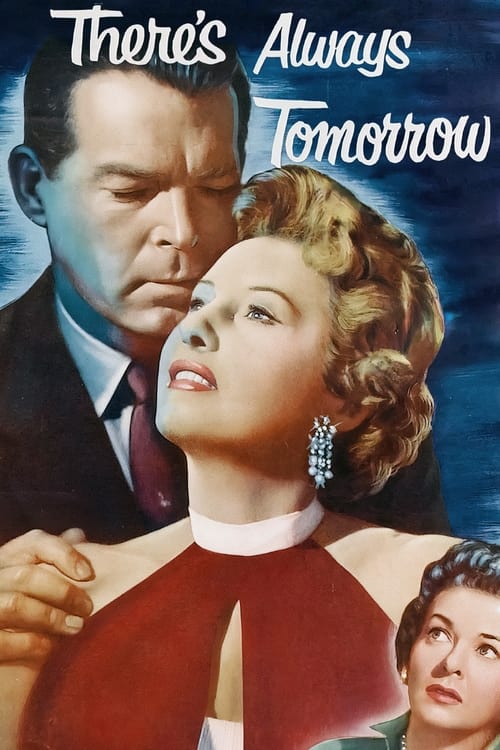
What I love about this film is that Douglas Sirk, the man who was maybe best known for giving women a voice, telling their stories of quiet imprisonment in their 50s households, turns it all around here by introducing us to a man who's struggling with domesticity, and no, not in a "oh gosh, I really gotta go out there and put my dick in something else" kinda way, no, Sirk tells this story with the same sensitivity he applied to his "women's pictures", and I feel that's what makes this movie unusual and daring. Fred MacMurray's character is a gentle and sensitive man, an attentive husband and a generous father, and his family is obviously taking him for granted. I am completely against the idea that only women are in danger of losing their identity in marriage and family life, men can feel just as unseen and unheard, and There's Always Tomorrow shows us such a man, and as the days pass by we care more and more for him and are with him in his subtle pain that comes to the surface through an encounter with a former employee (Barbara Stanwyck). He isn't looking for a quick adventure or an easy escape, he wants his existence to deepen instead of broaden, he wants to be here, the full owner of his life instead of feeling like a robot whose path is dictated by a set of batteries. He wants kindness and appreciation because he gives kindness and appreciation. And now and then, he wants time to stop, just for a moment, be able to look around and feel certain that this is exactly where he belongs. Home, instead of captured.
Vague spoilers ahead.Douglas Sirk makes movies about suffering. Suffering that is intense and pointed, yes, but it's also suffering that, often, comes from within; suffering that begins only when his characters open their eyes, and realize with horror that they've been miserable for years. Often, external voices (usually, it seems, played by William Reynolds who, for a brief period in the mid-1950s, cornered the cinematic market on loathsome, arrogant sons) enter the fray just as the characters awaken, articulating the social pressures that had become such an ever-present internal monologue that Sirk's protagonists hadn't even registered its presence before their newfound awareness.In There's Always Tomorrow, Sirk's somnambulist is Cliff Groves, played by Fred MacMurray at his most dimly earnest. When we meet Cliff, he has a job doing something he once loved, a wife who likes him and is also a competent partner, a magnificent house, and three high achieving kids. In truth, Cliff is living the American Dream, with emphasis on the "dream" part. Like so many other Sirk protagonists, he's drifting through his life, going through the motions, responding by rote and years of training to every predictable situation that arises (and they're all predictable). He's the man in the gray flannel suit, perpetually unfulfilled but constantly congratulated for his achievements. He's a man in command of his world: the very pinnacle of American masculinity.The tragedy of Cliff is that he wakes up. Roused from his slumber by the arrival of Norma Vail (Barbara Stanwyck), a toy designer he once noticed only when it was convenient for him, Cliff suddenly realizes that there is more to life than what he has; than what he's been told he wants. Like so many educated, white women who suffered as desperate housewives in the 1950s, Cliff, too, is trapped by his success, to such a degree that to escape it looks like betrayal; looks like selfishness. (Is betrayal; is selfishness.)For one glorious day, Cliff imagines a different life for himself. A life unencumbered by responsibilities (by work, by children, by commitments to others) and full of adventures with an exciting new woman who, he's decided, he loves. It's a beautiful fantasy, one that is burned to the ground with ruthless efficiency by Norma herself. Norma who, as a single, working woman in the mid-1950s, has long owned a pair of glasses from They Live. She sees the forces binding Cliff, and she can also see that he'll miss them when they're gone. He'll be relieved for a little while, perhaps, but it won't be long before he idly wonders what tragic ailment has most recently struck his youngest daughter, or what foolishness his son is blustering about now, or what his wife has bought for tomorrow's dinner. Cliff thinks he hates it all; things he wants to be free of it all, but Norma knows it's too late — it's become who he is, and Cliff cannot leave.Emotionally, There's Always Tomorrow ends the reverse of the way Psycho opens: with a long, slow pulling back of the camera to reveal endless suburbs full of houses just like the Grove home, and men just like Cliff, living their tepid, triumphant lives and unable to understand why they don't feel like celebrating. Cliff's burden is that he knows why, but it doesn't make any difference.