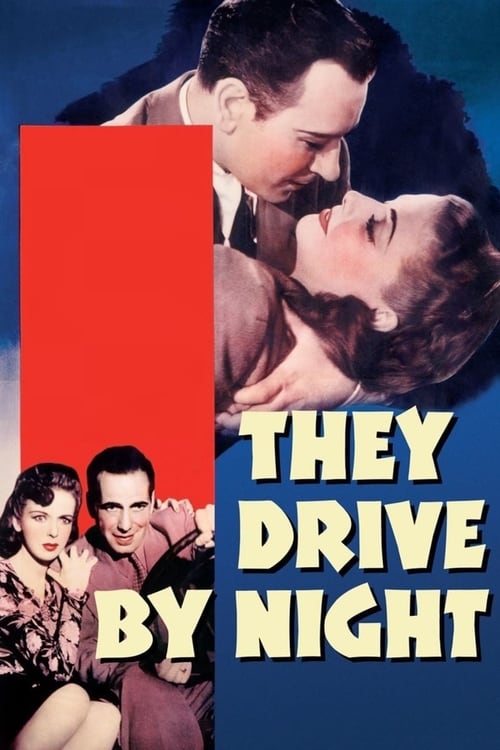
“They Drive By Night” is a noir ripped in two; half belonging to a pair of scrappy brothers, and half to a vicious turn by Ida Lupino as a woman scorned. Director Raoul Walsh seems to take a detour down a dark back road partway through “Drive By Night.” A film that begins following George Raft and Humphrey Bogart as two truck drivers perpetually behind on their payments eventually loses its protagonists almost entirely; falling under the spell of a positively maniacal Lupino. It’s a shift in gear that would wreck almost any other film, but Walsh’s penchant for solid worksmanship ensures that “Night” has a momentum that keeps on trucking. The two portions are tied together with lose threads of a theme that is essentially a riff on the pressures of capitalism. Sometimes it makes a guy waste his life away behind the wheel of a large automobile. Sometimes it propels a woman to curtail her shopping sprees to commit homicide. The soapy evil-doing in the movie’s later half by Lupino, and the charismatic early work by Bogart make “Night” a solid noir genre entry. But it’s director Walsh’s chummy message of fraternity over material concerns... or rather - bros before owes (?) that give “Night” unforgettable intentions with a heart of gold.
Some spoilers ahead.I loved the first half of They Drive by Night. It's a Depression film about men trying to scrape a living together any way they can, in this case by embracing the dangerous, largely unregulated world of long-haul trucking. Over the course of the first act, we meet what is essentially a collective of truckers: though some of them work legal and others run fright on their own, the group makes common cause, and they look out for one another regardless of whether they work for someone else, or for themselves. There's a lovely tone to this section of the film, a deeply sympathetic portrayal of fundamentally good men overlooked by most of society, all steeped in Warner Brothers' customary realism.The second half of the film, though, veers wildly into crazy lady noir, rendering the story stationary, with George Raft's former trucker Joe Fabrini moved into a management position in a straight trucking business while being frantically pursed by Lana Carlsen, the wife of his friend and boss, played by Ida Lupino in her first major role.At first Lana is simply flirtatious, interested in Joe because he's hot and she's bored, but it quickly escalates to an obsession, with Lana raging at the typically womanizing Joe for daring to turn her down (over and over again). Resentful of his constant use of her marriage to his friend as an excuse to escape her clutches, Lana decides to solve the problem by, well, killing her husband. Obviously.It all escalates from there, with Lana getting more and more unhinged and seeming to lose sight entirely of why she was interested in Joe in the first place — it becomes far less about attraction than it is a desire to win; for all of her endless, oddly naïve machination to not be for naught.Though the noir half of the film is certainly more exciting than the Depression picture opening, it's also completely absurd, dominated a character who is a spectacle rather than a human being. Lupino is certainly game, growling out Lana's rages with impressive commitment, but it's all just so silly that it's hard to really engage with her character, or to take anything that happens as a result of her mania seriously. There's a genuinely interesting story here — a woman determined to make something of her self, slowly climbing the ladder to success by use of the men available to her — but it's simply not the one that's being told, as the film chooses spectacle over humanity in its villain.Away from Lupino's flashy role, Raft and Humphrey Bogart as appealing as brothers whose love for one another overcomes any disagreements, and Ann Sheridan is refreshingly straightforward as Joe's solid, trusting (!!!!!!) girlfriend. It was such a relief for one of the flim's crises not to be her assuming that he was banging Lana! Credit to Raoul Walsh and the writers (I'm curious as to how closely the screenplay hews to the A.I. Bezzerides novel on which it was based) for leaving at least that one trope out of their crazy lady stew.