"Paris, Paris, Paris," the record loops but never advances suggesting he'll probably never get there. Conflicts over resources and debts, an utterance of "Shit!" as a tilt-up reveals European style high rise buildings over the more humble African abodes, Senegal has a strange appeal. Playful visual rhymes link a slaughtered steer and the protagonist's motorcycle, then blood draining from a goat's throat to the waves in a crevice to his girlfriend's sexual arousal. An abstract, surreal lovers on the run road movie explodes and implodes under the force of Mambety's stylized editing, the timeline of events vague and open ended. Maybe it's my cultural distance, but I felt nearly baffled by the final moments of the movie, though ultimately I found it mysterious in a pleasing way. It seems to be simultaneously a love letter and a eulogy for Senegal. Looking forward to seeing more Mambety and watching this again some day.
Paris, Paris, Paris...the search for an identity, home, and purpose with the excruciatingly unforgiving process that goes with it. a film so beautiful that it felt like every cell in my body was being pulled and pushed in every direction possible; if i had to look at one more beautiful shot or intimate moment, my body threatens either explosion or implosion. even the smallest details contain a vast love and knowledge for what is being filmed. rides an insane and seemingly impossible line between being entertaining, enlightening, visceral, deliriously punk, fantastical and realistic. goes without saying Touki Bouki and its director Djibril Diop Mambéty rightfully and justly deserve a spot in the realm of cinematic visibility of their french new wave influences and its directors (see: godard, truffaut, varda, resnais etc.). you've never seen the collision course for the past, present and future like this before.
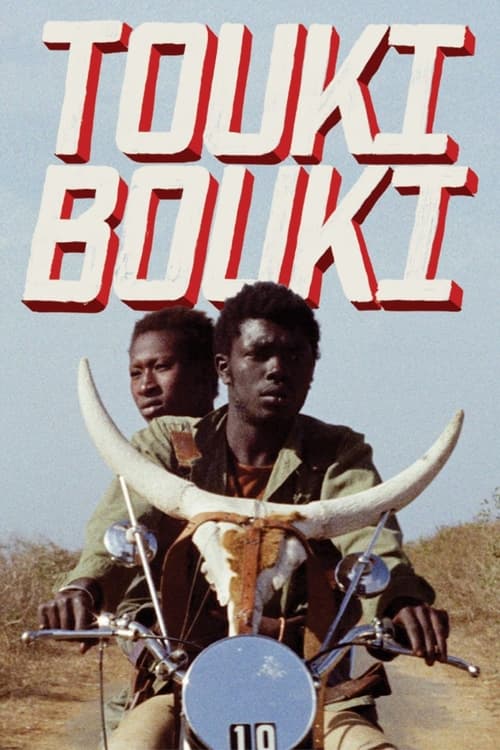
Film #1 in the 30 Countries Challenge: SenegalThis may be the first African film that I have seen, and I now feel immensely upset for having overlooked the films of this continent. Touki Bouki, also known as Journey of the Hyena, is a very static filma about post-colonial feelings in Senegal. The films two main protagonists, Mory and Anta, are university students that have become disillusioned by life in Senegal and seek change. They feel that it would be a great adventure to go to France, and the majority of the film consists of their exploits as they attempt to find enough money to leave Senegal.The film is shot with unflinching realism, and the camera never shies away from subject matter which could be described as disturbing, such as the slaughter of an animal. Every shot is full of intense heat, with bright earth tones and natural light, which lends to the realism of the film and also alludes to the narrative's timelessness (the film could be taking place in a single afternoon, or could even be lasting years). The objective camera, which remains mostly static while it documents the lives of many Senegalese people, provides a nearly ethnographic portrait of post-colonial Senegal. The sound design, especially, which includes sounds without screen fidelity, sounds nearly like field recordings of everyday life. One of my favorite auditory moments is the sound of a crying baby near the start of the film, yet the film maker never cuts to show the baby producing the sound. The unseen crying-child stands in for an infinite reality lurking offscreen, and causes for the film to feel very open and honest in its portrayal of the different people. Some of the actions in the film feel so spontaneous, in fact, that I would not be surprised if a large majority of the street scenes were unscripted; the film works almost as a documentary.Of course the film is not a documentary, and the main narrative thread that moves the film forward between scenes Mory and Anta's odyssey through Senegal. The different scenes that their quest to leave Senegal takes them through are equal parts humourous and horrific, including a scene where Mory is flirted with by a homosexual aristocrat and a tonally opposite scene in which Mory and Anta steal what they think is a case full of money, but in fact contains human remains. The two characters move through these events with passive frustration; they don't particularly care about anything besides leaving the country, and they are willing to exploit anyone along the way without showing any sympathy.Perhaps the film is attempting to make a statement about how colonialism in Senegal has produced a massive class distinction between the rich and the poor, or that culture is dying in post-colonial Africa. A clear contrast is made between Mory and the people around him; the framing clearly defines separation between Mory and other Senegalese people, further emphasizing how Mory feels like and outsider in his own country. The framing of certain shots also divides people by class (the white French aristocrats never share a frame with someone from Senegal), and as the film moves forward, Mory and Anta put on upper-class clothing and suddenly refuse to share the frame with any lower-class people (one scene shows Mory handing money to someone offscreen, and then the film cuts to a shot of a woman receiving the money from a cut-off hand). Mory and Anta make fun of a spiritual elder near the start of the film, and a scene near the end of the film features a boatload of French aristocrats making fun of the savagery of the Senegalese people and calling their art primitive trash. At the end of the film, it appears as though some form of nostalgia has awakened inside of Mory, and he runs away from the French boat in search of his lost motorcycle. Is he running away from a French lifestyle, which could be compared to selling out his ethnic heritage, or is he running back to his country because he doesn't want to give up on it in the same way that the French have? The film's ending is left very open-ended, and I propose that you take up your own conclusions with what it all might mean.On a final note, Mory's motorbike is one of the coolest vehicles I have seen put on film. The bull horns on the front of the bike are incredibly intimidating, and provide a great link between the modernized colonial Senegal, and the spiritual and agrarian past. The bike becomes like Mory's totem, or a spiritual animal that guides him on his quest, likening him to a primitive warrior that might have ridden on a bull (or even a farmer, whose innocence has been lost in a post-colonial age). The bike is incredibly cool, and it is incredibly depressing to see it crashed at the end; one could say that the bike becomes one of the main characters alongside Mory and Anta.Touki Bouki is a spiritual and ethnographic journey for any western viewer, and being exposed to such a different film style was a great pleasure for me. I barely even touched on the editing, which is perhaps the strangest element of the film, or some of the choices of shots, which I found incredibly unconventional from a western perspective. This is an incredibly cool and interesting film, and I highly recommend it to anyone interested in world cinema.