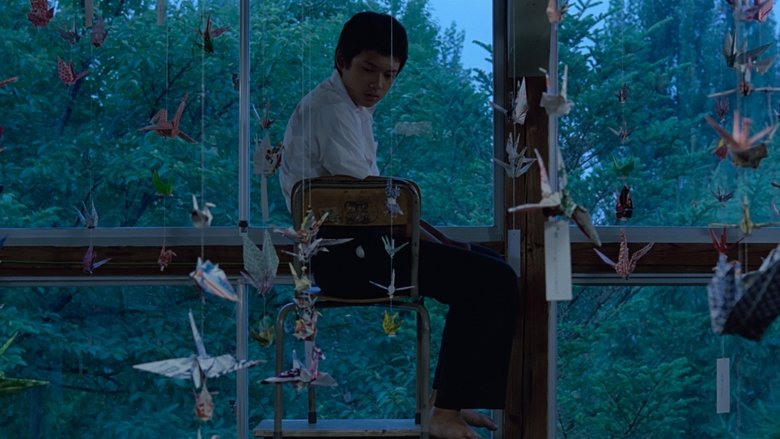
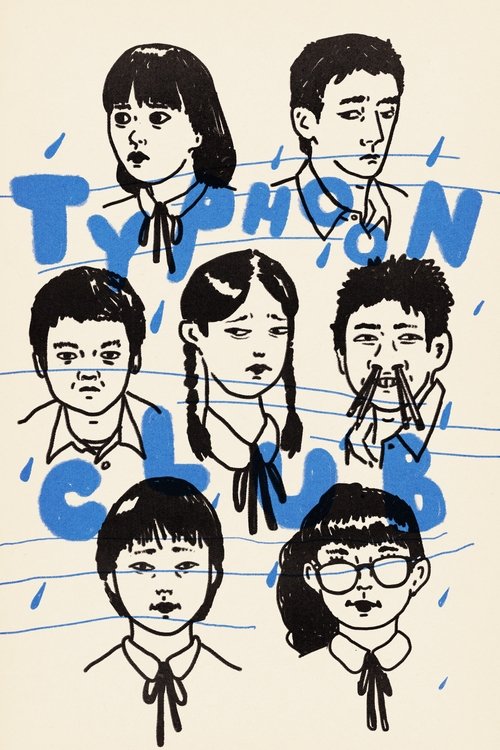
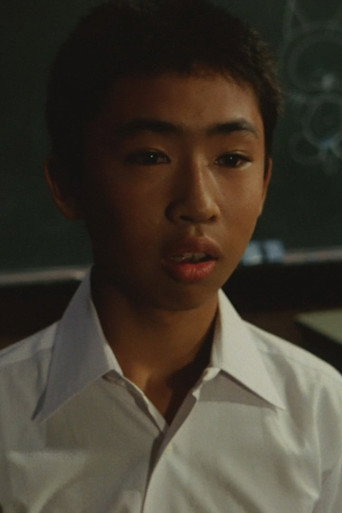
Typhoon Club is not a coming of age film, I think it could even be called an anti-coming of age film. It denies any notion of maturing, it loathes not only the idea that one should feel comfortable with growing up, but also the idea that "grown ups" are people to be looked up to, when they're mostly just as fucked up as their younger counterparts. This is a film that doesn't try to impose any illusory qualities to its characters, instead, it accepts their flaws and tries its best to present each of them as an individual, abhoring the idea of turning their characters into examples of the so called "problematic youth". Instead, by understanding what they are going through, and humanizing their internal troubles, it paints an almost perfect portrait of teenagers dealing with pressure, confusion, alienation and fear of the future, all imposed by the society they live in.Every action of each of the main characters in this film has a reason, even if the reason is the action itself, even if is inconsequential and harmful to others around. To escape boredom, to be seen, to deny any labeling that forces identification. Every action is reflected directly by interiorized feelings and the idea that soon they'll not be teens anymore, the idea that death comes with the falacy of maturity.The school, when unattained by adults, results in the manifestation of the most sincere side of each of the students that get locked in, it enables a feeling of freedom, helping to forget, even if for just a moment, about the weight tied to the end of their youth, the death of the soul. This ephemeral freedom can be felt tactfully in the most brilliant scene of the film: the students who are locked in the school are in the basketball court, the girls dance seemingly without a worry in their minds, even though not long before this, all of them found out about the disappearance of Rie, who ran from home. The camera rests far away from Mikami (who could be described as the main character), who seems to be the only one worried about their friend Rie, this doesn't come as a surprise, as he's the most levelheaded character of the film up until this point (on first impression, at least). As the camera slowly moves in on the characters, on an uninterrupted take (one of many in the film) the alienation felt by Mikami becomes unbearable even for the viewer, almost materializing as a character itself. In that moment it becomes known just how much Mikami really is like his peers, with just as many conflicts internalized by a society who turns a blind eye and fails to care. But then, he gets up and dances without a care in the world, forgetting about Rie and about the future for just a second, pure bliss, pure freedom.The fact that Rie went missing seems to only matter for Mikami, but soon enough even he arrives to the conclusion that blaming others for not caring at all is a mistake. The disconect between the bodies and souls of these teenagers would be something that'd happen sooner rather than later, as the school days are much more brief than the all the life that comes after it. By the end of the film, Mikami arrives to the conclusion that it's not really worth to go on, he doesn't want to forget and be forgotten as easily as Rie was, it would all be downhill from that point.Rie's journey has touches of surrealism, part of it because of the almost alien atmosphere that she finds herself in. It paints the point of view of youth when in a setting prohibited for them, presenting adults as something to be avoided. Maturity as a falacy, chaos as the only certainty.The typhoon is symbolic, it reflects the chaotic nature of youth, and it helps with their eruption. When it ends, it leaves not much but the notion that nothing much matters, the future is an unrelenting force that stops for no one, no matter the outrage. At the end, innocence is just as much of a falacy, as is maturity.ps (spoilers below):Also, the death of a character that is so infatuated with knowledge and that questions life in such an incessant way being grotesque as it is (it is a suicide, after all) but depicted in such a cartoonish way with his legs popping out of the ground... it kinda sums the whole falacy point even more. The irony is undeniably cruel.
Cinema of detachment. A disconnect between body and soul, between children and adults, between real life and the fantastical expectations you have of it, between your idea of a dignified death and the actual result after you jump off into the ground and onto the cosmos. Irrepressible sexual desire bursting into physical attacks. Alienation and a lack of care from people who you thought cared leading to running away from home. Questions surrounding life and obsessing over transcending it via death, the one precondition of life. Throughout Typhoon Club, the ensemble cast of students are seemingly stuck in a tug of war between liberation and alienation before we realise that, unbeknownst to them, there wasn't ever a tug of war to begin with; it was a cycle of liberation and alienation, one fueling the other. Coexistence of two extremes, and the disappointing realisation that alienation will always remain a constant in society. But honestly, isn't that what makes liberation all the more sweeter, regardless of how ethereal it might be? Youth is a dying concept. Adults are a myth. Growing up is a pain, but it's all the more volatile and affecting when life forces you to do so in a matter of days. The typhoon was more than just a literal one. It irreversibly changed their lives forever by annihilating their very understanding of living. They can never be the same again, because they now know how little everything matters and how fragile one's existence can be. One moment you find yourself dancing naked in the pouring rain, the next moment you are drowning in your own existential crisis.
Disturbing beyond anything Moving would have led me to expect. Has the set-up of a comedy where the fun gets out of hand, leading to some sort of final-reel lesson-learning—and the film does end with a girl walking alongside a boy towards the school on a sunny Monday morning, telling him, "You've grown." But at this point, the girl (Rie) has just returned after running away to Tokyo for the weekend and taking up briefly with a sketchy guy (as in other parts of the film, the threat of rape hangs over this thread), while the boy (Akira), in the film's opening minutes, is caught peeping on a group of girls dancing by a pool, then waterboarded by them in return, though we only find out the latter after seeing him floating face-down in the water and then being resuscitated. In essence, Somai structures things like a comedy, but directs for horror. The scene of Ken repeatedly entering his house and saying "I'm home. Welcome back" is amusing on first contact—the shot is calm, deliberately uncontextualized, and pictorially beautiful—but in retrospect it's an unmistakable indication of familial abuse/trauma and mental breakdown, and the fact that those same lines recur when he's kicking down a door and attempting to rape one of the girls is absolutely horrific. Likewise, the opening passage sets us up to expect scenes of joy/liberation, but every scene thereafter includes and underscores a more melancholy/frightening element: the scene where one girl attempts to console the other who's worrying about her dying grandmother, while another girl dances indifferently in the background, while all three take off their blouses; the gymnasium scene, where the camera hangs back from the rest of the group dancing on stage, staying with Mikami (who is pegged as intellectually/socially distant from the rest of the students, though still accepted, respected, and even loved, albeit as a kind of parent figure in this noticeably parentless film), but keeps its distance and stillness even after he joins in and everyone starts stripping; and the scenes where they exit the school and keep on dancing, the camera distance and the eerie electronic thrum intensifying the chilly horror vibe. Likewise, Mikami slowly piling up the chairs/tables in the classroom builds to a horrific "punchline," but then follows this with an actual sight-gag. Somai's control of the frame is strong throughout—particularly like the high-angle shot of the kid swinging in and out of frame near the scaffolding—but ultimately, there's a sensationalistic undertone that connects uneasily with the film's generational, orphans-of-the-storm ennui. On a different note, can someone tell me what Rie is supposed to be doing when she's bending spoons and putting them in a container of ice that evening before she runs away from home?