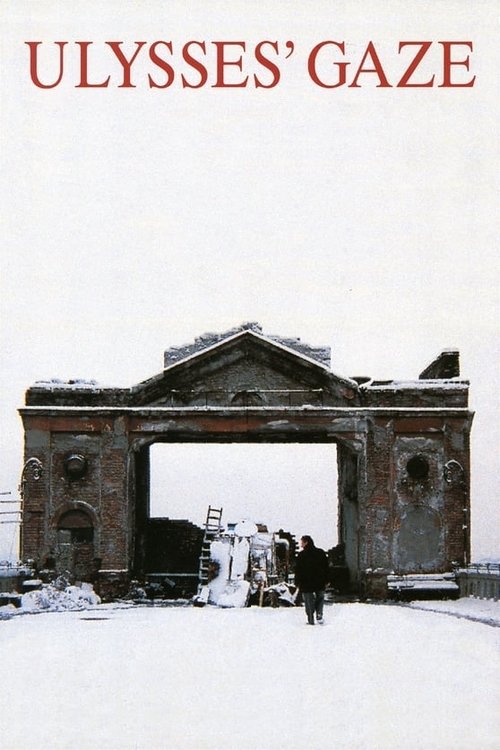
Obsession distorts all else, overriding every other desire, impulse, sensibility until there remains a single fixation, even at the behest of the most basic of perceptions. That is what haunts A (definitely not Angelopoulos btw), a Greek film-maker who returns to his homeland in pursuit of missing film reels which could predate the earliest-known Balkan film, The Weavers, which depicts a 114-year-old woman spinning and weaving. A fitting first film, that of a maternal figure so old she may as well be ageless, performing an act of creation as if she were Clotho, Lachesis, and Atropos all at once; from her do all other Balkan film descend.So what does it mean when A seeks an even-older progenitor, one that might not even exist outside of myth? What could possibly exist before the creator herself? One gets the sense that it's not really these reels A is after, but a reclamation of identity which is his true odyssey. It is in this obsession that dimensions such as time and space are collapsed into each other (as Angelopoulos is wont to do) and memory blends with ancestry blends with nationality blends with antiquity. But at each point is he halted by the notion of borders, the gridlock of modernization which impedes his pilgrimage. The 20th century obsessively overrides all that came before.But this is where the gaze liberates. Film is a manner of recording human history, and indeed is the first Balkan film a documentary. By gazing the world through that of cinema, two simultaneous potentials emerge: the film-maker both captures the world, and creates their own. The most authentic of documentation is still fictionalized in some way, and even the most outlandish of fiction still reflects human experience. A is a man who is lost and would stay lost in reality, but the world of Ulysses' Gaze, the world of the film-maker's gaze, allows him to break free. He is blessed with overcoming history, and then cursed to forever exist outside historical time.
After watching Christopher Nolan’s adaptation of The Odyssey, it felt like the perfect time to finally dive into Theo Angelopoulos’ Ulysses’ Gaze. While both movies draw inspiration from Homer’s epic, Angelopoulos takes the story somewhere far more abstract and introspective, using the idea of an odyssey as a search through memory, history, and the soul of a fractured continent.Harvey Keitel plays a filmmaker returning to the Balkans after years of self-imposed exile, setting out to find the earliest lost footage ever shot in the region. It sounds like a straightforward quest, but the destination is never really the point. Like Odysseus searching for Ithaca, this is a man searching for a home that may no longer exist. Every border crossed and every ruined landscape becomes another reminder that history has a way of reshaping places and people until they’re almost unrecognizable.Angelopoulos’ belief that cinema can preserve a kind of innocence that history cannot is something I found fascinating. The search for those lost film reels becomes a search for the world’s “first gaze,” a way of seeing people before nationalism, war, and politics divided them. There’s something deeply moving about that idea. That the earliest images captured by a camera weren’t trying to rewrite history, but simply observing life. Angelopoulos seems to ask whether it’s still possible to look at humanity with that same compassion after everything the twentieth century has endured.The movie is also filled with unforgettable imagery. Time seems to fold in on itself, memories bleed into the present, and history feels like something we’re forced to keep walking through. It often feels as though you’re drifting through a dream where personal memory and political history become impossible to separate, and that’s where Angelopoulos is at his strongest.That said, this being only my second Angelopoulos movie, I do think I connected with it slightly more than Landscape in the Mist. What stood out to me here was how much more expansive and assured it felt, with its journey across borders giving the movie a real sense of scale and purpose. Even when it drifted into abstraction, I was still drawn in by the imagery and the weight of everything it was carrying.Still, Ulysses’ Gaze is an incredibly rich reflection on exile, memory, cinema, and the scars history leaves behind. It’s less interested in adapting The Odyssey than in asking what an odyssey looks like in the modern world, where the monsters are no longer mythical creatures but war, displacement, and the loss of cultural memory. Even if it didn’t fully sweep me away, it’s impossible not to admire the ambition behind a movie that believes the greatest journey isn’t toward a place, but toward recovering a way of seeing the world that we’ve long since lost.
The one and only celluloid project that silenced a shocked audience with an angry and disappointed Angelopoulos not winning the Palme d'Or at Cannes, Ulysses' Gaze is one of the most beautiful and honest love letters to the cathartic power of cinema as an art form in the individual.The "film" that 'A' is seeking symbolizes that such film will exist as long as the director is aware of the existence of his audience first, and the existence of the director's own ideas and aim. That is the connection that exists in every film. On an overall scale, this wonderful testament constitutes a reflection of both a national and autobiographical history, skipping from time to time non-chronologically, just like memories work, and an entrancing connection between this trilogy of elements that are indispensable in the process of creating a film: a director aware of himself, a director aware of his ideas, and a director aware of how he wants his ideas to be transmitted to the audience. With such a pervasive lack of said third element, the film becomes an epic-length journey (hence the title "Ulysses") of a director in an attempt to conciliate the first two through a geographical and metaphysical self-identification.I am sorry, master auteur, but I will have to agree with Cannes this time: even if you surpassed your previous efforts of the 80s and 90s with this colossus of enamored impressionism, Kusturica defied all formalisms of cinema and broke all possible cinematic boundaries in the most faithful tradition of Juraj Jakubisko and Wojciech Has with a 5.3-hours titan of Yugoslav madness and accurate political turmoil and dementia criticism. Nevertheless, this remains as the most personal testament of an honest filmmaker dissecting the psychological connections between man and film.95/100