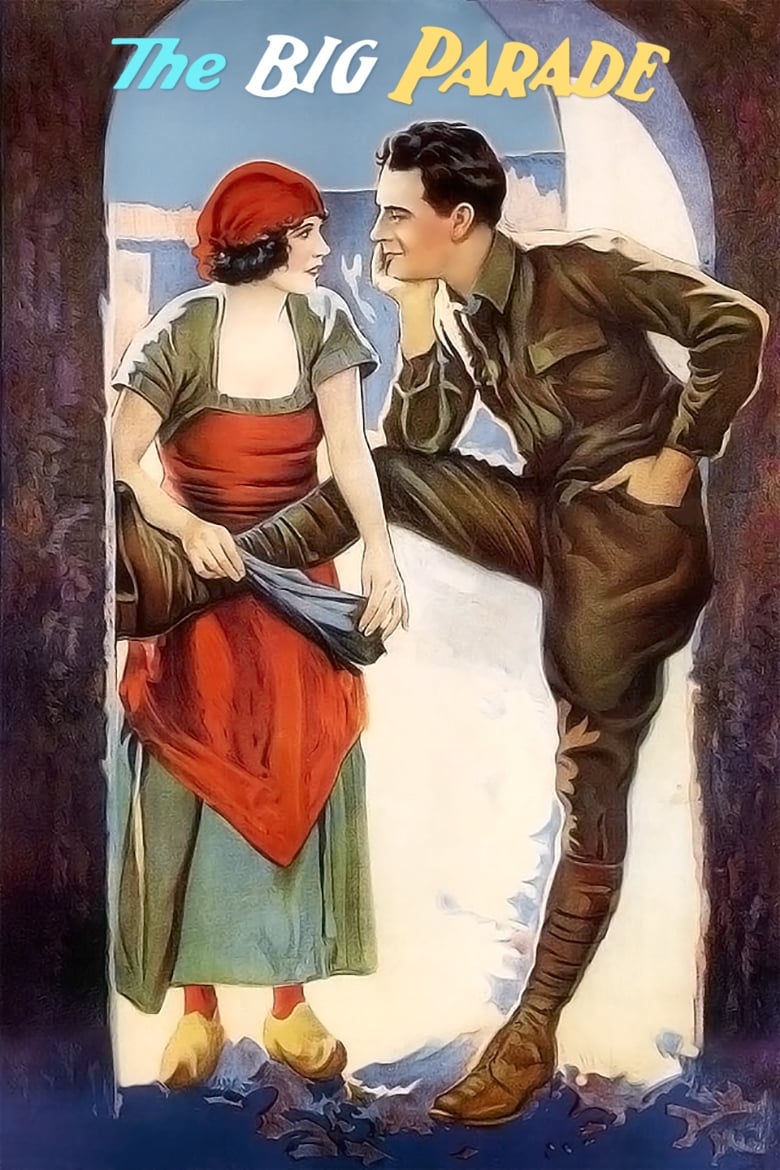


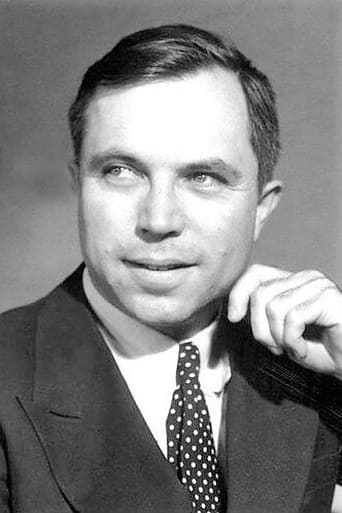
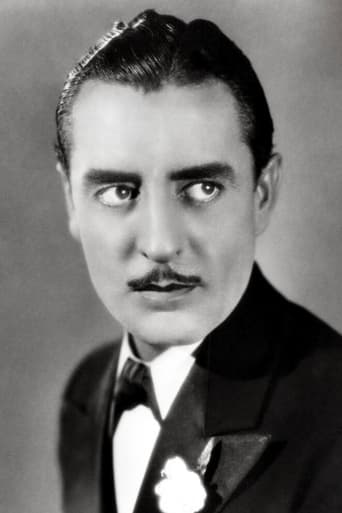
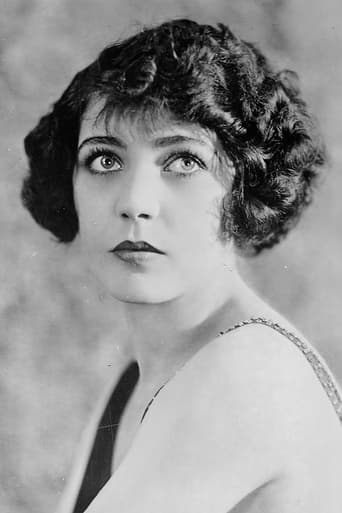
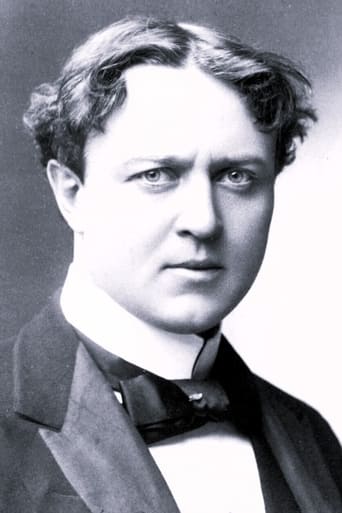

For years I'd seen this on lists of great silent movies, yet never really felt compelled to watch it. I was a little curious, but in my head the term "war epic" suggests a lurching, stilted, sappy white elephant. Well, now I've actually seen The Big Parade, and if you'll permit me I'd like to replace those preconceptions with the interjection "holy shit." Where do I even begin describing how thoroughly this movie overwhelmed me? Because, okay, it is a war movie, but the fighting only starts in the film's latter half, when pals Jim, Slim, and Bull are plunged into a 40-minute sequence based on the real-life Battle of Belleau Wood. Prior to their front-line deployment, the movie's really just a rough-and-tumble service comedy about Americans stationed in the sleepy French village of Champillon, one of whose residents (Melisande, played by Renée Adorée) is courted by Jim.This portion of the movie is every bit as light and cute as the battle is brutal. It does some work to deglamorize army life—e.g. Jim's girl back home writes asking of his "picturesque surroundings" when he's shoveling shit and sleeping in a barn—but mostly it's devoted to pastoral romance interlaced with Slim and Bull's slapstick antics. They get blotto on stolen wine and brawl with military police; meanwhile, Jim and Melisande sit side by side on a stoop or river bank and fall deeper in love. Their love story never feels obligatory or, hell, anything less than vital, which is a testament to Adorée and costar John Gilbert's expressive performances, as well as King Vidor's patience when directing them. Their relationship sprouts onscreen out of their interactions with different props: a barrel, a frog, a French-English dictionary, and most famously a stick of gum. Their communication is largely gestural, and intertitles between the two are sparing. Could it be that silent filmmaking is especially suited to depicting love across a language barrier?Given this gestural nature, the ties between them always feel so delicate, inflected by circumstance with a certain carpe diem quality. So it's no great shock when their story takes a turn toward melodrama, with one of those "lovers torn apart" scenes that invariably reduce me to mush. He's dragged onto a truck and out of town; she stands amid hundreds of marching soldiers, calling his name; eventually they reunite, but only for a few seconds. I can't think of anything more gratifying in its heartbreak than a scene like that. It leaves aftershocks, too: it means that throughout the following battle, Jim's mind (and mine) will be on this lovesick woman left kneeling on the dirt road leading out of Champillon. That lingering memory of their happiness, the hope for another reunion, the tonal contrast between the film's two halves... that's what supplies The Big Parade with much of its awesome power.Once the soldiers are on the road, everything changes. Slim and Bull still crack wise, but now their jokes are tainted with proto-Catch-22 absurdity. Vidor orchestrates some massive spectacle here, crowded with planes, horses, trucks, and men, but it all has a pall of death over it. The company's march, first through the forest and then across a shelled and machine-gunned no man's land, is grim, terrifying, and darkly funny. The camera moves backward through the trees, taking in the row of advancing Americans while keeping its back to the (sniper-infested) space before them, and the camera keeps moving backward even as the ground grows thick with bodies. Warfare here is raw, relentless, an eternal reenactment of "The Charge of the Light Brigade." It's fluid, bloody chaos pointed this way and that by a commanding officer's orders.Later, the three protagonists take refuge in a shell hole, and Vidor frames them side by side just as earlier he'd framed lovers by a river. The Big Parade, it seems, is wound around a series of temporary intimacies, these merciful caesuras within the onslaught of history. They culminate in a 3½-minute static shot of the wounded Jim lying beside a dying German—giving him a cigarette, repeatedly hitting him in the face, caught between urges toward sympathy and violence. It's the pinnacle of Gilbert's staggering performance, and he even works emotion into the mere act of adjusting the way he sits. If you squint you can see war trauma forming here, zygotic but very real, then growing into bitterness and alienation throughout the film's falling action.Luckily for my emotional well-being, the movie ends on a positive note, but still it leaves a litany of unanswered questions. The resolution to its melodrama, so superficially conventional, is in fact electrified, politicized, and angry; it implies everything that works like The Best Years of Our Lives would eventually elucidate. The Big Parade is a war movie, a hell of a war movie, but it's never constrained by its subject matter which is part of why I love it so much. It's an "everyman" story (like Vidor's The Crowd) that traipses through romance, comedy, and horror in order to convey the whole of one man's wartime experience. It's never confined by how others have shot war in the past. Instead it becomes a glimpse of heaven punctuating a trip through hell.