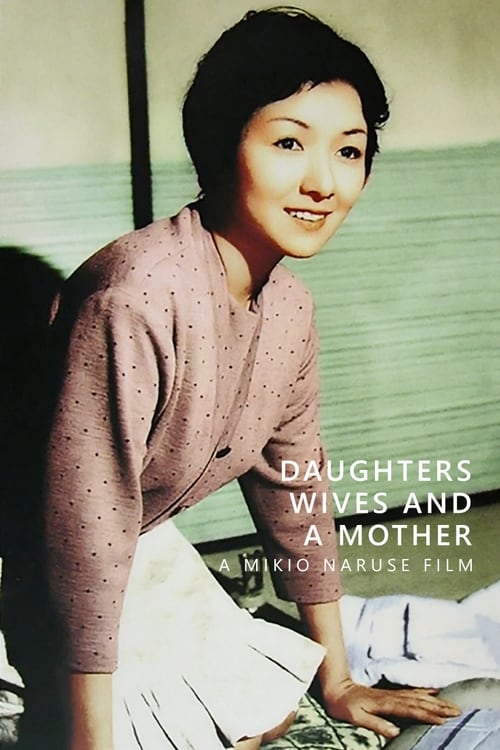
In Daughters, Wives and a Mother, Mikio Naruse once again proves why he's the maestro of compelling, multilayered family dramas that feel like home cooking.Newly widowed, the eldest daughter of five children (Sanae, played by Setsuko Hara) returns to her family home. Being the beneficiary of her husband's insurance policy, various members of the extended family seek out Sanae's financial help. While the story kinda-sorta revolves around money, it's about so much more than that. The intricately constructed plot unravels in a way that observes the complexities of family relationships and the interactions between married couples, siblings, and parents and children. Further, we see how financial issues impact these relationships. Further still, we see how these relationships are shaped by culturally-informed ideas of obligation and how, mixed with economic strain, these mores lead to distress and personal sacrifice for the sake of oppressive traditions and filial duty.Naruse is very much in his wheelhouse here; for those more familiar with Ozu and appreciate his family dramas, this may be right up your alley - especially if you're a fan of Tokyo Story. This film eventually veers into that heartbreaking territory involving children trying to figure out what they should do with their mother and whose responsibility it should be to "deal with her." Despite this plot thread being relatively minor compared to everything else going on, it's still crushing. 🥺💔It's not all bad though.Aside from its poignant moments, Daughters, Wives and a Mother is abundantly delightful, funny, and "wholesomely cozy" thanks to Naruse exploring family dynamics and the "little things" that make life worth living and sharing with the people that you love. And of course it helps to have a great ensemble cast! I was a tad disappointed that one of my faves, Hideko Takamine, had only a minor role and played a subdued housewife (Sakanishi, in-law to Hara's Sanae), but she still killed her role.As usual, Setsuko Hara was excellent. The way that she's able to portray faintly veiled sorrow with a smile...ugh, my heart. Out of everyone who took L's in this, I especially feel for Sanae, whose pursuit of happiness was hampered by the suffocating pressures of tradition and the actions of those closest to her. No spoilers, but I must share this one quote:"I've enjoyed knowing you. I was tired out, my throat parched. And then I met you, and at once I felt revived. I'm grateful." ❤️💔 - Sanae(My 29th Naruse film)🌟Why I Love East Asian Cinema🌟
Sanae is left a widow after her prestigious husband dies, but holds the proceeds of a million yen insurance policy. Being childless, her former in-laws have no objection to her return to her own family.
Where to watch
1Daughters, Wives and a Mother is showing in 1 cinema in Los Angeles — next screening Saturday 1 August at 13:00 at Los Feliz 3 Theatre.
Saturday, 1 August
Cast & crew
6What people say
it is very intriguing how a postmodern sensibility seems to immediately take hold of naruse's work at the dawn of the 60s -- especially in a mega-production like this with such a hugely talented cast. all at once, his neo-classical style is brought to bear on broad material that is self-consciously preening, almost custom designed for naruse based on his previous work, now updated for tohoscope. yet the economic situation has changed: stocks, investments, mortgages. life insurance, wineries, this is a thoroughly bourgeois film, far from the visible decay and senescence of floating clouds or late chrysanthemums -- we end this film on the promise of the new overtaking the old, but we don't actually get to see it happen. we are no longer in a strictly post-war context of reflecting on the tragedy of the past, japan has been rebuilt and re-industrialized and while there is anxiety over money, it is the difference between being comfortable and being poor, not between being poor and being destitute. i don't mind that change of tone, naruse is simply responding to the times he's in, but it does mean that the general 'pessimism' (a word i hesitate to use here except in the broadest sense) that he is known for as a director is flattened out with beige colors and a sparkling piano score. daughters, wives and a mother is the closest i've seen naruse come to making a douglas sirk or george cukor picture (there's a birthday party home movie scene that feels very cukor-esque) -- i like all three of these directors, so it isn't a bad thing, but this instance of cross-pollination makes me think about the changing tides of cinematic vernacular during this crucial period.the relationship between setsuko hara and tatsuya nakadai is so adorable here, openly affectionate in an atypical fashion for naruse, and it goes a long way to help lighten the tone of the film. i'll be frank and say that this is quite prosaic and uneventful even by naruse standards, but i'm so far down the path now that i don't really care, i love the rhythmic structure of every shot flowing easily into the next, and in general i do like melodramas even if they're middling -- there are many worse ways to spend two hours than with this realistically compromised and discontented family.
The economics of family bonds. The scene where the children talk about who shall take care of their mother might just be one of the most quintessential Naruse moments that exists, and one of the most cruel.
What is Daughters, Wives and a Mother about?+
A widowed woman returns to her family home with a significant insurance inheritance, triggering complex negotiations and power struggles among her siblings and aging mother.
Who directed Daughters, Wives and a Mother?+
Mikio Naruse directed this 1960 family drama, known for his sensitive portrayals of women in post-war Japan.
Is Daughters, Wives and a Mother available in color?+
Yes, this production is one of Mikio Naruse's notable films shot in color.