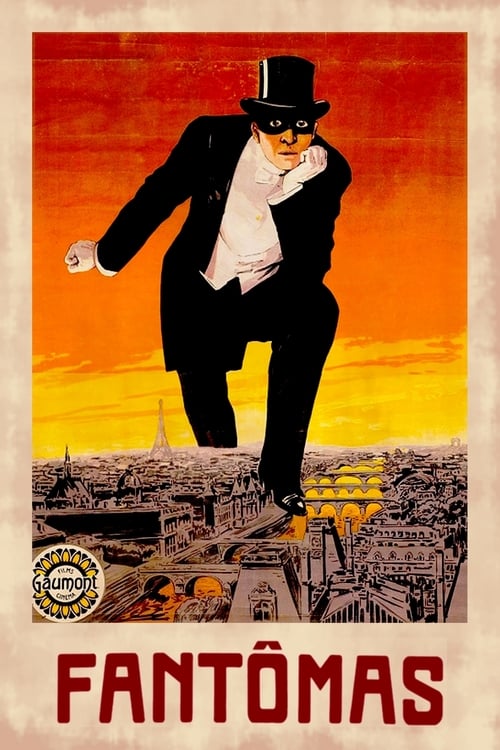

Released by Gaumont between May 1913 and April 1914, it was produced at a specific point in history when the optimism of the Belle Époque — a moment when public confidence in social order, in the legibility of the city and in the reliability of identity itself, was cracking up. By 1913, France was prosperous and still believed in the big narrative of industrial progress, but there was a sense that something else had been created in addition to that, about what modernity had actually produced, the metropolis full of strangers as potential predators, the state as a machine perpetually one step behind. It’s no surprise then that the film came into such hysteria. The first episode attracted 80,000 spectators to the Gaumont Palace — the largest cinema in the world at the time, with 3,400 seats — the people were not looking for entertainment but for answers to their own fears.It must be pointed out that the source material is pretty important as context. The novels, begun by Marcel Allain and Pierre Souvestre in 1911, were themselves products of the same cultural moment. Their publication coincided almost exactly with the crimes of the Bonnot Gang, an anarchist collective that terrorized Paris and Belgium in 1911-1912 using technologies (automobiles, automatic rifles) that placed them systematically ahead of the police. The Bonnot Gang was a demonstration that the modern state’s instruments of surveillance and control were insufficient, that the city had produced a kind of outlaw who could move through its infrastructure faster than law enforcement could respond. When critics noted the similarities between Fantômas and the Bonnot affair, they were identifying something structural rather than incidental. Both figures (fictional and real) articulated the same terror, that the city was not a managed space but an ungovernable field of competing power and that power could belong to whoever understood its hidden logics.Gaumont acquired the film rights to the novels in 1913 for 6,000 francs and assigned Feuillade — already the studio’s most prolific director, a committed conservative monarchist and Catholic whose sensibility was oriented firmly toward popular melodrama — to produce a serial adaptation. The industrial logic of the serial format was inseparable from the logic of the popular press because both relied on suspense, on the episode that ended without resolution and on audiences conditioned to return for what came next. It’s truly remarkable that Feuillade had completely grasped the formal requirements of such a structure. He couldn’t just make a narrative stretched across episodes, he had to make a different architecture of time, one that opposed the closure that traditional dramatic form demanded. Each installment concludes with deferral (a body discovered, a disguise shed or an escape completed), which means the spectator remained forever unable to catch their breath. Unlike a play or 'well-made' drama, which promises its cathartic release, the world of the serial was one that couldn’t end, it was an open-ended structure of continuous suspense, much like the experience of being a stranger in a strange city.In scale, what Feuillade assembled across the five episodes (particularly the last two) is staggering even by contemporary standards. A total running time of approximately 337 minutes — nearly six hours of continuous narrative, spread across installments of varying length — it represents an industrial achievement and a formal commitment. At a moment when even ambitious filmmakers were still organizing their works around the short or the single-reel, Feuillade and Gaumont were proposing something closer to the novel than to the theatrical program, and that was not accidental at all. Allain and Souvestre had published 32 Fantômas novels between 1911 and 1913 alone, at the rate of roughly one per month, and their audience had been trained by serial fiction to expect narrative on a different temporal scale than theatre permitted. The film serial was thus partly a bid to capture that readership, to migrate popular prose fiction’s relationship to time into a cinematic register. Whether it succeeded on those terms is less interesting than what it produced in the attempt.The film itself is a bit behind in terms of techniques. The camera remains relatively still throughout much of the film, set up at a consistent distance from the scene of action, imitating a theatrical audience's perception of stage space, a perception that cinema had struggled against for almost a decade. Interiors are shot frontally and actors placed into a shallow staging that renders space into a kind of painted background, without any real dimensionality. It was not a neutral choice, by 1913 I’m sure it was a conservative one. Griffith had been systematically rationalizing cinematic space since at least 1908, turning the frame into a structure of directional power, using editing to manage attention and produce emotion through the redistribution of visual weight. Bauer in Russia, the Scandinavians, even some of Feuillade’s own French contemporaries were developing more sophisticated approaches to the language of the cinematic image. The use of the static tableau, then, is not an alternate approach to a cinematic problem but an avoidance of the challenge altogether. Feuillade’s interiors especially suffer from this, almost everything is cluttered and frontally composed, ultimately working against the film's energy rather than with it. But everything changes the moment when Feuillade abandons the studio entirely and takes his camera outside, where the city itself does the work the director is not yet doing.When Feuillade takes his camera into the streets and rooftops of actual Paris, something shifts fundamentally in the film’s relationship to space. Since the static interior shots produce a legible and bounded world (furniture, doorways, faces arranged for inspection), the exterior shots produce the opposite. Figures move through urban environments that were not designed for them, through the real textures of Haussmann’s city and its suburbs, and the image acquires a weird instability, a feeling of contingency that no studio set could reproduce. I noticed that Feuillade arranges his exterior figures diagonally rather than frontally, giving outdoor scenes a dynamic quality that is almost completely absent from the indoor scenes. The world outside the studio is already in motion, all the camera needs to do is yield to it.Even the criminal Fantômas himself is built around the same concept. Being like a phantom, he leaves traces of his existence through his deeds rather than by his own appearances — moving from dispersal, diffusion and distraction, evoking a 'ghost-like' presence, not yet here and already gone. The main way in which he attacks is through impersonation — the methodical dissolution of the indexical link between face and identity, that the modern state had been laboring to establish. The French police had spent decades trying to solve exactly this problem through Bertillonage — the systematic biometric identification of criminals through precise bodily measurements developed by Alphonse Bertillon — though by 1913 the system was already being displaced by fingerprinting, its own inadequacies exposed. The fear behind such scientific endeavors was the fear of Fantômas, the fear that identity cannot be static, that the body does not always indicate who one really is and the face that we show the authorities is not necessarily our real identity. As shown in the beginning, where the character rapidly changes costumes, this sequence cannot simply be seen purely as a demonstration of René Navarre's amazing acting skills. It’s also an illustration of how unstable the sense of social identity becomes in the era of modernity.In Feuillade’s cinema, Fantômas becomes an almost abstract figure, a principle of social dissolution rather than a psychological character. Unlike Méliès’ spectacular illusionism, the monumentality of Pastrone, the pathos of Gance or even the basic structure of montage by Griffith, the conception by Feuillade’s vision incorporated time as a structural element, it made Fantômas evolve into a narrative form that had more longevity than many of his peers. This is the fundamental distinction that any formal analysis of this film must eventually reach. While Méliès built the visual syntax of cinema around spectacular events (around the revelation, the trick and the gasp) and Griffith built it around controlling attention (through editing and thus emotion), Feuillade built it around endurance. His image never reaches a resolution but continues persisting. The result is accumulation — layers of incidents, unfolding spatial dimensions, dissolutions into disguises. The frame itself is a space of perpetual suspicion.And what it offers in the end is precisely this idea of the cinema as the articulation of criminal spaces. Not as something abnormal, as a pathology in the normal space of the city, but rather as an integral dimension of the structure of space itself, a fundamental organization of the city according to the principles of conspiracy, concealment and hierarchy which are known only to Fantômas. This conception would indirectly influence filmmakers such as Fritz Lang, who would elaborate on notions of ubiquitous conspiracies and unseen criminals, or even Alfred Hitchcock in his interest in false identity, the wrong man and sustained tension beyond the resolution of the enigma. In fact, I think there’s an even deeper level of inheritance here. What both Lang and Hitchcock inherited from Feuillade is an understanding of the nature of suspense as a matter of turning everyday spaces into spaces of potential threat and suspicion. Safe rooms or familiar faces, all have lost their innocence in a world organized by the principle of Fantômas.—Update: Although the film adapts the 1911 novels, the cinematic form owes a clear debt to Victorin-Hippolyte Jasset’s Zigomar (1911). I recently watched it and it’s very visible that Jasset had already pioneered the master-criminal serial with disguises, elaborate escapes and an elusive villain constantly outwitting the police, providing a model that Louis Feuillade expanded into something ultimately more influential.