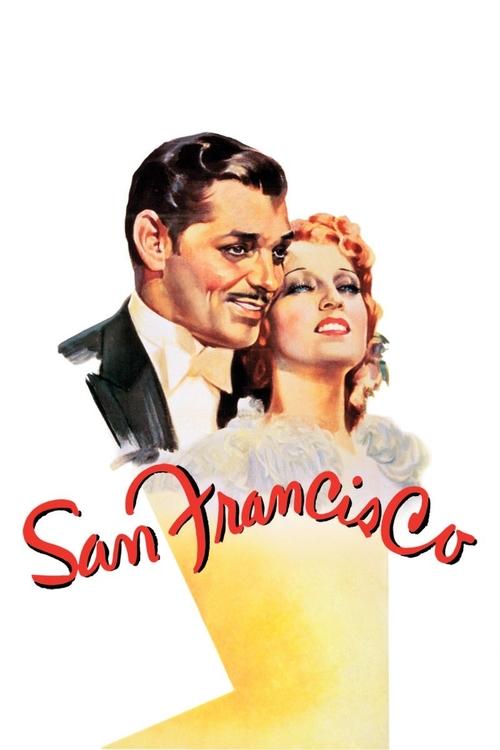
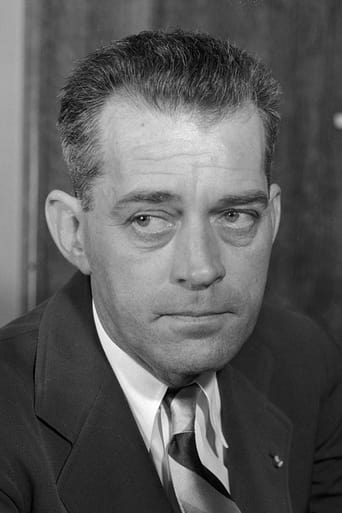
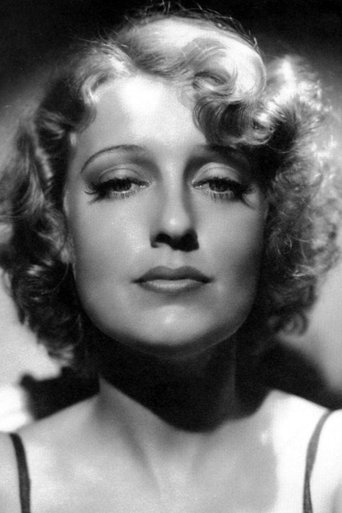
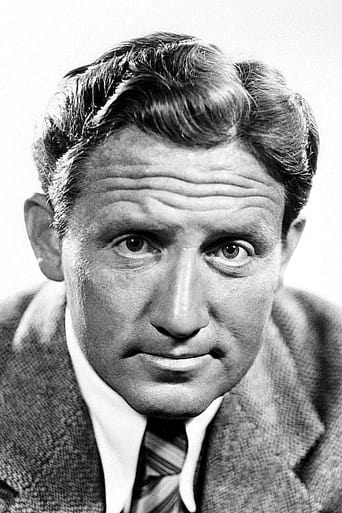
A grand old love affair between adventurous past and civilized future unfolds in W. S. Van Dyke’s “San Francisco.” A romance with musical interludes provided by one of classic cinema’s greatest sopranos, Jeanette MacDonald, the film casts Clark Gable and Spencer Tracy as the devil and angel on her shoulders; as well as of the city and country around her. “San Francisco” is set in the prelude to the infamous earthquake that leveled what remained of America’s last shimmering metropolis of sin; the Barbary Coast. It’s a sonnet to a place that would be better remembered with a strip tease. But… like, a darn classy strip tease. In a dynamic repeated with similar metaphorical affect two years later in “Angels with Dirty Faces,” Gable and Tracy play childhood friends who took opposite forks in the road of life. One (Tracy) towards priesthood and God - the other (Gable, of course); the farthest thing from. MacDonald makes an ideal midpoint between the blood brothers. She’s too intelligent and ambitious to fall for the pitch of either; preferring instead to forge her own route to success. “San Francisco” is a tender tribute to the last of the scrappy desperation on which Hollywood - and America - was founded. That gumption becomes near pastiche by the movie’s end; where it wears away to merely the celluloid resurrection of a national dreamland. And while the city that rose out of the dirt of the gold rush was long gone even when “San Francisco” the film was young, its subgenre of disaster musical romance… is one that absolutely deserves to be rebuilt for our modern era.
Directed by W.S. Van Dyke
San Francisco
An acclaimed, spectacular drama.
A beautiful singer and a battling priest try to reform a Barbary Coast saloon owner in the days before the great earthquake and subsequent fires in 1906.
Where to watch
1San Francisco is showing in 1 cinema in Los Angeles — next screening Sunday 6 September at 14:30 at Old Town Music Hall.
Sunday, 6 September
Cast & crew
6What people say
Let's just look at the scorecard for a moment...* Ridiculous plot turns? Check.* A-minus Clark Gable scoundrel performance? Check.* Brutal opera singing? Check. * A nonsensical timeline? Check. * Mid 30's wanna-be-Jimmy Cameron destruction technology? Check.* Spencer Tracy throwing hands? Check? Add it all up and It's a little like Baxter eating the whole wheel of cheese. I'm more impressed than mad. Clark Gable Ranked
It's not consistently great and occasionally feels dated, but the highlights are so powerful that it's not a film that can or should be forgotten: Jeanette MacDonald singing "San Francisco" while the whole joint starts singing and dancing along. That spectacular earthquake sequence that will blow your mind in a way CGI never can. And then Gable crying. Because it was so hard for him to show his vulnerable side, it's twice as poignant. * Make no mistake, there's more to it than just macho ideology. Young Gable was actually a very shy and tender-hearted boy who preferred memorizing Shakespeare sonnets to working on the farm and was constantly called a sissy by his father. By nature, he also had a high-pitched voice and it took him several years of training to sound 'more manly'. But even when he became the King of Hollywood, his father would still call him a sissy, and despite the fact that Clark supported his ass he still made fun of his son and told him that 'real men' don't become actors. This must have haunted him all his life. He nearly quit Gone With the Wind because Victor Fleming wanted him to cry and he just couldn't get himself to do it. His wife Carole Lombard spent hours with him on the phone, telling him that it was okay to cry. Eventually Fleming left the decision up to Gable. "Look, we shoot it one time with tears, one time without tears, and it's up to you which take we put in the movie." So Gable cried, and he cried beautifully, even he had to admit it. And he cries beautifully here, too.
What is San Francisco about?+
The film follows the romantic and social rivalries of a saloon owner, an aspiring singer, and a priest in 1906, set against the backdrop of the historic earthquake.
Who directed San Francisco?+
W.S. Van Dyke, an American director known for his efficient studio work and big-budget MGM productions, directed the film in 1936.
Has San Francisco won any awards?+
The film received six Academy Award nominations, including Best Picture, and won the Oscar for Best Sound Recording.
Where can I watch San Francisco?+
San Francisco is available on various rental and streaming platforms; follow classic cinema on Mood.