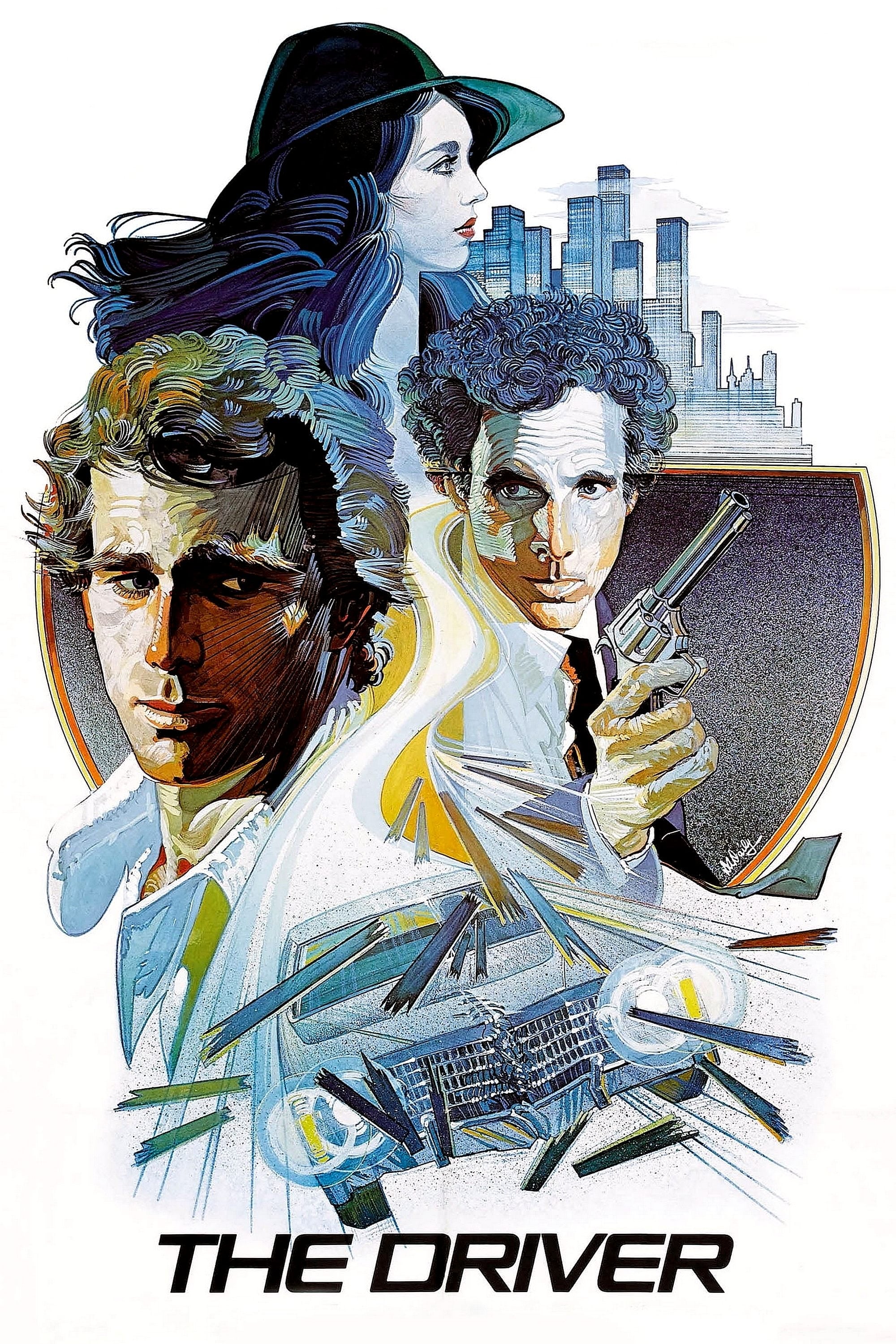
Pure American machine brutality and stylish Euro crime existentialism in a head-on collision. Genre filmmaking stripped to its bare bones, like Bresson but with wet neon city streets, the solitude and hideous urban architecture of Edward Hopper and the roaring engines of Bullitt. A world where no one even has names because what are we if not a series of jobs and actions and impulses? "Lotta crooks around these days."Full discussion on episode 160 of my podcast SLEAZOIDS.
“The Driver” doesn’t give out names. It doesn’t waste time on visual pleasantries. It begins by hitting the gas pedal against the floor, and doesn’t let up on the pressure until the closing credits. Taking inspiration from the stone cold silence of French gangster pictures, director Walter Hill strips the heist genre of anything that would interfere with its aerodynamic sleekness. There is no grappling with the sins of the past, or planing for the future. There is only the job, and what needs to be done to carry it off. This task-oriented myopia is one of “Driver’s” many aspects appropriated by a generation of filmmakers that followed. Mann took the perpetual neon darkness of the city. Nolan grabbed the singleminded workmanship of characters. And, most obviously, the movie was paid homage to the point of being remade in “Drive” and “Baby Driver.” The family portrait makes an image that Miller could be proud of as its stylistic patriarch. But every derivative of “Driver,” no matter how much a stone cold classic on its own, is an added weight. It could be a Jaguar retractable hood ornament, but it’s still an additional extravagance. And so — “Driver” remains a masterpiece of absolute simplicity. Pulling from Miller’s past chase-centric picture work as a second unit director for “Bullit” and screenwriter for Peckinpah’s “The Getaway,” it has its eyes on just one place: the road. Its mind only occupied with one thought: where to make that next turn.
Poor Ryan O'Neal was born too late. He could have been the most naturalistic silent performer of all, with a hangdog expression that has only ever been surpassed by James Gandolfini's. Give him more than three lines at a time, though, and the cracks start to form, his flat voice unable to even suggest the same cavernous depths that his eyes can. Naturally, THE DRIVER, which gives him just enough lines that you'll need your fingers and toes to count them all, suits him perfectly. He speaks primarily through motion, his perfectly controlled driving a venting that his cold face never permits. He hardens his countenance for this film, his slackened face drawn up into a frown, but the eyes still give him away.And no wonder; I can't think of many films lonelier than this, with Hopperesque compositions lit in sickly, fluorescent greens that half-suggest that the world is radioactive and that the sparse number of characters and the modestly filled streets seen in the film are all that is left of the city's denizens. Even so, people continue on with their jobs: O'Neal as the driver who demands his clients meet his own standard of professionalism, Bruce Dern as the cop who goes so far to collar O'Neal that he even orchestrates crimes to lure him out, Isabelle Adjani as the woman with a strongly implied past who lies to the police to pay her rent and gives the impression that this is the least demeaning thing she has ever had to do to get cash. The characters frequently share space, but they are always alone, and even the maelstrom of squealing tires and shrieking metal-on-metal collisions echoes in vast parking garages or off the buildings flanking streets, amplifying the sound but distributing it out into nothingness.