

"While I was reading your financial statement, I felt deeply moved."

Over the course of a few days, the paths of a group of young friends, lovers, and acquaintances in Taipei intersect, prompting them to arrive at realizations about their lives.
A Confucian Confusion draait in 1 bioscoop in London - eerstvolgende voorstelling vrijdag 27 november om 12:00 in Prince Charles Cinema.
Volgende voorstellingen: vrijdag 27 november.
Volledig programma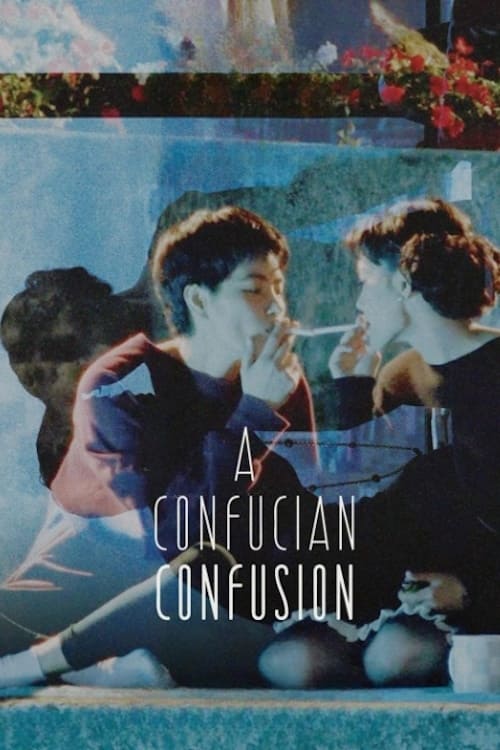
Speeltijden van A Confucian Confusion, elke ochtend ververst
Kies je bioscoop en krijg een seintje voordat de film van het doek verdwijnt.
"While I was reading your financial statement, I felt deeply moved."

Yang has always had an ability to start his films vaguely and slowly bring us closer to the characters, not necessarily attach us to them but to see their faces even if he basically never uses close-up. Here his characters are almost always covered in shadows, there is almost always something we cannot see from them; Yang uses space so masterfully that it leaves us speechless, for example this must be one of the best uses of elevators in cinema. When two characters sit in the same room, mostly in the oppressively small space of car that whisks them through busy city, words of a film that is filled with them, really gain their measure. People are always ready to explode, no matter what space they are in - there's comedy in them, there's deep tragedy in them; camera stays mostly static and fixed, only rarely if ever we see an image without human presence in it - still it feels all too lonely. There's so much to grasp, in characters, in images, in the whole, that almost any attempt to make an analysis about the film after the first time disappears into thin air. This kind of structure defines Yang's films, it feels impossible for him to have a simple focus on one or two people, as if the silence would become too unbearable. Taipei seems always bigger than our characters so it's no surprise it confuses us and still it seems so small that people can by chance run into other on one of their anonymous buildings; still so huge to have secrets behind others' backs. Conflicts between modern and traditional (the main conflict that defines Taiwan), business and art, public face and personal face, all push each other away. Even if this is a film in which most prominently Yang searches for philosophy of life, it isn't quite the film in which he finds it most accurately. But still, he completely gives the mosaic structure his own touch; many crazy fights in which people seem to deliberately alienate each other seem to only reflect the absurdity of "finding oneself" that only leads to tiredness and stress in a country like Taiwan. There is always something corrupted, something that is out of reach - the geography and architectural determination of the structure in both image and writing isn't chance unlike many of the ways communication moves are, many of the ways feelings move are, many of the decisions character make are. Ultimately even in this land between East and West, even at the cost of failure, the most human feelings are hard to avoid and this eternal questioning, constant moving seems to be both the salt of life and the seed for the ultimate tragedy.

Relentlessly cynical until it isn't at all. The long, arduous and painful process of rediscovering the real.
Gedurende een paar dagen kruisen de paden van een groep jonge vrienden, geliefden en kennissen in Taipei elkaar, wat hen ertoe aanzet om tot realisaties over hun leven te komen.
Edward Yang regisseerde A Confucian Confusion in 1994 en vestigde zich als een belangrijke stem in de moderne cinema.
A Confucian Confusion is geclassificeerd als 15 in Zuid-Korea.
A Confucian Confusion werd uitgebracht in Hong Kong op 13 oktober 1994.