
No one tells their story, they literally had to steal the camera to tell it themselves
On the outskirts of Medellín, Colombia in the late 1980s, local residents report strange lights descending from the sky. When a reporter arrives to investigate, a ragtag group of teens from a lawless neighbourhood storm the scene and steal his camera. In the hands of its new owners, the device records a mesmerising plunge into their frantic existence.
Barrio Triste draait in 1 bioscoop in London - eerstvolgende voorstelling woensdag 21 oktober om 12:05 in Institute of Contemporary Arts.
Volgende voorstellingen: woensdag 21 oktober.
Volledig programma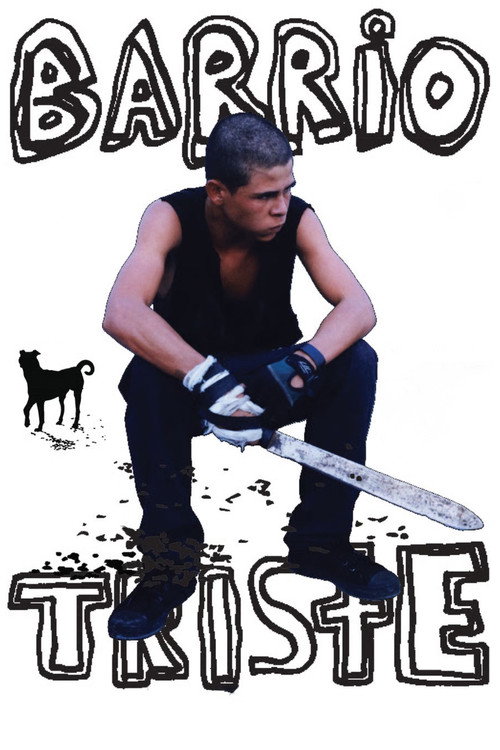
Speeltijden van Barrio Triste, elke ochtend ververst
Kies je bioscoop en krijg een seintje voordat de film van het doek verdwijnt.
No one tells their story, they literally had to steal the camera to tell it themselves

Korine goes Favela. a couple of kids steal a camera and film their shitty life in Medellin's slums in the 90s, including a jewelry robbery and suicidal ruminations. the devil himself comes visiting. all of this accompanied by the brilliant score of Arca. nihilistic fuck-you-and-your-whole-crew cinema that brings you to the edge, as edglrd does. my ears were bleeding afterwards because the sound was at 187%. fortunately this aggressive attack on your physique is easy to forgive when the film is worth it, and for Barrio Triste it's definitely worth ruining your health.

Honestly, one of the saddest, bleakest, and most hopeless films I’ve seen in a while. Barrio Triste follows a group of kids who become adults not by choice, but by their lack of a proper system that supports them. As they fade into crime, poverty, and the film’s central focus—depression and loneliness—there’s no one who can pull them out of their distress. One of the main characters says he never had a father figure, and though his mother was present, she was never one to take care of him. From an early age, he was forced to fend for himself to the point where he is barely surviving, hanging on by a thread, and considering suicide almost every single day.You’d expect that a film would somehow give them a path to recovery, but this is not the case here. The narrative flows almost like a documentary. At the beginning, they steal a news crew’s camera and record their day as they prepare to rob a jewellery shop—a robbery that goes incredibly wrong. We then follow the aftermath, as they return to their neighbourhood, where everything feels so distant, hopeless, and bleak, even though they live just on the outskirts of one of Colombia’s largest cities. And this is not something that just happens in Colombia, but could be anywhere in Latin America.At times, the film feels like Korine’s Gummo meets Glazer’s Under the Skin—unflinching, unsettling, and surreal—yet also strangely tender in its portrayal of the characters’ isolation. It even has moments that feel like a videogame, but only in the sense of exploring a free world: walking through empty streets, talking to NPCs, uncovering layers of their environment, their barrio, which becomes a character of its own. At points, it feels almost like wandering through backrooms, minimal, endless, and tirelessly uneasy. This blend of magic realism with gritty reality is just so fitting and so well achieved.As the camera follows the mundanity of their situation, we also learn that many boys have disappeared, and that at certain hours a light shines so brightly it catches the attention of the news crew. We discover how the kids rely on this light-being, which can stand for many things—suicide, crime, or something else, depending on your interpretation. For them, it’s the only thing that helps them cope with their loneliness and depression.The film is accompanied almost entirely by Arca’s score, whose collaboration with Stillz feels almost like that of Mica Levi and Jonathan Glazer—oddly unique, yet eerie and fitting. It haunts you, but also blankets you when needed. Some of Arca’s famous imagery also makes it into the film—without spoiling—but such a reveal feels so well worked.In the end, Barrio Triste is one of the year’s standouts. It will inevitably be divisive, but it’s hard to deny that the combination of these minds (Stillz, Korine, and Arca) is a gift, and that the story succeeds so incredibly well in portraying a Latin American struggle without relying on shock value to convey its vision
Barrio Triste ([object Object], [object Object], 2026) is On the outskirts of Medellín, Colombia in the late 1980s, local residents report strange lights descending from the sky.
Barrio Triste draait in Institute of Contemporary Arts in London. Bekijk alle speeltijden op Mood.Bekijk details.
De voorstellingen van Barrio Triste in London beginnen op woensdag 21 oktober om 12:05, in Institute of Contemporary Arts.Bekijk details.
Barrio Triste is geregisseerd door STILLZ.
In Barrio Triste spelen Juan Pablo Baena, Samuel Velazquez, Tomas Tinoco Higuita, Bryan Erlin Garcia, Samuel Andres Celis.
Barrio Triste heeft een beoordeling van 3.4 op 5, gebaseerd op 5.673 beoordelingen.