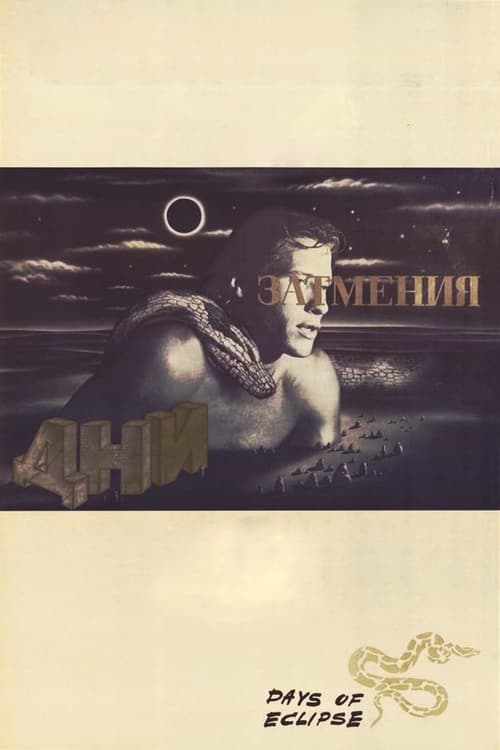


There is no better person to adapt a story by the authors of Stalker than Andrei Tarkovsky’s ostensible successor, Alexander Sokurov. Knowing full well how Sokurov’s slow-burn cinematic style is heavily influenced by the Russian master, I got real excited to experience another philosophically charged, sci-fi flavored rumination on the human condition. And I’m pleased to say that Days of Eclipse did meet my expectations, though it wasn’t as mind-blowing as witnessing Stalker the first time through. Also, it’s a little light on the sci-fi side of things, like there’s almost nothing futuristic or otherworldly about the goings-on. That’s not necessarily a fault, but it led me to believe that Sokurov may have strayed far away from the Strugatsky brothers’ original text. The result is no less profound. This is an interesting political fable about an alienated Russian man living in a Central Asian country that is under the waning grip of the Soviet Union, all told through Sokurov’s rich visual artistry.The plot revolves around a young doctor named Dmitry. He left his native Russia and settled in Turkmenistan so that he could write a medical paper on the correlation between a child’s hypertension and the parents’ religious affiliation. Dmitry lives and works in a dilapidated and sweltering, paper-infested shack. Despite his efforts to finish up his writing, he gets distracted by an odd turn of events. Chief among those is the intense heat felt around town which attracts some pesky and sneaky reptiles as well as a steady stream of bizarre visits by people who really wants him to quit writing. At first the encounters aren’t so strange like when his sister cooked rabbit for him or when his friend Sasha came by for a nice chat over lobster aspic. But things got a lot weirder afterwards. Dmitry bumps into a crazed soldier who takes him hostage inside the house at gunpoint; then he talks to his dead neighbor at the morgue who committed suicide just the night prior; he also meets a mysterious, sickly kid who is abruptly taken away by a heavenly force; and he soon finds himself in Sasha’s flat, the place shockingly transformed into a real-life version of the Salvador Dalí painting “The Persistence of Memory.”All these random encounters aim to stop Dmitry from achieving his goal, from writing his paper. But is this really what he wants? He escaped one of the most oppressive states in the world just to live in another Soviet controlled squalor and risk alienating everyone he knows. He could’ve joined Sasha in his Caspian Sea voyage westward for a better future (there’s even a subtle hint of homoeroticism between the two). The scene by the way is preceded by a train ride that kind of resembles the trolly car journey to the Zone in Stalker. And yet Dmitry stays put as an alienated foreigner in a land where he isn’t needed, falling deeper into his identity crisis as he absurdly types away—perhaps hoping for a better Soviet future, a future that we now know holds not the rise but the fall of the Soviet Empire.Dmitry’s ennui is presented in a Tarkovsky-esque manner (e.g. long takes, snail-crawl pace) but bearing Sokurov’s unique vision. He frames Dmitry and the village locals in his trademark sepia-toned canvas, like a classic sfumato painting brought to life. The old painting aesthetic nicely complements the dreamy narrative. This desaturated look sporadically transitions into full color mode for no reason, which probably suggests that what we see on screen is Dmitry’s own perception of his environment. Sokurov not only wants his viewers to see what Dmitry sees but also feel what he feels. Bursts of color could mean flashes of hope for the revival of the Soviet spirit that Dmitry finds in the mundane living of ordinary village folks. Sokurov also employs wide lenses with spherical qualities, slightly distorting the look of the world. Sometimes he goes total abstract like the scene where he shoots Dmitry aimlessly walking over a miniature version of the town, eclipsing everything in his path. Moments like this make Days of Eclipse a film worthy of Tarkovsky.