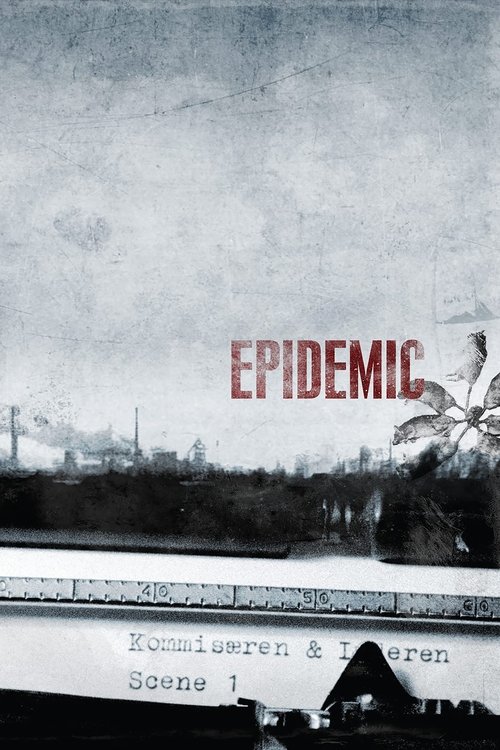
Het script waar een regisseur en een scenarioschrijver 18 maanden aan hebben gewerkt, verdwijnt plotseling van hun computerscherm. Ze laten zich niet ontmoedigen en beginnen met nieuw elan aan het script over een plaag van wereldwijde omvang, zonder zich bewust te zijn van de epidemie die rondwaart in de wereld waarin ze zelf leven en werken.
This isn’t Lars von Trier’s best work in terms of having a good, thoughtful plot, especially compared to his later films. However, considering it’s only the second film in his filmography, it’s more than impressive. At least I found it engaging to watch — unlike his previous film, The Element of Crime (1984), which felt overly obvious and disjointed in its plot.That being said, the writing in the top left corner with the movie title really annoyed me.
Rafael "Mister Movie" Jovine2.0
Action!: The Kingdom of Chaos and Nihilism That Von Trier BuiltLars Von Trier, for better or for worse, has proven to be a filmmaker who’s not afraid of taking some very interesting directions in his career. Some have gotten him in trouble and turned him into the polarizing figure he’s today, while others, like this movie, are simply odd... personally. By that, I mean, a black-and-white meta-film about the process of screenwriting starring a fictionalized version of yourself and your co-writer seems like something you would probably do as your debut film, not a second one. Not that you can’t do it and has it been done before, but I dunno, I found it kinda interesting.Putting that aside, the film is really great visually. The use of black and white and the cinematography as a whole are stunning. It doesn’t feel like a gimmick, but it actually fits the style and tone of the movie. If you didn’t know this was by Lars Von Trier and released in the late 80s, you could have easily thought this was some experimental movie from the 60s or 70s. Lots of cool visuals and scenes, like Lars (riding) hanging from a helicopter and riding/flying around in an open field. Reading through some plot synopsis, there seems to be some inside jokes and details that maybe someone from Denmark may pick up, like the producer complaining about the lack of violence, few deaths, and no subplots on our two leads script, which seems (-emed) to be something common in Danish cinema. Unfortunately, as the movie went on it got a little too redundant and eternally boring.All in all, while it starts relatively strong and there’s plenty to life, unfortunately it loses a lot of steam by the end. But maybe it's worth checking out for fans of experimental cinema.Action!: The Kingdom of Chaos and Nihilism That Von Trier BuiltTODAY SCHEDULEFacelessEpidemicA WarWonka
Steve Lovecraft2.5
The second film in my retrospective of Lars von Trier's filmography is a bit of a step back after the richly textured and deftly executed The Element of Crime, but Epidemic is much more indicative of the director's unique abilities and perspectives. Recently, another director with lofty aspirations and often accused of being pretentious, Peter Greenaway, said "I think... basically cinema's hardly moved at all. Spielberg and Scorsese make the same films as Griffith. What's the difference?...Maybe I'll have to wait another thousand years before we can actually say there's real cinema." At the core of Epidemic is the idea that film needs to escape from the restrictions and expectations placed upon it, and here we can see where the seedlings that would become "Dogme 95" took root. Reportedly funded on a bet Trier had with producer Claes Hansen to prove he could make the film for 1,000,000 krones ($150,000 US), for the most part it looks and sounds its price. The camera is clicking away through most of the scenes, and much of the blocking looks like it was improvised that day with occasionally poorly handled lighting. Then there's this obnoxious red watermark that says EPIDEMIC in the top left hand corner for the entire film. But these things are understandable on the budget and Trier's innate audacity, so I won't harp too much on the technicalities. What really stands out in the film is the structure of the script and its recursive meta-textual narrative. Trier and his co-writer Niels Vorsel play themselves cobbling together a new script after losing the computer file of their script for "The Policeman and the Whore" - an obvious reference to The Element of Crime. With the deadline to get a script to Hansen, they begin working on a film about a doctor who leaves the safe confines of his fortified institution to help people dying of a plague out in the country. Unknowingly, the doctor is the carrier of said disease, and the movie within the movie is interspersed between scenes of the writers brainstorming the script and going off on tangential quests and conversations that have seemingly little to do with broader plot (but I'm sure a case can be made for lots of subtle parallelism). Immediately, one can point to plenty of inspiration coming from Federico Fellini's 8 1/2 as both films are about directors making a movie while their reality and fantasy blend in the camera eye. The opening scene of Fellini's masterpiece where a man floats above the ground is closely paralleled in the doctor's exit by helicopter in the inner movie of Epidemic, and it is easily one of the most gorgeous shots in the film. So too are really all of the inner film's scenes that seem to follow more in line with the refinement of Trier's debut. I'd rather have seen that movie fully realized, but by the end I understand that he was making a statement about the lack of creativity in film narratives amidst audience expectation for genre film. And ultimately, this is one of the main reasons why he and Greenaway are convinced that cinema is stagnating: you can barely get a movie made without proper funding, nobody wants to bankroll a commercial risk, and audiences prefer the comfort of a straightforward narrative in a well-established genre. Epidemic was billed as a horror, but the film deliberately diffuses any sort of conventional build up to terror until the hysterics of the climactic dinner scene and its brief ensuing gore (even then, I was laughing uncontrollably because it's more over the top than early John Waters films). I can't say it isn't interesting, and there are some really novel things going on in it that would have easily earned him an A grade in film class had he not already made it onto the lineup at Cannes. Epidemic was certainly a sign of great things to come, but ultimately it is an unnecessary curiosity with a few stellar performances and sequences to justify the watch. However, if it had been my only exposure to him back in the day, I would have probably dreaded watching any of his future endeavors, but they can't all be zingers.
More like this
Veelgestelde vragen
Waar gaat Epidemic over?+
Een filmmaker en een schrijver werken samen aan een scenario over een wereldwijde plaag, zich er volledig onbewust van dat zich om hen heen een ramp in de echte wereld ontwikkelt.
Wie regisseerde Epidemic?+
Epidemic werd in 1987 geregisseerd door Lars von Trier als het tweede deel van zijn Europa-trilogie.
Wat is de beoordeling van Epidemic in Duitsland?+
Epidemic heeft in Duitsland de beoordeling DE 12.
Wanneer werd Epidemic uitgebracht in Denemarken?+
Epidemic werd op 11 september 1987 uitgebracht in Denemarken.