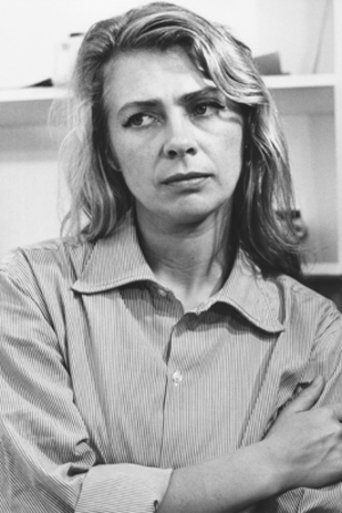


ever heard of a little lady named susan sontag? the people in the theater who approvingly “mmm’ed” at seeing her name def have & want u to know.
In maart en april 1966 maakte Markopoulos dit filmportret van schrijvers en kunstenaars uit zijn New Yorkse kring, waaronder Parker Tyler, WH Auden, Jasper Johns, Susan Sontag, Storm De Hirsch, Jonas Mekas, Allen Ginsberg en George en Mike Kuchar, die hij grotendeels observeerde in hun huis of atelier. Gefilmd in levendige kleuren, bruist Galaxie van leven. Het is een meesterwerk van cameracompositie en montage, en een levendig antwoord op Andy Warhols hedendaagse Screen Tests. De film werd in 2001 bewaard door het Academy Film Archive.
Galaxie draait in 1 bioscoop in New York City - eerstvolgende voorstelling vrijdag 20 november om 18:30 in Anthology Film Archives.
Volgende voorstellingen: vrijdag 20 november.
Volledig programma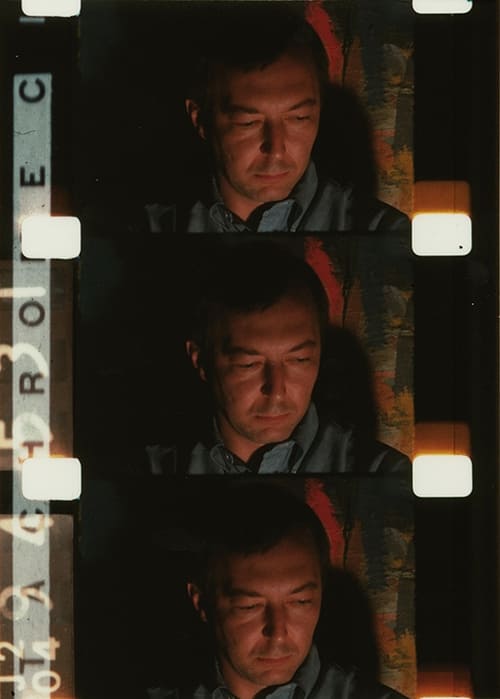
Speeltijden van Galaxie, elke ochtend ververst
Kies je bioscoop en krijg een seintje voordat de film van het doek verdwijnt.
ever heard of a little lady named susan sontag? the people in the theater who approvingly “mmm’ed” at seeing her name def have & want u to know.

“For me, locations and beautiful people have always been the backbone of my work.” - Gregory Markopoulos Portrait-oriented films I feel have an inherent “simple” quality - both in general construction (at least the PERCEIVED make-up) as well as in how the works are taken from the audience. The generic form of portrait film involves filming a subject (persons/people) for a given reason(s) or context by the involved artists; this form, at least in my experience, allows quite a bit of room for speculation since it is typically rigorous - hanging ones attention on to moving head shots of people for more than 30 seconds per subject would surely cause many to become irritable and cause ones mind to wander. This sometimes feels done by design rather than appearing as a byproduct. When watching films like these, my brain tends to immediately default to background and sequencing speculation. Take Gidal’s Heads for instance, a film composed of (I believe) handheld shots of friends/associates of Gidal. Having people like Thelonius Monk and Pete Townshend amongst others like Markopoulos and Schneeman is entertaining enough to think about on its own in a kind of silly “look at this” kind of way. I suppose I’m already enough of a shill for Markopoulos as is so I’ll try to avoid hyperbole but I do think something like Galaxie isn’t far from the ideal form of portrait film on my end. Generically, it is much like similar films. Markopoulos filmed a number of portraits of his artist friends, from filmmakers to poets to the author of where the wild things are, mostly either in their living spaces or a studio of sorts. The film opens with a synopsis of itself, the clang of a Hindu bell plays throughout an opening montage of all the subjects; this is the whole of the film including the soundtrack. Opening with Parker Tyler’s scene is him in his studio, immediately following we’ve Markopoulos’ famous in-camera editing and superimpositions, perhaps the most immediate differentiator from associated portrait film, used to similar effects in his Ming Green. The scene progresses until the hammer is struck, a quick montage occurs and we move to Storm De Hirsch.Galaxie’s form quickly evolves into one of constant and immediately growing complexity; in part due to the organization of the film being dependent on the order in which it was shot - meaning to say Tyler’s comes first because it was the first portrait Markopoulos shot, and so on. So here you have a pure growth in compositional complexity but what also follows is an additional clang of the bell per portrait. The length of the clanging per scene seems to correspond to the beginning of the scenes respective rapid montage. These montages aren’t far from what one would expect from other Markopoulos films when looking at the editing but through the simple fact of this being Markopoulos documenting friends and associates (meaning to say based in reality). There’s an inherent grace to this form regardless of the framing (again, compare the form of this to Heads) but of course with Markopoulos this comes full blast even if he wasn’t trying. A particularly fascinating aspect of the superimpositions is the incorporation of gestures and personal objects incorporated into peoples portraits (which also comes with the natural progression of the film like the clanging). Battcock’s scene, for example, is often spliced between two instances, one of a basic headshot, the other of him nude (I believe?) and laying on an exotic rug. I could most easily relegate this as a means of characterization but words of greater worth escape me at the moment. The biggest point of relation here’s easily Warhol’s screen test series and I think it’s a worthwhile comparison to make as while similar meanings can be drawn (documentation of beauty or something of the like or something something temporality etc) but figure and gesture are typically not big concerns of Warhol’s, with gesture being a key part of acting in Markopoulos’ catalogue. Galaxie’s almost somber tone, as carried through the oftentimes either melancholy or apathetic demeanors of the subjects is incredibly evocative of painted portraits (not to say the images themselves are painting-like) adds such a simple but effective sense of Greg commemorating these people with their own eternal-isms that go beyond basic portraiture with incorporations of these people’s lives through montage and added objects, similar to the treatment of traditionally masculine and feminine objects or clothes in Himself as Herself; somber-ness being further rung in with the lack of sound other than the projector and the clanging bell. The film is, generically, an incredible demonstration of Markopoulos’ early portraiture techniques and one of his first major developments in form.

TOWARDS A NEW SOUND COMPLEMENT FOR MOTION PICTUREBelieving more and more in the truth inherent in Plato's dictum that time is the moving image of eternity I propose a new sound complement for motion pictures. My own personal concern for such a sound complement arose during the editing of Twice a Man. At that time I had proposed to everyone's dismay a new narrative film form in motion pictures. When I put this idea into immediate effect it proved successful not only as theory but also for the film spectators who came to view Twice a Man.With Twice a Man I utilized a form of editing which contained all that I had learned over a period of some twenty years, which were the inherent possibilities of classic editing according to groups of shots in various lengths. The difference occurred when to this form I added a new form in which the idea of the classic shot to shot was applied to the film frame itself; i.e., a single film frame to another single film frame, and its obvious inexhaustible architectural possibilities; exotic varieties which might recall Luther Burbank. However, when it came time to address sound to the film images I was obliged to disconnect the very sounds which seemingly create the meaning of a word followed by another word. In order not to offend the images I had constructed so intricately, I fragmented the words, the sentences themselves. The dialogue which my protagonist, Miss Olympia Dukakis had recorded, was dismembered. With this, at first, mysterious dismembering I realized for the first time that sense which is inherent in the lyricism of the independent, silent spaces. At the time I recalled Schoenberg, for I had once attempted to read his classic study on composition.Later a different sound complement was needed to augment the images of the motion picture Galaxie. But with Galaxie the sound needed to be, to pretend at least, to be a single shattering of Time the Image. The result was the use of a Hindu bell. Even a few weeks ago a still different need arose after the editing of the motion picture made at Roccasinibalda, Gammelion. With Gammelion it was a matter of utilizing a single, well known musical composition to relate to the film spectator what he might not otherwise receive from the static images, so brief, and the entailed submergence because of the use of visual lines of opaque leader faded in and out like measured strains of music or poetic device. It now seems possible at this writing that the music to be used will be from Wagner's Lohengrin. But now with the approaching production of the Byzantine project Ascension there seems to be a need for a greater departure from what is otherwise an ordinary use of sound in motion pictures; a departure far greater than that ever attempted before. Whether this will become a reality remains to be foreseen, for too often with film the very effects of BOREDOM, ANXIETY and DELAY take their sum toll, and the filmmaker is left but with the barest thread of what an original theory or intention might have been. Yet it must be said, for once and for all, that of all the arts that have existed in the past, The Film As Film, as the most sublime art form to date, the most arrogant, and the most resplendent in the image and soul (THOUGHT foremost) of man himself, subsists best before the DEMONS OF BOREDOM, ANXIETY and DELAY. Delay above all! For the crux of the ultimate success of any original theory is delay. In the past achievements resound with delay: Freud, Michelangelo, Proust, Carravaggio, von Stroheim!There is no doubt that the filmmaker enamored of the film must persist and persist, must stumble and stumble, and above all resist that temptation which is beyond the commercial temptation, the temptation of his own desire in order to achieve the very peak that is the limit of his own creations. These: persistence, bold stumbling, resistance, mark. each one of them, the difference of one filmmaker from another. Two such filmmakers appear before me: Brakhage, Beavers. One known, one unknown. Brakhage working and I quote, "The Book of the Film, and its first 'chapter': Scenes from Under Childhood, will take YEARS to finish (I am working a frame-at-a-time with A, B, and C rolls and SOUND!)..." While Beavers in Roma has completed the editing for his motion picture Winged Dialogue shot in Greece this past summer and is now concerned with its sound. It is interesting to note that Winged Dialogue consists of the following film form as outlined briefly by Beavers:Title: FO3A - part 1 FO1 - part 2 FO2B - part 1 FO1 - part 2C - part 1 FO1 - part 2 FO2 FI3D - FO3E - part 1 FO1 - part 2 FO2F - part 1 FO1 - part 2G - part 1 FO3With the motion picture Ascension I propose to begin the luxury use of a sound camera during the actual filming of the action. Not a tape recorder but, say, an Auricon which would be perfect for my needs. Dubbing for Ascension would be completely out of the question: a) because of the sound-image theory of the film; and b) because dubbing is at an all time low level seen in Roma these past two months with their accompanied poor professional projection and smoky theatres. The clue to the use that I intend to put sound to is to be found in the superimposed imagery of the motion picture Galaxie. In Galaxie the portrait sitter, and there were 30 such portrait sitters, was superimposed on a single roll of 16mm Ektachrome Commercial film anywhere from one to ten times. The result was a lively and remarkable psychological study showing the pleasures and displeasures of the portrait sitter; pleasures and displeasures as revealing and credible as the many veined figures in a Tchelitchew painting. Further work using the technique of Galaxie in such later films as Ming Green, The Divine Damnation and Bliss provided me with that other clue TOWARDS A NEW SOUND COMPLEMENT FOR MOTION PICTURES. And the vehicle for this sound experiment seems to be Ascension. The protagonists in Ascension will be permitted the freedom of movement, the privilege of speech at will, literally at will. However, the filmmaker through the use of the system of fades which he himself is attuned to and has developed in previous projects (Eros, O Basileus, for instance) shall have at his command both image and sound. Like a surgeon he will be able to sever a filmic tendon, or bind and unbind any sound that emanates from the vocal box. With luck the achievement shall be an orchestration to rival music, to dazzle the eye, and to fascinate the ear.13th of October, 1967Roma
Galaxie is een avant-gardistische portretfilm met prominente New Yorkse schrijvers, kunstenaars en filmmakers, geobserveerd in hun huizen en studio's.
Galaxie werd in 1966 geregisseerd door avant-garde filmmaker Gregory J. Markopoulos.
Galaxie werd uitgebracht op 3 september 1966.
Galaxie werd in 2001 gerestaureerd en behouden door het Academy Film Archive.