
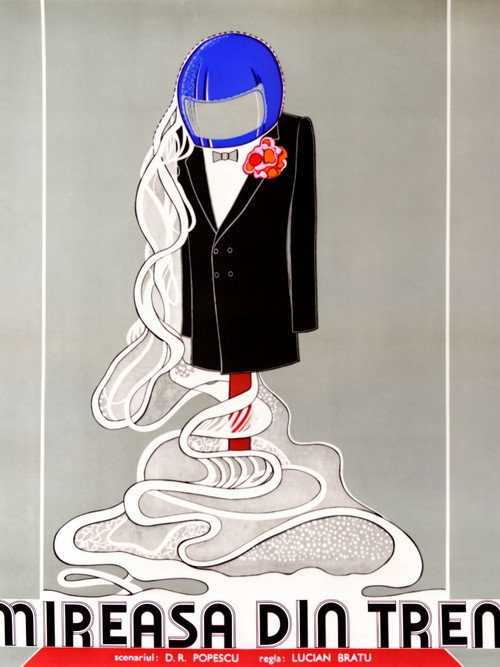





*WATCH this film FREELY on CINEPUB.RO*www.youtube.com/watch?v=WWzUjSYthHUA film with a charming boy It must be a great privilege to have your work, ten feature films and dozens and dozens of short films, continuously rediscovered over the past ten years. This is the case, the destiny (?) of Lucian Bratu (1924-1998), whose (re)understanding in the history of Romanian cinema refuses to come to an end. Here, for the first time in a very long time, is "The Bride from the Train" (1980), a " up-to-date" film about young people in the provinces, a love triangle with factories and plants in the background: in principle, nothing more ordinary or commonplace for a Romanian film from the 1980s. And yet, in Bratu's hands, the film acquires, in addition to a gender consciousness ("socialist feminism", as many have called it, starting with journalist Iaromira Popovici), a kind of tremor, a spark, and, something truly rare in Romanian cinema, a relaxed, imponderable sex appeal, possibly thanks to Gheorghe Visu, whose body and face, especially after Dan Nuțu left the country in 1979, would bring masculine sensuality to the Romanian screen (a sensuality very different from Nuțu's, more opaque, fixed and self-assured, while Nuțu was "the tough-vulnerable man of 1960s cinema", as Tudor Caranfil aptly described him). Visu, therefore, played a lover alongside theater actress Aurora Leonte, then a student and screen debutante, and Radu Gheorghe, also in love, but in the role of the domestic saint, the good, romantic, and ambitious boy "with a future".Those familiar with Bratu's career will recognize in "The Bride on the Train" a distorted reflection of another film by the director, "A Film with a Charming Girl", which caused a historic episode of censorship at the time. However, very few people are familiar with Bratu's career, at least in detail.So:A skilled filmmaker, sometimes brilliant, often neither here nor there, lacking in masterpieces, but with a formidable flair for sophisticated popular films. Part of the Moscow generation educated at VGIK (Victor Iliu, Mircea Săucan, etc.), Bratu made his debut in 1956 with "Admirabilul X Popescu" (The Admirable X Popescu), a post-Stalinist satirical comedy in the vein of "Directorul nostru" (Our Director, dir. Jean Gorgescu, 1955), but much more allegorical, about the cult of personality. However, the revolution in Hungary caused the authorities to halt production. He made his debut towards the end of the decade with a forgotten spy film ("Secretul cifrului" [The Secret of the Cipher], 1960) and inaugurated the so-called "national cinematic epic" with the historical biopic "Tudor" (Vladimirescu) in 1963. But he was not to become a Sergiu Nicolaescu — Bratu was indeed a contradictory filmmaker, an outsider. But certainly, at least for this first, "Tudor" has always had a place of honor in the history of Romanian cinema—although, I admit, it remains my favorite epic, along with Malvina Urșianu's "The Return of King Lăpușneanu" (1980), a colleague of the same generation with whom, incidentally, Bratu had much in common – including the writer Paul Anghel, the filmmaker's husband and co-screenwriter on the unmade "Admirabilul X Popescu" (The Admirable X Popescu). This was just the beginning of a long career as a filmmaker of writers, with practically every one of Bratu's films being a collaboration with writers, screenwriters, novelists, lyricists, playwrights, journalists, etc., from Mihnea Gheorghiu to Dumitru Carabăț, Dumitru Solomon, Eva Sîrbu, and Petru Popescu. In fact, he was also the first translator into Romanian of J.D. Salinger's The Catcher in the Rye, in collaboration with Catinca Ralea (Editura pentru Literatură Universală, 1964). "Really!" This literary interest, coupled with his training in the visual arts — at one point in his complicated biography as a poor, orphaned young Jew, he became a disciple of M. H. Maxy at the School of Arts for Jews — and tripled by that sophisticated pop flair for the new that I mentioned earlier, were undoubtedly decisive in distinguishing Bratu in pre-December cinema (he died in 1998, after two unsuccessful attempts to re-establish himself in the “new” guild as deputy director of the ProFilm studio and teacher at ATF).However, his most famous literary collaboration remains his collaboration with Radu Cosașu on the screenplay for the film "A Film with a Charming Girl" (1966), the first of the rediscoveries of recent years: if not in 2011, as Cristian Tudor Popescu did from the plane in "The Deaf Film in Mute Romania" (Polirom), then certainly in 2018, with Andrei Gorzo's careful study. It is Bratu's first "topical" film — as films with immediately contemporary subjects about working people and their daily lives, often treated in a realistic aesthetic key, were called — but an unusual one, concerned with the lives of chic urban youth in Bucharest, as seen around Ruxandra Vancu, a young aspiring actress who has just failed her exam at the IATC and who now, slightly discouraged, is looking to make her way in Bucharest's bohemian scene. As Gorzo points out, from the moment the script went into production, it stood out as unusual, as if sympathizing with the youthful recklessness of its protagonist: Ruxandra Vancu was unpredictable, irresponsible, with an urban lyricism and in a continuous game of flirting with two very different men, a young director of utilitarian films (named Paul Manu, after the first Romanian filmmaker, Paul Menu, played by Ștefan Iordache) and a mature engineer (Emmerich Schäffer). In other words, although she was likeable, she was not exemplary or representative of socialist youth, these being key concepts in which cinema was discussed at an official level, from studio directors to film critics. Naturally, the young people of the 1960s could not be the same as those of the 1950s. In Gorzo's words, "the implication is that the first stage of building socialism is over, and these young people are privileged — their parents, who did the hard work of construction, have handed them a world that is still a big construction site, but which they can afford to treat as an amusement park". However, the protagonist did not reveal any humanistic ambitions, let alone socialist ones — with all the naivety of her age and her charm, her ambitions were nothing more than careerist and hedonistic, and the way Bratu and Cosașu portrayed her from beginning to end did not betray a moralizing discourse to which Ruxandra Vancu would submit. Thus, a few days after its theatrical release, the film was withdrawn to have its ending changed, at Bratu and Cosașu's expense. In the new version, the protagonist does not take the role in Buftea for which she applied, with a voiceover repeating what the engineer had said to her earlier: "To succeed in life, it's not enough to be a charming girl".A few years later, Bratu began a series of films that were less glamorous than the one with the charming girl, in which the protagonists were mature women over forty, with complicated biographies, often coming out of abusive relationships, and with jobs that allowed the films to scrutinize the state of affairs in literary editorial offices, provincial town halls, and the ever-changing city of Bucharest, sensitively observing aspects of the condition of women at the time. These are the two films that preceded "The Bride from the Train", namely "Drum în penumbră" (Road in the Shadows, 1972) and "Orașul văzut de sus" (The City Seen from Above, 1975), both starring Margareta Pogonat, and the one immediately following, "Angela Goes On" (1982), with Dorina Lazăr in the role of Angela. As the director himself said in an interview with Roxana Pană, "both the typist in Road in the Shadows and the mayor in City Seen from Above, as well as the taxi driver in "Angela Goes On", were primarily hypotheses of contemporary heroes in which 'the condition of women', admittedly, played a primary role." This "socialist feminism" of Bratu's is the second rediscovery of his work in recent years, brought almost to canonization by the recent "Don't Expect Too Much from the End of the World" (2023), in which Radu Jude uses "Angela" to structure a then and now: two female taxi drivers, Dorina Lazăr then, Ilinca Manolache now, crossing Bucharest 40 years apart to document the changes in the city, social relations, gender dynamics, the evolution of work, the actors of then, now, but especially the cinematic subconscious of Bratu's film, the fact that, being interested in current events, the first signs of 1980s austerity, queues, and urban decay can be seen in the corners of his fiction, which Jude explodes in zoom-ins. This would be the third rediscovery of Bratu's work, partially overlapping with the second, but without being confused with it: based on a genuine interest in contemporaneity, in the here and now, his cinema bears a documentary aspect of the era, not a generic one, of zeitgeist, but a lively one, of nooks and crannies, rich in details and social sensibilities.Thus, when we talk about "The Bride from the Train", we refer to all of these things, as well as to a mature Bratu, already with a sure hand in cinema, but only on his second attempt at a story with young people — for more than a decade, "A Film with a Charming Girl" had been enough. The screenplay belonged to Dumitru Radu Popescu, and at that time something was happening at the Buftea Studio, the dawn of that short period, lasting only a few years, until the "Mangalia theses" of 1983, but extraordinarily important for Romanian cinema, when "Microphone Test" (dir. Mircea Daneliuc, 1980), "A Girl's Tear" (dir. Iosif Demian, 1980), "The Cruise" (dir. Mircea Daneliuc, 1981), "Why Are the Bells Tolling, Mitică?" (dir. Lucian Pintilie, 1981/1990), "Sequences" (dir. Alexandru Tatos, 1982), "Rainbow Bubbles" (dir. Iosif Demian, 1982), "Faleze de nisip" (dir. Dan Pița, 1983), and others. Also in 1980, another film written by Dumitru Radu Popescu was released, "Gently was Anastasia passing" by Alexandru Tatos, and documentary filmmaker Ada Pistiner also released a remarkable topical film, "Snapshot Around the Family Table". Although he was not old at all (he was 56 when the film was released), Bratu remained one of the seniors at Buftea, alongside Ion Popescu-Gopo, Iulian Mihu, Manole Marcus, Andrei Blaier, Savel Știopul, Malvina Urșianu, and a few others. Compared to the films listed above, "The Bride from the Train") does indeed seem old-fashioned, including in the way it portrays its young protagonists. This is because the most provocative portrayals of the young people of the 1980s (especially those by Daneliuc) already showed them to be cynical, reserved, unsentimental, and somewhat dark. However different Visu may be from Nuțu, the script and direction are ultimately those of the sixties: more literal, more prone to allegory, with reflective and melancholic protagonists, weighed down by the guilt of not being a heroic generation, by big questions and the inability to communicate — for what is this Mihu, Visu's role, if not a very late Ceauescu regime James Dean? Nothing could be more natural for the filmmaker who translated J. D. Salinger as quickly as possible, almost 15 years later. But, ironically, this desynchronization works in the film's favor: because the truth is that these cynical and resigned young people of the 1980s had something ascetic about them, even when they were having sex. Bratu's young people, on the other hand, despite the fact that they talk about sex in a vulgar way – you know... – are sensual, carnal, the protagonists of a mise-en-scène that measures them from head to toe; and Visu, as I said, simply adores them, as few cameras have adored their protagonists in Romanian cinema. In a short text from the 1960s ("We have films with young people. But films for young people?", 1968, in "Pagini despre film"), George Littera brilliantly ironizes the clichés of romantic films with young people: "Here, for example, are the heroes who love: they walk around gazing lovingly into each other's eyes, they kiss with photogenic shyness, they play hide and seek with a manufactured innocence, they swing on swings, they chase each other among the trees..." And although Bratu's film is not entirely devoid of "rosy lyricism" and "sweet sentimentality," the fact that none of them are overly likable or stereotypical helps them stand out on screen; the French kisses help too.The bride from the train is called Carolina, she is a waitress at a terrace serving mici and beer in an industrialized provincial town (Reșița). By all appearances, the story should be hers, the film – about her. But it is about her groom on the train, Mihu, played by Gheorghe Visu, with whom she is only playing at being just married. He is a kind of mysterious motorcycle stuntman who appears and disappears from his hometown whenever and however he wants, not only playing at being a groom, but playing with and at life in general. Carolina, on the other hand, would like to say yes to something serious, namely what Filimon, a factory worker, evening school student, and unexpected spectator of one of the games of bride and groom on the train, can offer her. And although it is clear that Bratu is horrified by the closed world of the provincial town, he keeps Filimon, the defeated winner, perfectly dignified. Especially when the roles change, with Carolina now playing with Filimon under Mihu's watchful eye.In that small, fixed provincial town (of which Bratu actually shows very little — and, judging by the caricatured ways in which he presents the parents, first Filimon's, then Carolina's, then all the better), the kind of town where you have a town hall, a brewery, and a factory, the appearance of Mihu, the taciturn rebel, is an event in itself, and even more so is his motorcycle show (in which he does wheelies on a centrifugal track nicknamed "the wall of death"). I said that the story, that the film should belong to Carolina, but that is not the case at all — on the contrary, she is Bratu's most bland protagonist, a combination of Ruxandra Vancu's spoiled spontaneity and the resignation of his mature women. Well, this story, this film, belongs entirely to Mihu's character, the charming boy who has to make a decision whether to start his life – marriage, work at the factory, evening school – like Filimon, or not, to continue playing the game alone. And, like other protagonists, but especially Bratu's female protagonists, Mihu is a misunderstood melodramatic character, a false egoist whose face must have filled the walls of many teenagers. And although it seems that this film with a charming boy has learned the lesson of a "film with a charming girl", that Mihu is a rebel completely different from Ruxandra Vancu, Bratu recalls in his autobiography ("Cu mine în rolul principal" [With Me in the Leading Role], Antet, 2000) how this film also had problems with censorship, initially being refused a premiere in Bucharest — although, ultimately, it must have been a much more sensitive film for the provinces. It seems that there is something rebellious in the filmmaker's very way of understanding youth, which was certainly unsettling for the Ceausescu regime, both early and late. And it's a good thing that it was, because, among Bratu's other professional and personal strengths, this understanding allows "The Bride from the Train" to be more than just any film.There are a few more feature films by this filmmaker that we have missed, not to mention all his utilitarian short films. I have no doubt that they are also full of surprises.(Călin Boto, cinepub.ro)
