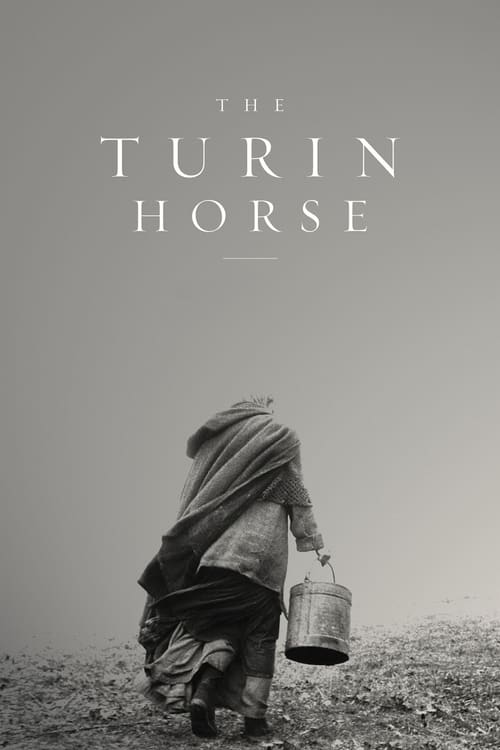
This is a film of the elements. Between the constant wind, the need for water, the dirt and mud, and the light of small, flickering flames, this film is the sum total of reality. In the midst of all of these is the aether, the fifth element that controls movement and light. In this case, the aether is the camera, which moves fluidly about our sparse subjects and observes, yet also commands their fates in a metatextual way. The aether is Tarr's storytelling.The wind is the uncontrollable power that sweeps away everything. It is the horse's refusal to work and the inevitability of the end. It is constant, grating, and brutal, and it drives those who attempt to move through it into the ground. It is Tarr's pessimism and rejection of divinity and mortality in favor of an admission of frailty and doubt. The wind is drudgery and hardship.The earth is represented in the shit strewn straw of the horse's pen, in the hard packed ground of the cabin, and the thick, plain potatoes that feed the farmer and his daughter every night. It is dullness and necessity, but also life-bearing. It is the only symbol of hope, and it is trod upon and ignored, a side effect, an inescapable fact that has profound bearing on the story but only insofar as nothing exists without it. It is the routine, and thus, Tarr's fear of (warning of?) plainness and emptiness and boredom.The water is the source of life, and its weight is the price of life. When it is gone, it is true despair, desperation. It is representative of how we cannot escape our natures, how small things drive us. When the water is gone, the farmer and his daughter try (and fail, because of the wind) to find another way, another path. The water is what we work to attain, what we cannot live without, both literally and figuratively, and it is Tarr's career. When it is gone, he goes to seek something else. Perhaps he will fare better than the subjects of his film.And the fire is what keeps the darkness out. It is hope. It makes the potatoes edible and the cabin warm despite the wind. It boils the water. When it flickers out, when it can no longer hold back the darkness, then comes the end, comes death. The fire's inability to hold back the dark is Tarr's giving in to age and experience, turning away from hope. As he himself said, he no longer seeks to change the world. He simply wishes to express the heaviness of life, and so he has.
First Day: Food and shelterSecond Day: Touching, acquiring and therefore debasingThird Day: God watches all over youFourth Day: ScarcityFifth Day: Darkness and silenceSixth Day: MortalityPredominant elements throughout the days: A storm raging outside and moving everything that can be found in the air and on the ground, like trying to reach a destination, shadows, cotidianity occupying three alienated souls (two humans, one animal), a strong wind heard while outside, ghastly and scary wind sounds from the inside, repentance, mysteries unspoken, emotional detachment, water and potatoes.Bonus feature: Presented in the Second Day: A destructive critique to civilization throughout the centuries against authority and other godly figures attempting to establish their false omnipresence above everybody else, until a worldwide populace realizes that those trying to embody godly roles actually represent false promises and attempt to tear the system down.The moment in which the horse started to cry, my soul escaped my body and tears attempted to escape through my eyes. If this is meant to be the final testament from a film-making master, I shall embrace every single "post-neorealist" fragment and landscape he tried to represent throughout 5 decades, culminating in his most death-oriented statement composed by 30 shots with an average length of exactly 4 minutes and 52 seconds each.97/100P.S. It surprises me that this is the most acclaimed film by the director, and also the most famous. Not arguing about this master farewell's greatness, this wouldn't even be in his Top 3. Oh, my dear shattering art piece: you would be the best film of the year if Lech Majewski hadn't directed anything in 2011.
RIP Béla Tarr, 1955 - 2026In the last two decades of his career, there was no director more singular than Béla Tarr, no filmmaker with such a unique embrace of the cinematic form and its artistic potential. He was distinctive in his extreme commitment to placing allegory in the real world, whether through long windswept walks or minutes of characters sat in silence. His collaborations with Nobel prize winning László Krasznahorkai produced a series of profound and melancholic films. Tarr's skill was in taking Krasznahorkai's cryptic, apocalyptic tales and portraying them in a beautifully literal manner, turning flowing poetic text into long takes that emphasise the void of time that sits between significant moments. Our lives are rarely noteworthy and Tarr found a way to depict that seriously, within political allegories on the nature of power and hopelessness. Tarr's three greatest masterpieces are Sátántangó, Werckmeister Harmonies, and The Turin Horse. The first remains the greatest use of adaptation in all cinema, a seven hour filmic behemoth that recreates every chapter in a novel to produce a slow and complete allegory without truncation. The second is Tarr's most overarching vision of a world embracing chaotic despair and the most succinct display of his political and formal boldness. Finally, The Turin Horse is the greatest distillation of Tarr's style, a film so simple and bleak in premise that it is arguably the peak of nihilism in cinematic form. Béla Tarr was an icon of cinema and a collaborative artist who produced some of the most significant pieces of modern cinematic art. No filmmaker has more impacted my understanding of the artform. Tarr's films changed my life. His passing is a sad day for cinema.