


Kind of wild to see a movie that actively calls out just how openly sexist, racist, and homophobic the first wave punk scene really was. That the soundtrack is so killer is the icing on top.
Geregisseerd door Isaac Julien
Een sfeervol, realistisch drama.
Londen, 1977. Chris en Caz runnen een piratenradio die soul en funk uitzendt. Iemand vermoordt hun vriend TJ, die homo is, en ze beginnen Chris en zijn vriendin als verdachten te onderzoeken. Aan de andere kant begint Caz een relatie met een punk genaamd Billibud, die een heel conflict van racisme en homofobie aan het licht brengt. Young Soul Rebels is een thriller en een sociaal drama tegelijk en weerspiegelt de bijenkorf van subculturen, rassen en seksuele keuzes van het Londen van vóór Thatcher.
Young Soul Rebels draait in 1 bioscoop in London - eerstvolgende voorstelling dinsdag 20 oktober om 20:50 in BFI Southbank.
Volgende voorstellingen: dinsdag 20 oktober.
Volledig programma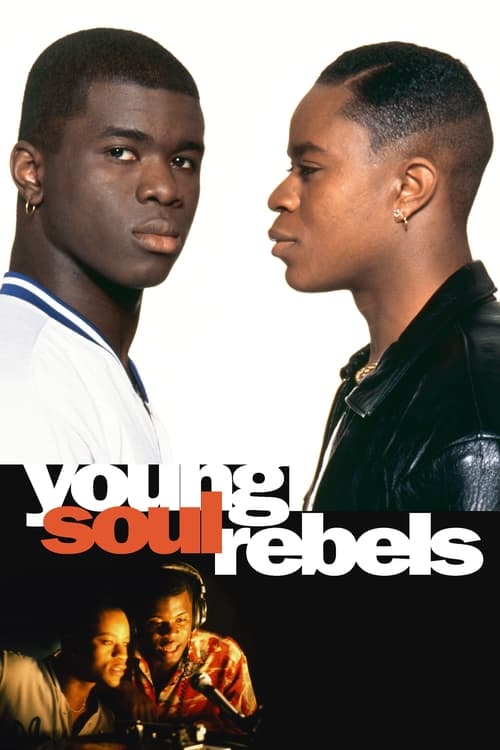
Speeltijden van Young Soul Rebels, elke ochtend ververst
Kies je bioscoop en krijg een seintje voordat de film van het doek verdwijnt.
Kind of wild to see a movie that actively calls out just how openly sexist, racist, and homophobic the first wave punk scene really was. That the soundtrack is so killer is the icing on top.

CW: violence, homophobia, racism, sexism, elections, mental healthI love it when a film whose themes and ideas resonate with me also looks good. Bright red against dark blue on the steps. A celebration in the streets draped in red, white, and blue, just a wonderful cacophony of British imperailistic pride, with our protagonists serving as some of the few counter images within. Three skinheads leaping off a building in tandem. Those pink socks. Just image after image that begs to be captured, because it's composed with the intention of clarity, of beauty, and of energy. All in favor of an idea, an examination, an observation of being black and queer.Also, the mixture of soul, funk, and punk on the soundtrack was perfect."Call the police?" the white cis guy asks. The black cis guy responds, "No. No use."I sometimes think of that famous quote about how the worst thing about living outside the law is not having its protection, and how awful it is that we've relegated a majority of this world's people to living without its protection, outside of it, for immutable qualities of their being. In recent years, the unrelenting murder of black people by the police in the United States has gotten more attention than ever, thanks in no small part to social media meaning that mainstream media finds it harder to ignore. In many of these cases, the people who have been murdered are actually calling for help from the police when they police respond in malice. This film, made in 1991, set in Britain in 1977, portrays the same environment, one in which no one not white cishet and male can really feel safe. It'd be easy to say nothing has changed in 40 years, but obviously, nothing has changed in much longer than that (in terms, you pedantic scum, of this particular issue)."Disgusting."They snarl as they see two men kissing. Queer love was radical then, and it's still radical now. Interracial queer love is even more so. The way they fill the screen is not exploitative. When they make love, it's not pruriently filmed. The only time anyone is outright objectified, it's done by the villain, a villain who is... problematic, I guess. Internalized homophobia becoming external homophobia in a violent manner is all too real, unfortunately, a gross symptom of a world that erases and scorns us. But the filmmakers' view of interracial queer love is so warm and intense and close that the unintended problems of that portrayal--the stereotype of a bigot who is in the closet, which loops around to being homophobic itself--is overwhelmed. These characters are allowed joy."They're not gonna run me out that easy."Tracy is the best character in this. Her voice is one of wisdom, but not at the expense of her depth as a character. No one in this is too complex, but the four principals are allowed a little room to be more than archetypes. Tracy, though, seems to rise above the others, carrying a perspective on institutional racism, on success in a system that works against her, on her own role in the life of Chris. The film, the narrative, makes clear that she is unfairly treated by the place she works in a variety of ways, based on both race and gender, and that she is aware of it. She, like many of the other characters, gives voice to an intersectional viewpoint. Like Chris, especially, she is seeking to succeed in their system on her terms. The film never shows whether the filmmakers think this is possible; it simple allows us to understand that it is painful, difficult, and dehumanizing at times. "How are you supposed to explain it to a kid? I can't even explain the bastards to myself."We are constantly faced with trying to understand the violence against us. Our children have to understand, have to be told, to protect them, but the gap between us and those who perpetrate this violence is so wide that understanding it is impossible. Bridging that gap is improbable; it means understanding someone who doesn't even see you as human. That's part of why Chris and Cas are so desperate to widen their broadcast. Spreading their voices--their genuine, their real, their actual voices--further means being heard, being known, being real to so many more people. It means pushing that boundary of hatred back just a little more. It might never be enough.I took the day off today. I went to breakfast with some friends. I slept. I responded to an emotional crisis. I mourned Leonard Cohen. I got offered a miracle (I took it, I think, but it's complicated). Yesterday, I worked, and I took a look at the people my work serves: people of color, immigrants, women, the people everyone else hates. I reminded myself of my own privilege as best I could, and I worked to help others. Mostly, I tried not to cry, not because of recent events--well, not directly--but because the wave of despair rippling through those I love is so palpable that I am experiencing flashes of my worst periods, reminded of crises past. Triggered. (I got permission to use it.) But I resolved, too, in response to that, to continue to amplify my own efforts to love others. If you are feeling scared, alone, hopeless, or hurt, remember that I care about you. I am here for you (you are not alone). And there is always hope. As I have expressed before, my space is your space if you are in need. Remember that I love you (even those whom I have blocked). This goes for those of you in other countries, those who are not immediately affected, too, but yes, mostly, for those of us who have everything to fear. (And to those of you taking joy in this moment: I will never stop fighting you.)This atmosphere, this current of fear and despair, anger and anguish, is a reminder, not a watershed. This is how it has been for us. It feels worse now because it is more explicit than before, but it is not a moment of change. It's the opposite, a moment of stagnation, of reinforcement of what has been, what we've always been struggling with. There are a lot of resources rolling around the Internet right now for people who see what meager resources they have coming to an end next year. It's what we can do. We're banding together more deeply, reminded yet again of what we're up against and therefore reaching out. That's the ending of this movie. In the aftermath of violence comes healing.

"so st martin school of arts"
Twee piratenradio-dj's in het Londen van 1977 proberen de moord op een vriend op te lossen te midden van raciale en seksuele spanningen.
Isaac Julien regisseerde dit Britse drama uit 1991, bekend om het verkennen van zwarte en queer identiteit in zijn film- en installatiewerk.
Ja, de film won de prijs van de Semaine de la Critique op het Filmfestival van Cannes in 1991.
Volledig schema op Mood.