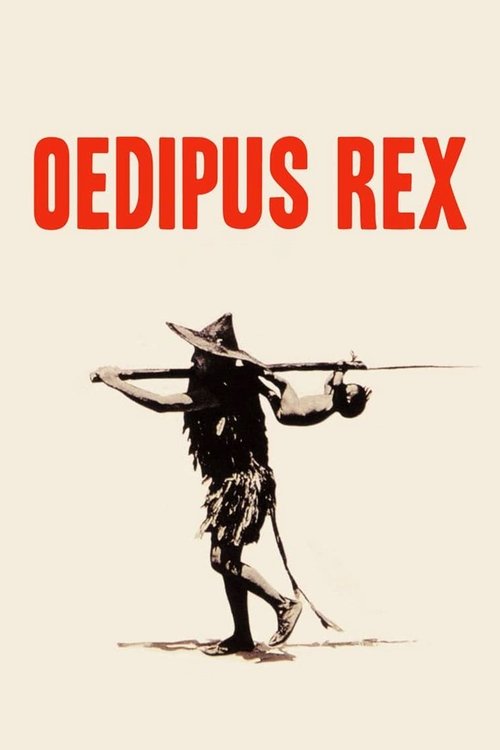
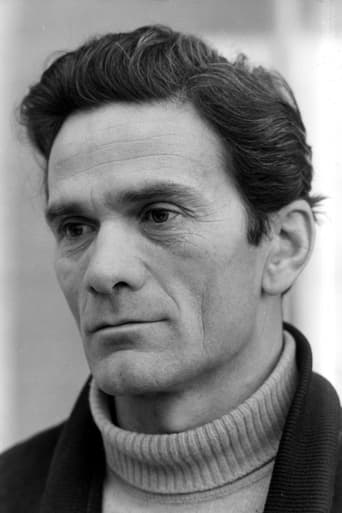
Pier Paolo Pasolini immortalizes the classic Greek work of “Oedipus Rex” by transposing it to all time, any place; but confronting a very specific evil. The Italian director chose to adapt the Sophocles tragedy as a way of grappling with the past of his own father, a Lieutenant in Mussolini’s fascist army. The tragedy, of a hero turned tyrant by the sexual urges within him, makes an adept framework of interpretation for this inner turmoil. Pasolini’s “Oedipus” at first appears to be almost laughably lost. Set in Greece, but clearly filmed in the Atlas Mountains of Morocco, it starts as misplaced as its wandering protagonist. Then, Pasolini’s mixture of medium and culture begins. Painting with the music, masks, and costumes of various cultures across the ancient world, “Oedipus” turns from belonging only to the Greeks, only to Pasolini, and becomes universal. Using much of the text from Sophocles’ work, the implication is artfully pristine. Oedipus, by lying with his own mother, also is choosing to embrace the aspects of his own id that derive from the corrupted desires of his father. Oedipus as King becomes not just the terror of Thebes, but a fascist tyrant to the world. But where Pasolini’s prior works have elaborated on sexual repression as a gateway to fascist fetishization, Oedipus, here, is also doomed upon his consummation of his inner desires. It is a complex and fascinating public psychological grappling by Pasolini; is a heart swollen with corrupted aspiration ever possible to be sanctified for good? “Oedipus” begs for another thousand years to answer the question.
Salò o le 120 giornate di sodoma (1975) was not the first time that the self-proclaimed cinematic poet Pier Paolo Pasolini borrowed classic literature in order to criticize the Nazi-Fascism of Italy. Remember that Salò is a toponymical metonymy for the Italian Social Republic (RSI), since such city was its seat of government during the last days of Benito Mussolini’s regime, making it a puppet state of Nazi Germany. He mixed the politics of Nazi-Fascism with Marquis de Sade’s book and created a furiously brutal criticism against the politics that pervaded Italy during its war times and during the aftermath of World War II.In Edipo Re, he is making a strongly autobiographical and free adaptation of Sophocles’ work showcasing his personal epiphany with Oedipus as a character, but he is also contextualizing the play under a viewpoint of timelessness. Hence, the film is applicable also to modern and future times. With this in mind, we witness Oedipus’ birth during pre-war Italy and concludes the story with post-war Italy. The development, however, takes place in a timeless setting easily attributable to a Thebes and a Corinth of 5th Century BC. The climactic exile is perpetuated for centuries in a way to symbolize that ideas in art and politics are perpetuated throughout time.These are the two main pillars of Pasolini’s personal cinematic vision towards the Athenian tragedy. One treats the politics of the time. Developing the oedipal complex, Pasolini is reflecting his personal experience as a son strongly attached to his mother because of the time that the generation of Nazi-Fascist fathers spent at war. His father was a soldier persuaded of the virtues of Fascism. The second pillar is the biographical face of the adaptation. Allegedly, actress Silvana Mangano, who played Jocasta, strongly resembled Pasolini’s mother. Watching Pasolini developing an oedipal complex through his personal identification with Oedipus as a parentless character bound to tragedy through incest and murder is nothing short of interesting, especially when you consider that Silvana Mangano was filmed in scenes of somewhat explicit sexual nature.The other topic I treated is the concept of a free adaptation. Pasolini is further developing the minimalistic tragic scope treated in the open-minded The Gospel According to St. Matthew (1964), but with an enhanced impressionism that begins to scratch the visually impressive realm of Kakogiannis’ adaptations of Euripides. However, Kakogiannis is purposefully being overtly theatrical, deeply respecting the ancient acting traditions of the performances on stage. Pasolini only displays this in the second act, but the first act employs images and political allegories to reflect the senselessness of human conflict. There is hardly any dialogue. The power of the image both embraces and communicates the power of storytelling in an enamoring duality. Suffice to say, the cinematography is so extraordinary that it is otherworldly ahead of its time. The role of the Chorus on the original Greek plays was that of highlighting unspoken emotions, unclarified actions, or explaining the tragic circumstances that were surrounding the characters. That role is subtly replaced with juxtaposed intertitles with a black font and a white background, as if reading the pages of a book, a wallpaper design that Pasolini would utilize later on.It is a bold cinematic piece of art, without the explicitness of the anarchic disorder of his later Arabian Nights (1974) or that of Fellini’s Satyricon (1969), which is a magnificent predecessor for Pasolini’s madness. It is loyal to the story but with a focus on the irrational and impulsive while being hypnotic in its pace and imagery, utilizing genital and phallic symbols to communicate the horrors of incest and murder. It is one of the best films of the year with an impeccable visual precision deeply rooted in the power of communication through an ambitious visual language that attempts to speak, primarily, to the Italian nation.94/100