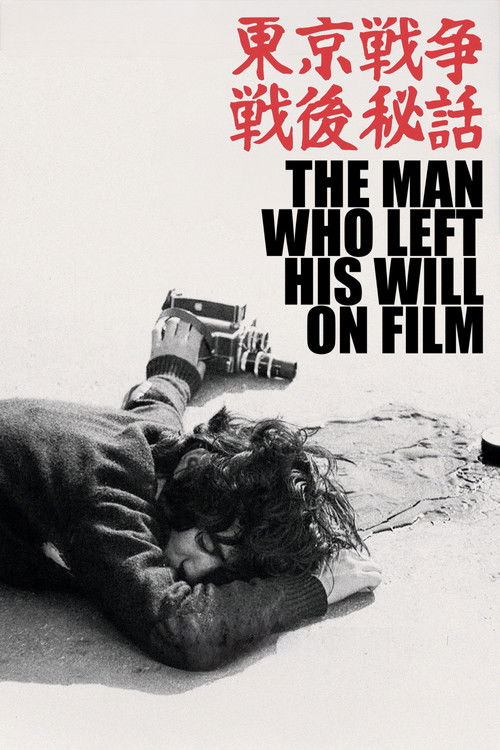


It would perhaps be instructive to start with the primary Japanese title, which references the period—a play on the Japanese word describing the period post WWII—after the so-called 'Tokyo War', in which mass protests were held, not just in Tokyo but in other cities as well, against the prime minister's visit to the U.S. The failure of this particular collective action, the endpoint of sorts for the student movements of the 1960s, is ostensibly one of the reasons why Endo, the young filmmaker whose subjectivity becomes ours during the film's frantic opening moments, leaps to his death, with his camera in tow. The other: the loss of faith in filmmaking as a revolutionary act.Not unlike Godard, Ôshima also has a tendency to weave an array of inquiries and insights around an image or situation. Here, the death prompts a comrade named Matoki (Goto Kazuo) to become obsessed with discovering the "truth" behind what happened. Along with Endo's lover Yasuko (Iwasaki Emiko), he reconstructs the dead man's journey using the film footage he left behind in the camera. It turns out to be a collection of random, supposedly meaningless shots of rooftops and streets. The contemporaneous 'landscape theory' by radical filmmaker and activist Adachi Masao, in which "all the landscapes which one faces in one's daily life, even those such as the beautiful sites shown on a postcard, are essentially related to the figure of a ruling power," remains out of his grasp.Ôshima leaves the possibility open that the death in the opening sequence was an illusion, perhaps to Matoki's own. Which makes his journey all the more haunting. Matoki tries to relive events in Endo's past, both political and personal, but the world around him keeps interfering. Unlike his often airless Brechtian experiments of the late-'60s and early-'70s, Ôshima manages to tell a little story here that pulsates with concurrent real-life associations and meanings. And he's conjured up some brilliant visual ideas. In one a naked Yasuko masturbates in front of the projector with the images shot by Endo playing over her body. Another, supposedly offering the point-of-view of Yasuko as she is being sexually assaulted in the backseat of a moving vehicle, has the landscape literally upside down—an impossibility, which turns the image into a symbol."I am not interested in making films that can be understood in fifteen minutes" Ôshima once stated. Co-produced by Sozosha, Ôshima's soon-to-be-defunct production company, and the Art Theatre Guild, which helped save auteurist cinema in Japan during the '60s and '70s, The Man Who Left His Will on Film is an aesthetically and ideologically rich effort that opens up the possibilities of the cinematic language and calls for the camera to be used as an active rather than a voyeuristic tool.