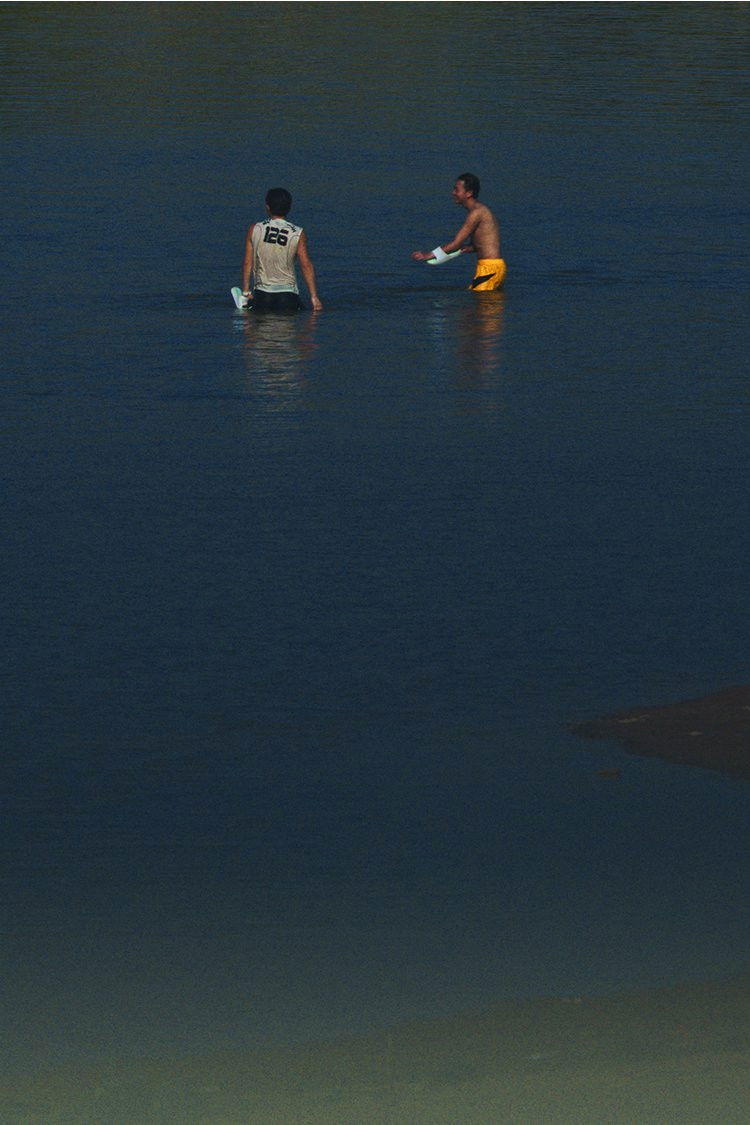




I saw a water-themed avant-garde film program last year and in the post-screening Q&A, director Greta Snider explained that our ears are hypersensitive to water in its myriad sonic possibilities. You can always tell a stream from rain drops from waves, you can always sense the intensity of oceanic movement, you can always get a feel for where the water’s traveling (e.g. falling from a gutter onto the ground, from a faucet into a sink).All this came to mind this while watching The Rib of the Greater Bay Area, a film that lets you hear and see so much, but also so little. Zhou slyly wavers between clarity and abstraction: there’s fuzzy static, revealed to be sprinklers amid flickering lights; we hear conversations of people on a boat, our view obscured by shrubbery; we see someone bathing, and it doesn’t sound so different from a man doing backstrokes. Zhou plays with our sense of assurance and confusion from the get-go, and the film’s visual style—a result of a telephoto lens turning the landscape into pure color—only amplifies this pleasant disorientation.Zhou films around the Greater Bay Area, from the Pearl River to Victoria Harbour. Its various locales are no stranger to tourists, and it’s hard not to think of all the fraudulence, harmless as it may be, that comes in presenting oneself via social media. I thought of this when the camera slowly pans to observe a boat, a structure obstructs our view, and when we reach the other side, a bird flies in frame—were these parts stitched together, or was Zhou just lucky? Really, it doesn’t matter. Before this, a bride and groom happily pose for a photo-op—it’s familiar and staged, obviously, but it’s still meaningful and real.Crucially, Zhou's images are stunning but also frequently ugly, and having both such scenes arrive with equal weight makes every scenario special. The aforementioned bride and groom are shot in a peculiar manner: the bottom half of the frame is a pale orange, like Zhou's got his finger over the lens. Elsewhere, resplendent footage of water looks alien and surreal, not dissimilar to the VHS rip (and not the 16mm print) of Stan Brakhage’s A Child’s Garden and the Serious Sea. The scrolling and abstraction largely reminded me of the seductive visual tricks of Vincent Grenier’s World in Focus and Closer Outside, as well as Ernie Gehr’s recent works. Digital flatness reigns supreme, though, and while there’s a certain formal attitude here, Greater Bay Area isn’t painterly like Sharon Lockhart or pointedly structural like James Benning.The result is something loose, freeing, fleeting. About 50 minutes into the film, we see the Panasonic sign that sits atop the Elizabeth House in Causeway Bay. It ruptures the beauty of everything we’d seen beforehand. Notably, Zhou doesn’t even shoot this sign at night; it looks resolutely crass, but not terribly so given that he masks the image and follows a bird flying in the distance. That juxtaposition of the elegant and natural with the corporatized and man-made triggers a subtle shift in mood for the remaining 20 minutes: we hear machinery, and people speaking in the distance, and other noises that have an impersonal, even ghostly tone.Zhou then shows people on their phones filming the water, their footage not dissimilar to his own. Then he shoots the back of heads, a selfie stick; they take in the scene through mediated means, and when they're done, they simply look down at what they shot. Shortly after, he shoots islands that look somewhat fake, the image gauzy enough that you’d think he was shooting a giant sign at an airport. And then it ends with the sky, the colors so blown-out that the light is a radioactive yellow. These final passages feel like an admission of how a lot of us exist now: abstracting reality as ostensible necessity. How else will you find beauty?