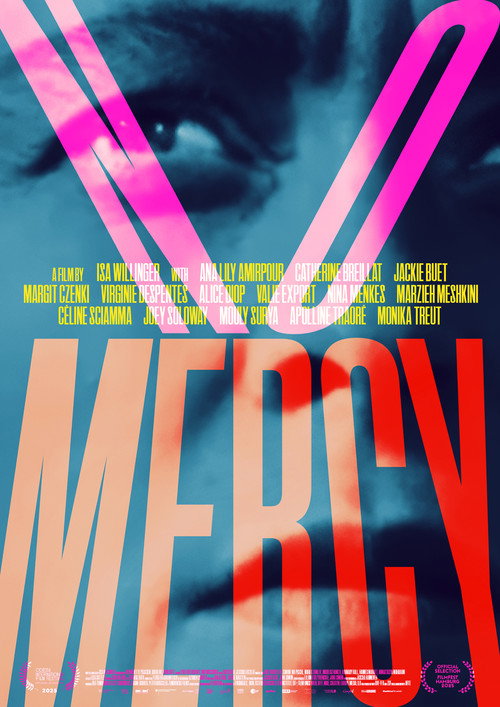





I'm really torn about this film. It tackles a very important subject and does so quite well, but it also dilutes itself for no reason with very questionable politics and a pretty meaningless central question: "Do women make more brutal films than men?" A question that, as the film itself realizes, doesn't make a lot of sense because you can neither quantify brutality/violence, nor can you shove all of female cinema under the same umbrella. The direction of this film is rock-solid, the editing is very energetic and I really liked the music. It's also pretty crazy how many of the big female filmmakers they managed to get. Hearing them talk was really fascinating and if the film does one thing exceptionally well, it's making me want to watch almost every film shown in here.But now to the politics (and philosophy): a contemporary feminist film should surely break with conservative gender norms and the idea of a simple, always progressing evolution of film history. But instead, No Mercy just changes one simplified narrative for another, and to support that narrative, the film doesn't care whether or not what it conveys is actually true. That leads to such absurd moments as when the film implies that the Rape/Revenge genre was invented by women, consists of basically just three films and started with Baise-moi. With stuff like this, the film isn't giving female filmmakers the platform they deserve, it just straight-up lies to the audience in order to tell a more compelling narrative.Something similar happens with their only mention of Alice Guy-Blaché. She is one of the most important early film pioneers (of any gender) and all she gets reduced to is one side comment about how "it was a woman who invented narrative films". Not only is that disrespectful towards her contributions to cinema, it also fails to deconstruct the idea that it was certain "great geniuses" that invented the cinematic language we all know today. In reality, many people invented narrative cinema at the same time, it doesn't help anyone to tell these half-truths. The most egregious moment however comes when one of the filmmakers that get a voice in this film tells a story about how she and her friends used to sexually assault men "because men did the same to us". And she's laughing as she tells the story as though she was reminiscing about her glorious days of youth. This is... fucking disgusting and the film never really comments on it. That's another thing I have to criticize the film for: it hides behind its supposed "neutrality" (which is another cinematic myth) in order to let all of these people say whatever they want and I'm sorry, but some of them say some really stupid things. The one about the sexual assault is by far the worst, but from sexism to casual transphobia, the film undermines its own message by not taking a clear stance or confronting any of the interviewees whatsoever. It's really sad, because there is such a great and important film in here somewhere. In its core, I really like what it's going for, but there's too much bullshit to simply be hand-waved away. It's still a good film, most of these examples I gave are few and far between, but they definitely sour the experience as a whole.