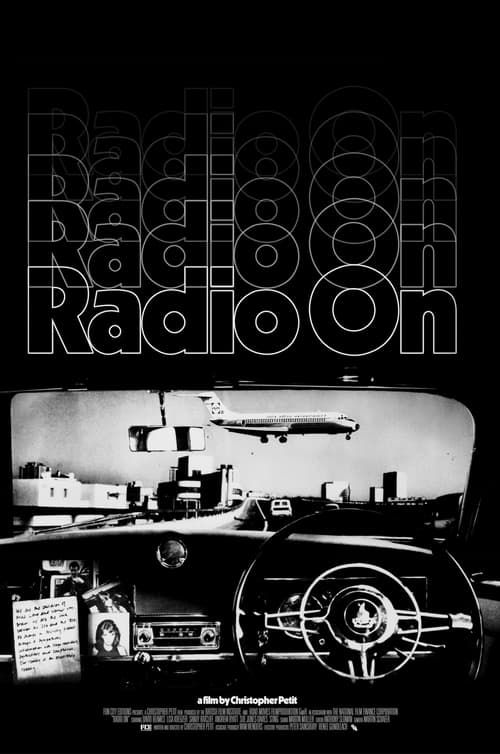
"Radio On" is a late 70's British endeavor about a search for meaning in a manner of ways. As the film is a great effort within itself and very purposeful in merit, there is a sense that the title of the film can be a presented misconception for some watching the film blind without research of context first. Possible misconception is more of a negative driver, rather it should be said that the title feels like plays upon two concepts. First is that of the face value "Radio On" feeling like we are going to get a musical endeavor, regardless of the tonal feeling of the film, we will be getting music at a constant to match. There is a bit of this energy, but far heavier the conceptional "On" in the title being more within the vein of soldiering on through the bleakness of it all, the finding of purpose, the theme of continuance when there is much reason to do so. It is with that energy the film really sets its pace.The narrative of the film centers around a DJ character, our proverbial "Radio", that is on a search for reason after his brother commits suicide. He progresses forward within his journey, only to come about varied off beat citizens within their situational soldiering on as they the characters and the main protagonist compare and contrast. In this tone, the film carries itself, as even though it's musical within assumption-based face value, in fact it's very bleak but intent on being metaphorical. Carrying with that, it holds its tone with cold black and white monochrome and the purposeful music on comes into fruition within spurts. The soundtrack is great, but not nearly as central as you would believe.Rather than musical base, the film actually is a commentary on British political stances within the time shaped and molded into the form of a Wim Wenders road movie. from '74 to '76, Wenders famously made a trilogy of road films searching for meaning within the existential vein, "Alice in the Cities" (1974), "Wrong Move" (1975), and "Kings of the Road" (1976) respectively. The infamous "Road Movie trilogy" is a banner inclusion within New German Cinema, a thematic style that was in turn used to establish style for "Radio On" and its generatic style even though it is centralized on British mentalities. It comes as no surprise that Wim Wenders is an associate producer on "Radio On" itself, drawing a clear connection that "Radio On" is complete in homage to Wender's prior works. As Wender created a trilogy on creating meaning within the "aimless journey", director Christopher Petit did the same with "Radio On"At the completion of the film, it is a powerful endeavor for a distinct grouping but runs a risk for many falling into a trap of misconception. It's clear on its defined purpose to bring one on a journey of introspection, just don't be looking for a journey through music at a constant. Far more often, it becomes a film of quiet reflection, an invite to read into the lyrical meaning and doing a review after having the song played. Afterall the film itself is built upon a journey of review after the loss of life, and so with an understanding of that first, one might be more inclined to appreciate the film for what it is rather than to be dissuaded within its actual muted tone with such a musical title.
Doc Lyon3.5
1st Chris PetitThe Midlands and North rendered eerily beautiful by luminous black and white widescreen cinematography. A man makes his elliptical way north to Bristol to piece together some reason as to why his brother killed himself, discovering that the destination was probably not worth the journey. More than anything, the plot feels like a thin excuse in which to conduct an extensive piece of psycho-geography on the state of England in the late 70s. It's a bleak place, filled with boredom, hostility and jaded apathy to all. Yet Petit manages, with the aid of a German cameraman and some rich shadows, to turn the rooms our lead wanders through into crepuscular beauty. One particular pub, cast in heavy shadow, takes on the appearance of a black and white Hopper painting, a truly memorable moment. It is a sad film, then, but one that revels in the gloomy alienation of the period, where the Troubles gripped the populace and the memory of the three-day week was still fresh in their minds. Petit's referencing of German New Wave Cinema, especially Wenders (who helped produce this) is crystallised in the character of Ingrid, who's backstory is a clear reference to Alice in the Cities. It's a snapshot of an exciting time in UK cinema, where the injection of money into the BFI and then Channel 4 led to novel new approaches to cinema from people like Petit, Greenaway, Davies and the Brothers Quay. Artistically pretentious? Absolutely, but brimming with an imagination not seen since the 40s. If I was less exhausted, I could construct a more coherent analysis of this film, one that does not give up its secrets easily but begs to be considered further. I will leave you with the fact that a low budget Brit movie was able to get rights to David Bowie's Heroes and three tracks from Kraftwerk. Imagine how expensive that would be today. How times have changed.
Jesse Snoddon3.0
"I'm off"Robert (David Beames), a London radio DJ, hits the road and heads to Bristol to find some answers after he gets a phone call telling him his brother has died. Robert's journey in the company of 3 Kraftwerk cassette tapes his brother mailed him as a birthday present and the car radio is reflective of a broader hurt and search for answers to unanswerable questions permeating the country in general. Robert can't understand the loss of his brother and why it happened. People sense something has been lost in England and things have changed in a way they can't explain. The parallel comes through in snippets of news over the radio at different points of the long ride that capture a specific socio-political climate, but without knowledge of the time and place it's difficult to completely 'get'. We can pick up on a feeling but are never really immersed in it. As a piece of socialcommentary wrapped in a personal experience though? Not bad. The description of the film, which lists it as a trip to Bristol to solve the mystery of his brother's death, is a little misleading. The death of his brother is the catalyst for the journey, but the narrative is never really all that engaged with that element. As a result, the film is curiously lacking an emotional centre. What we get in actuality is mostly a tour of part of Britain at the time, complete with gorgeously photographed countrysides and city streets (the foggy winter backroads in particular make for great visuals). Things are set to a slow pace and director Chris Petit doesn't mind lingering in the places where Robert stops and letting the music be the only thing we hear for long stretches without dialogue. There's no real urgency, it's a little aimless and can feel too buttoned down and reserved in a way that smothers feeling, but if you're in the mood to drift through a sad sojourn and watch the country go by it will scratch that particular itch. I think the biggest misstep it makes is setting the energy and tone level very high by using Bowie's Heroes in the opening credits. It's a great way to come in and a great track but the rest of the film just doesn't have that same energy. [Final thought - the sign that says we are the children of Fritz Lang and Werner von Braun, the missing link, is cool]
More like this
Common questions
What is Radio On about?+
A London radio DJ travels to Bristol to investigate the mysterious circumstances surrounding his brother's recent death.
Who directed Radio On?+
Chris Petit directed Radio On in 1979, a film noted for its unique visual aesthetic and iconic post-punk soundtrack.
Is Radio On a road movie?+
Yes, it is often described as an anti-road movie that uses the journey to capture the isolation and mood of late 1970s Britain.