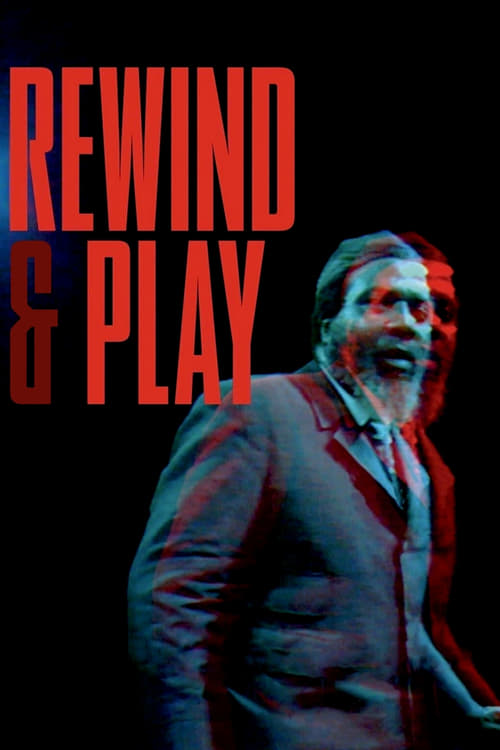
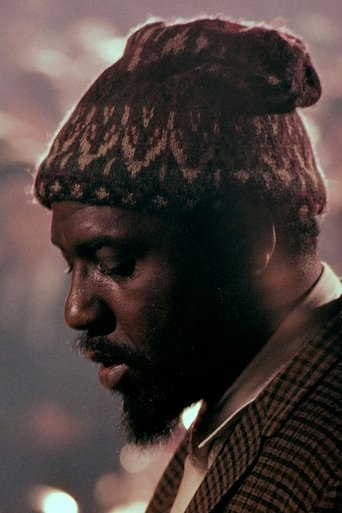
This is quite possibly the most uncomfortable I've ever been watching a film/documentary, and I recommend you watch it if you can.Imagine this.You are shy. Extremely shy. In fact, you don't like to talk, especially to strangers. And yet here you are, in a foreign country, being interviewed by someone who speaks another language (although he also speaks yours). You are a jazz pianist. Quite famous in some places.So here you are, for 1 hour, on a stage that is all lit up. Have you ever been on a lit stage? It's hot. Really friggin hot. Thelonius Monk is wearing a suit and a hat and he's got longish hair and a huge beard. And he's under the stage lights. So yeah, he's getting hot - like menopausal hot.He's sitting at a piano - a lovely piano. And he's just waiting... and waiting... and looking around... No one is saying anything. He's not sure what it is he's supposed to be doing. So after waiting around he has nothing else to do so he starts playing. Thelonious Monk starts playing. And you listen. You listen because it's kinda wondeful, whether you know Thelonious Monk or not. And still nothing from the people around him on this stage, so he plays again, and again.Finally something happens.The 'host' of the show leans on the piano and asks a question in French for the television audience and then again in English for you.But you don't like answering questions. You always defer to your wife. She does all of that.Oh, but you must. So the show host moves around a bit and repeats the question.You answer.Darn, the host was not in the right position. He leans back on the piano and repeats the question in French and then in English.You don't quite understand, it's the third time he asks you the same question.... but you answer as best you can.The host asks you a few more questions, one at a time, always in French and English, and always repeated 2, 3, sometimes even 4 times if your answer wasn't good enough.For 1 hour.Thelonious MonkIn a full suit with hat and full beardon a stage with a lot of lightsand never once was he asked if he wanted wateror a cigarette, which he cravesnothinghe is completely ignoredAnd when his reply to a question is too honest, they have to figure out how to ask it again to get a better answer. The answer they want. The answer that would make The French feel good.He never does give that answer.So they repeat. Again. And Again.He wants water.He wants a smokeHe plays.Can you play something a bit more "peppy"?He plays again.Is it the end soon?
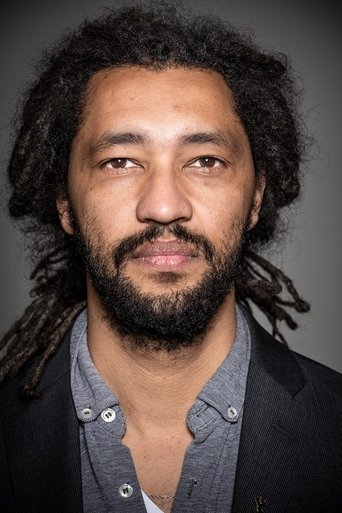
Though it has some occasional moments of radiant beauty, mostly found in Thelonius Monks' piano playing, this film is a brutal watch. To see an exceptional musical genius like Thelonius be slowly reduced to a piece of easily digestible entertainment for a white European audience is soulcrushing.It reminded me strongly of 'Meeting The Man: James Baldwin in Paris.' in which a Swedish TV-crew blatantly misunderstands and disrespects Baldwin while supposedly making a documentary about the writer. Though the two films bear some resemblance, there's also a major difference: Baldwin is a verbal communicator, Monk is a musical one. This means that he cannot defend himself from televised exploitation in the same way Baldwin could. Where Monk lacks Baldwin's verbal strenght to protect himself. He is however able to retain his dignitity through his music.It's here that Alain Gomis' film really shines. In this material, once used to turn art into commodity, he finds nuance and emotion. Both the vileness of the ignorant exploitation by the TV crew as the beauty of Thelonius' piano playing get beautifully highlighted in the editing. I really hope Gomis' film gets the attention it deserves and I'm already looking forward to seeing his passion project: the Thelonius Monk biography film he's working on.
One of the year's best films, Rewind and Play might best be characterized as a forensic documentary. French-Senegalese director Alain Gomis acquired the unseen rushes from an episode of the French TV program "Jazz Portrait," created and hosted by one Henri Renaud, an interviewer whose smug officiousness is matched only by his discomfort in his own skin. I haven't seen any other episodes of "Jazz Portrait," and based on what we see in Rewind and Play I am in no hurry to track them down. Because what Gomis shows us quite clearly is that this man's project, consciously or not, is to explain jazz, to make it palatable for the Today Show / Good Morning Britain crowd. And we see him do this by being both dismissive and condescending to one of the greatest artists of the last century.Thelonious Monk was in Paris following a brief European concert tour, and agreed to appear on "Jazz Portrait" although it's not entirely clear why. Renaud keeps referring to being in Monk's kitchen hearing him play twenty years ago, and while his repeated mention of this encounter makes him sound like an unironic version of LCD Soundsystem's "Losing My Edge" (I was there!), it's possible that Monk was trying to do an old acquaintance a favor. But the extended passages we see of Monk trying to deflect Renaud's inane questions are simply painful to watch. At one point during the taping, Monk gets up and implores the man to forget the show altogether. "Let's go get some dinner!" Gomis's presentation of the material, largely untouched, not only displays the technical mechanics involved in "making TV," although there's that. When Monk doesn't provide satisfactory answers to Renaud's questions, the crew adopts a plan-b mode, showing Monk playing during extended shots, and then later shooting B-roll with Renaud pretending to listen appreciatively. But more than this, we are seeing how a media apparatus deals with an artist it finds difficult or uncooperative. French TV is trying to sell a product called "Thelonious Monk," and the man himself is perceived as an impediment to that pandering. Renaud and "Jazz Portraits" want to create a simplistic biography for Monk that explains his art -- his relationship with wife Nellie Monk, his early study of classical music, a supposed rejection of his first compositions as too "avant-garde" -- and it's evident to Monk that it's idiotic.Rewind and Play would be fascinating enough if all Gomis did was deconstruct Renaud's project and highlight Monk's resistance to it. But because the producers could not accomplish the back-and-forth they wanted, with Monk playing a piece and Renaud's questions and comments explaining it, they ended up just letting Monk play. We hear classics like "'Round Midnight," "Crepuscle With Nellie," "Epistrophy," and more, and when we're given the chance to just listen to Monk, the formal meaning of his work is perfectly clear. From his skirting around the tonal center, to his use of keyboard runs and flourishes as punctuation, clearing the decks for a new musical idea, it's all right there. The fact that stagehands and lighting techs wander around him while he plays, as if he were tickling the ivories in some rundown piano bar, just shows that Monk could be brilliant under even the worst circumstances.Final thought: Renaud's treatment of Monk was indeed condescending, but was it racist? Perhaps; one could hardly imagine a TV producer treating a white cultural icon like this, and if they did, they'd probably be more inclined to give everyone involved a proper dressing-down. At the same time, it doesn't mitigate the specificity of racism to recognize that, after all, racism is a particular strain of human stupidity, and Rewind and Play is a document that displays great art's ability to transcend even the most absolute mediocrity.