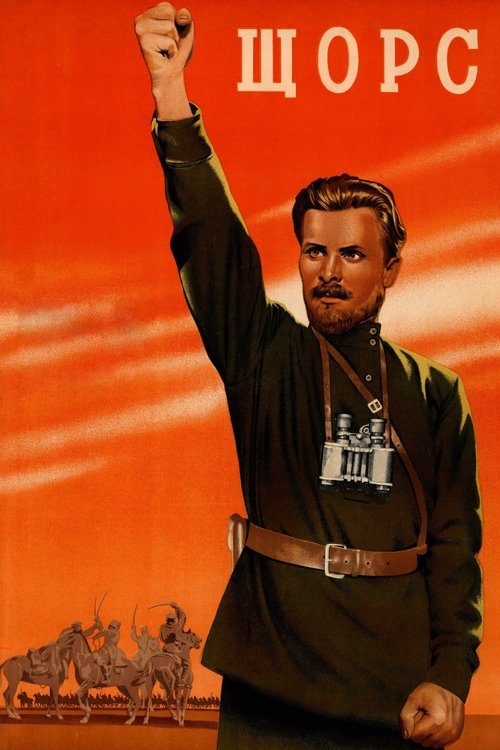
...Shchors lives as a film, despite everything, possibly because the autobiographical source of all Dovzhenko's films is frankest here. He had taken part in many of the military and political actions shown in the film. He knew the real-life models of every personage in it (no matter under what name)—and there is, of course, much of himself in the person of Shchors, a firm, determined intellectual who has pledged his being and talents to the new social order. As in all his best work, Shchors leaves in the memory burning images of death and of passionate life. To move from the pitiless ferocity of the opening to the tragic dirge of the close —both set in the same shattered fields—gives the film a wide form that can absorb any amount of speechifying. But all the rhetoric of the film is outweighed by moving pictures—riderless horses, smoking ruins of destroyed homes and lives, a boisterous wedding procession that jingles through a bombardment, cavalry through snowy meadows and icy avenues, military bands at the disposal of any victor, hand to hand struggle, riderless horses—pictures that pour across the screen...Jay Leyda (Kino - A History of the Russian and Soviet Film, 1960)www.youtube.com/watch?v=opwzbvCP9Mg
A quintessential Dovzhenko image—a sunflower rising in the foreground of an opening shot of a meadow, is immediately engulfed in the spewed Earth of artillery explosions. World War I is over but the aftershocks of the Russian Revolution are reverberating into Ukraine who are being torn at by Russia, Germany, and Poland to determine the outline of the emerging Soviet Union. Stalin commissioned the film as a valorization of Red Army leader Mykola Shchors “liberating” Ukraine, and Dovzheno’s propensity for gorgeous vistas and loving shots of people shot in heroic low angles with glowing, almost halo-like key lighting is as well-suited to the task as it is in his broader salutes to the Soviet common man. It’s remarkable how well Dovzhenko takes to the stodgier format of a war drama, particularly given the strain of Stalin’s personal oversight at the height of his Ukrainian purges. (Purportedly, the script had to keep being revised to remove more and more of the real figures depicted within it who were being executed at a rapid clip.) And yet, even operating under a level of stress that gave him a heart attack, all of the lyricism of works like Earth is on display here, if often sidelined for scenes of soldiers on the Red and White sides announcing their defiant wish to defeat the other. But even those have a compelling quality, not only for Samoylov’s magnetic, almost Capraesque performance but the way Dovzhenko finds ways to constantly illustrate the historical crossroads, of revolutionaries navigating maneuvers through hamlets where people still get around on horse-drawn sleds, or of them setting up posts in the lavish Old World chateaux they just got done fumigating of White Army officers or capitalist cabals. There’s a great moment near the end where they overrun such a place and the overwhelmed loyalist in charge tries to blot out the coming sea change by covering his ears to the sound of the reds bursting in, and the soundtrack briefly mutes with his gesture until he un-cups his hands and it comes roaring back.There are some stunning bits here, as when royalist army officers begin shooting themselves as they are informed of the tsar’s death, or of German troops promptly lowering their guns and greeting Russians as comrades in the global class struggle as Shchors urges them to return home and take on their own bourgeoisie. Combat scenes always find some pre-Malickian grace note, such as an attack on a supply train that juxtaposes exploding cars with livestock in one compartment fleeing from the carnage. The camera regularly moves among assemblies of revolutionary and loyalist forces while sparing glimpses at the idyllic villages being heinously crisscrossed with barbed wire and dug-in gun nests. Routinely, this feels like a late Soviet silent converted years later into a talkie rather than a bulky and rigidly controlled early sound film. The sky always has ample space in the frame around characters, and the endurance of nature in the face of man’s ruin undercuts the blunt force of Stalin’s image management with pure poetry.
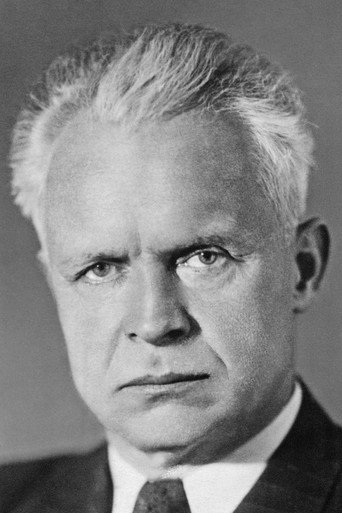
(The Soviet classics and obscurities marathon continues...)The epic Soviet biopic, Shors (aka., Shchors), intrigues immediately with a striking and thrilling opening scene of a peaceful sunflower field suddenly turned into chaos with artillery exploding all around. Oddly, the flowers seem to barely register the violence, vibrating softly from the falling dirt, as if nature is eternal through man's stupid wars. Suddenly, out of the thickets, men appear in full-on clash mode, and we see the targets of the artillery. The combat is savage and hand to hand. The time is 1918 in the Ukraine, and the fighting rages between Ukrainian independence forces and invading German interventionist troops. The politics behind it all is complicated, and, like most of the film, not very well explained, if at all. The battles encompass major overlapping events, the end of World War I and the Russian Revolution and the beginning of the Russian Civil War, and the alliances are labyrinthine.Out of the conflict, so the film posits, arose a great national hero, Nikolai Shors, who led the Ukrainian Bolsheviks to oust both foreign and domestic enemies from the homeland.The problem is,Shors is manufactured history, mostly fabricated from the mind of Joseph Stalin himself. Shors was a real man, but his role in the events depicted is heavily overstated. Stalin, along with the public, had loved the 1934 epic Chapayev (a good film, btw) centered around the revolutionary exploits of that eponymous hero, and wanted a Ukrainian version of same crafted from the glorious deeds of a Ukrainian military leader, and Shors was selected. And once it was, Comrade Stalin became the project's principal author.Poor Alexander Dovzhenko was "volunteered" to make the film (with co-directorial assistance from his wife, Yuliya Solntseva), helming a nightmarish project for almost four years that literally caused the man a nervous breakdown. Stalin and the Communist Party continually rewrote the script and dropped characters from the film as people cited in the film's story were literally purged by Stalin during production, in one case, resulting in a man being led away from the studio right in front of Dovzhenko and sent elsewhere to be shot. Dovzhenko himself feared the consequences of mere guilt by association.The film has long been listed in cinema survey books as an important one, including the 1940's editions of Paul Rotha's The Film Till Now. Notable contemporary reviewers such as novelist James Agee praised it, and positive assessments continued into the '70s by prominent film historian Jay Leyda, among others. In the internet era, online critic Chris Fujiwara listed it as one of the top five movies of 1939, calling Shors a revival of "the silent cinema's freedom of visual and narrative invention."Having watched it, sometimes with a growing sense of impatience, my feelings about it are mixed, but the effect of Shors on the psyche is not a healthy one. Its hero is an ideological maniac, humorless except in his very tight circle of friends; he's an anal-retentive prude who doesn't smoke or drink and who constantly barks orders and speeches with a voice that cuts through your skull. He's a fashion plate, never less than smashing in leathers, and if he wasn't this obsessed about perfect grooming in real life then Stalin and Dovzhenko certainly want you to think so.One wonders if this kind of fanaticism in the depiction of the leader was Dovzhenko's subversive swipe at Stalin. Or if Stalin, having infused himself into the character, was too un-self-aware to realize how unflattering it all looks.The film is concerned with the waging of war, through and through, and provides the viewer no real relief from it. Its sweeping panorama of the theaters of war is impressive, but the film's dramatic structure is predictably repetitive and episodic. Shors begins vigorously then falls into a catatonic rhythm, only invigorated by vivid battle scenes. It's as if Dovzhenko, having established narrative points acceptable to Stalin, repeated them over and over, just to get the movie done.The movie is a series of iconic-looking poses and sharply sculpted heroics, beautifully rendered, for sure, with alternating scenes of battles and episodes of Shors giving rousing stump speeches next to massive train engines billowing black smoke, or sitting around with his closest comrades in post-mortem private sessions of self congratulation and patriotic blather. The artful solidity of Dovzhenko's imagery makes you wish there was something more behind the Potemkin Village facade.For all its tiresome propaganda and hagiographic simplicity there are moments in Shors that made the experience of watching it worthwhile. The battles in Kiev depict urban warfare with a documentary veracity unmatched in any war film I've ever seen. Any time Dovzhenko goes outdoors, either to the steppes or the streets to depict the movements of armies, the film springs to life; the switch from politics to general combat seems to suit him. One early scene in the film shows the master director at his most poetic, as guerilla fighters slog through the lily and reed-laden brackish river and emerge from the fog-shrouded forest dappled in diffuse sunlight. These are painterly images. Another scene of grand spectacle and impressive logistics shows soldiers running en masse across an icy river in the background as horsemen in the foreground race across the snowy bridge above it, a staged perspective of warfare I haven't seen before. A battle near the end of the film takes place in the Vishnevetskvi castle, where Shors' troops have surrounded a regiment of Polish troops. The visuals of the battles inside the castle, with the combatants fighting astride rows of mounted knights' armour and wall murals of battle, are viscerally exciting; warfare being staged in a museum dedicated to it.Other great scenes include one where some troops are asked to "show their papers," and they lift their shirts to show their battle scars ("we have *different* documents"). At German HQ, a sassy soldier rants at his commander that working class Germans won't fight against the Bolsheviks, prompting an order to spear him on multiple bayonets in a grisly scene. When Shors and his men derail a German troop train, a captured officer tells him that the laws of war dictate he can only be tried by fellow Germans, whereby Shors rustles up some Bolshevik German sympathizers to try him.The attempt to humanize Shors in the film takes the form of his camaraderie with an old peasant soldier, Vasyl Bozhenko, who the commander refers to as "father." The other objective of the presence of this character is to show the heroic role that peasants played in the Revolution. But like most of the human-scaled stuff in Shors the relationship seems obsessive rather than humane, and even a little creepy whenever Shors looks at "father" with his maniacal gaze.Shors is a physically impressive epic, undermined by the circumstances of its creation, and despite fitfully moving moments it's sort of an ugly thing that leaves a nasty taste. The best way I can put it is that Shors is a major film but a minor achievement.(-K-)Previous reviews in the Soviet Classics and Obscurities marathon:***1/2 Aerograd: letterboxd.com/citizen_k/film/aerograd/**1/2 Tractor Drivers: letterboxd.com/citizen_k/film/tractor-drivers/ **** St. Jorgen's Day: letterboxd.com/citizen_k/film/st-jorgens-day/***1/2 Timur and His Team: letterboxd.com/citizen_k/film/timur-and-his-team-1940/**1/2 Accidental Meeting: letterboxd.com/citizen_k/film/accidental-meeting-1936/*** The Death of Dmitri Karamazov: letterboxd.com/citizen_k/film/the-death-of-dmitri-karamazov/**1/2 Golden Mountains: letterboxd.com/citizen_k/film/golden-mountains/**1/2 Peasants: letterboxd.com/citizen_k/film/peasants-1935/