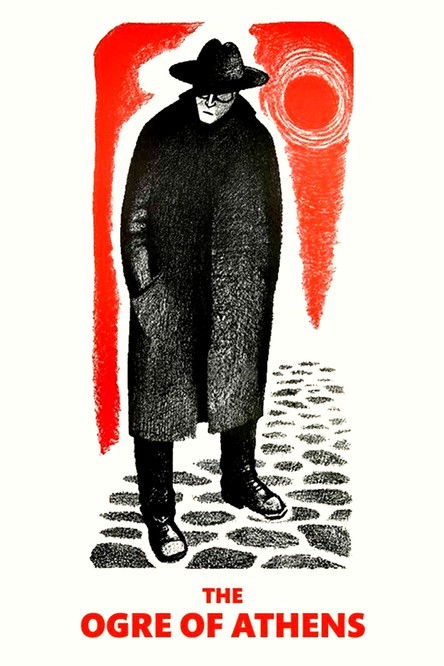
The one where a shy bank employee, Thomas plans to spend new years eve but gets mistaken for a criminal called "The Ogre" (The Dragon). This mistake changes Thomas’s life. Taken for the "Dragon", he's chased by the police and hides in a cabaret, where everyone thinks he's the real "Dragon". A dancer named Carmen protects him. Thomas never takes control and just goes along with events, which makes things worse. Despite his doubts, he joins the plan to steal the temple pillar, and enjoys a carefree New Year’s Day with Roula, and is later arrested by the police.. When they realize he's not the real "Dragon" they let him go. Back at the cabaret, the gang, believing the "Dragon" will escape from jail, prepares for the heist. When Thomas shows up, they celebrate and get ready. But soon they learn Thomas isn't really the "Dragon" and, in a tragic turn, they kill him. A very intriguing film and you can see how most of it reflects the political climate in Greece at the time, touching on themes of alienation, power, and how it’s used and abused...how regular people feel trapped by bigger forces.Koundouros looks at the difficult choices people face. Thomas is a really interesting character—just an ordinary guy caught in a bad situation, neither a hero nor a villain. The film doesn’t have rights or wrongs, but shows what happens when people care more about power than anything else. All in all, it’s a thought provoking Greek drama, unique with its take on alienation and how fear from the government affects people. It mixes neorealism, expressionism, and ancient Greek tragedy in a really interesting way. A real hidden gem!
Spoilers ahead.Fantasy is at the core of The Ogre of Athens. Fantasies of power; of love; of freedom. Every character is eager to pretend, embracing dreams that expand the possibilities of their worlds, or lay down roads to new ones. Whether they need a leader, a lover, or a simple purpose, everyone wants something else — not necessarily more, just something different — from a life that so far has offered nothing but disappointment.Tomas (Dinos Iliopoulos) is a lonely, unremarkable bank clerk, noteworthy only for his resemblance to a notorious killer and thief known only as 'The Dragon', for whom he is mistaken one night, just before New Year's. He's frightened and uncomfortable with the confusion, but it also means that criminals who were threatening him with violence suddenly see him as a hero, so he doesn't speak up. And the mistake gives Tomas a new life, one in which he's important and known; one in which he's not only respected, but revered.It also makes him worthy of love, the love of a girl called Baby (Margarita Papageorgiou), who builds her own fantasy on the foundation of the Dragon. For her, he's a man to be saved, one who uses stolen funds to support orphan girls, and who kills only when he drinks. With Baby in his life, she imagines, the Dragon will become a new man, reborn a law-abiding citizen thanks to the power of her attention and love. And Tomas, in turn, blossoms under Baby's affection for the man she imagines him to be, dreaming for the first time of a brighter future in which he matters; one in which he makes decisions for himself rather than humbly submitting to the expectations of his boss, his landlord, and his state.The relationship between Tomas and Baby is deeply unsettling, because there's a real sense she's being taken advantage of, but the perpetrator of the deception is largely her own imagination, not the man to whom she's attached. Everything between them is a dream, but not a shared one — instead, each imagines a partner with whom they're in love, with precious little regard for the reality across the table from them. It's heartbreaking and uncomfortable, but it also brings each of them such joy and optimism that, perhaps, the fact that their relationship is built upon nothing but sand doesn't matter so much.The same is true of the relationship between Tomas and the gang that adopts him — the Dragon — as their leader. To a man, they thrill to his arrival — without his even saying a word, the mere presence of such an important, powerful figure ensures the success of their biggest-ever heist, the one upon which the dreams of each man rest. All they needed was someone to whom they could pin their hopes, and the Dragon is that man. His presence compels the entire group into a cathartic, emotional celebration of life, a ritual they practice before each crime, just in case they don't come back. It's one of several stunningly beautiful dance-centered scenes in the film, and one that explicitly celebrates the importance of dreams as each man offers a prayer to his imagined future, fervently believing in the fantasy of the Dragon and his power to protect and inspire.In the end, however, each fantasy is torn down; every dream destroyed. There's a cruelty to the way the world smashes even the smallest gestures of the lower classes toward a better future, but one thing is clear: every single character would rather have had their dream and lost it, than to have never dreamed at all. And the care and grace with which the gang handle Tomas' body, once his dream is lost, is a reminder of the real people behind the fantasies; of the simple, generous humanity that resides within men, should they be allowed to express it.⏩ ☃️ Winter of (foreign language) Noir 🗡️*This is the 100th film in my foreign language noir project, and the final official entry. I might post a longer wrap-up eventually, but for now: it's been amazing to explore a sea of films I'd never have seen otherwise, or at least not gotten to for a long time. I'm working on a new project for spring, but this one will be hard to beat in terms of the way it's expanded my knowledge of and appreciate for directors, actors, and movements of which I'd previously been entirely ignorant. (I'm looking at you, Mexican Golden Age.)
Unlike your usual Hitchcock turn with the concept of "mistaken identity", Koundouros constructs a powerful statement of social critique. What if you had the chance of assuming a power and status that does not belong to you regardless of its reputation? It's the taste of greed, power and a more satisfying existence driving us to irrational behaviors. The Greeks will always be tragic in their outcomes, but this stunningly deep masterpiece, shot with visual experience, is a true work worth of reflection.99/100