
Music
EN
Claude Debussy
A nostalgic, polished classical artist.
9 followers
Tracks5
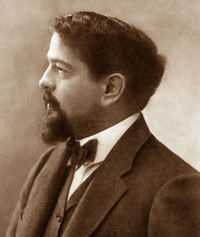
Claude Debussy (born Achille-Claude Debussy) was among the most influential composers of the late 19th and early 20th centuries. His mature compositions, distinctive and appealing, combined modernism and sensuality so successfully that their sheer beauty often obscures their technical innovation. Debussy is considered the founder and leading exponent of musical Impressionism (although he resisted the label), and his adoption of non-traditional scales and tonal structures was paradigmatic for many composers who followed. The son of a shopkeeper and a seamstress, Debussy began piano studies at the Paris Conservatory at the age of 11. While a student there, he encountered the wealthy Nadezhda von Meck (most famous as Tchaikovsky's patroness), who employed him as a music teacher to her children; through travel, concerts and acquaintances, she provided him with a wealth of musical experience. Most importantly, she exposed the young Debussy to the works of Russian composers, such as Borodin and Mussorgsky, who would remain important influences on his music. Debussy began composition studies in 1880, and in 1884 he won the prestigious Prix de Rome with his cantata L'enfant prodigue. This prize financed two years of further study in Rome -- years that proved to be creatively frustrating. However, the period immediately following was fertile for the young composer; trips to Bayreuth and the Paris World Exhibition (1889) established, respectively, his determination to move away from the influence of Richard Wagner, and his interest in the music of Eastern cultures. After a relatively bohemian period, during which Debussy formed friendships with many leading Parisian writers and musicians (not least of which were Mallarmé, Satie, and Chausson), the year 1894 saw the enormously successful premiere of his Prélude à l'après-midi d'un faune (Prelude to the Afternoon of a Faun) -- a truly revolutionary work that brought his mature compositional voice into focus. His seminal opera Pelléas et Mélisande, completed the next year, would become a sensation at its first performance in 1902. The impact of those two works earned Debussy widespread recognition (as well as frequent attacks from critics, who failed to appreciate his forward-looking style), and over the first decade of the 20th century he established himself as the leading figure in French music -- so much so that the term "Debussysme" ("Debussyism"), used both positively and pejoratively, became fashionable in Paris. Debussy spent his remaining healthy years immersed in French musical society, writing as a critic, composing, and performing his own works internationally. He succumbed to colon cancer in 1918, having also suffered a deep depression brought on by the onset of World War I. Debussy's personal life was punctuated by unfortunate incidents, most famously the attempted suicide of his first wife, Lilly Texier, whom he abandoned for the singer Emma Bardac. However, his subsequent marriage to Bardac, and their daughter Claude-Emma, whom they called "Chouchou" and who became the dedicatee of the composer's Children's Corner piano suite, provided the middle-aged Debussy with great personal joys. Debussy wrote successfully in most every genre, adapting his distinctive compositional language to the demands of each. His orchestral works, of which Prélude à l'après-midi d'un faune and La mer (The Sea, 1905) are most familiar, established him as a master of instrumental color and texture. It is this attention to tone color -- his layering of sound upon sound so that they blend to form a greater, evocative whole -- that linked Debussy in the public mind to the Impressionist painters. His works for solo piano, particularly his collections of Préludes and Etudes, which have remained staples of the repertoire since their composition, bring into relief his assimilation of elements from both Eastern cultures and antiquity -- especially pentatonicism (the use of five-note scales), modality (the use of scales from ancient Greece and the medieval church), parallelism (the parallel movement of chords and lines), and the whole-tone scale (formed by dividing the octave into six equal intervals). Pelléas et Mélisande and his collections of songs for solo voice establish the strength of his connection to French literature and poetry, especially the symbolist writers, and stand as some of the most understatedly expressive works in the repertory. The writings of Mallarmé, Maeterlinck, Baudelaire, and his childhood friend Paul Verlaine appear prominently among his chosen texts and joined symbiotically with the composer's own unique moods and forms of expression. ~ Allen Schrott, Rovi
New Claude Debussy dates land in the app first
Follow once, hear about them before tickets go on sale.


Similar Artists
Similar Artists

Music profile
energy
20
polish
80
commerciality
80
fashion
0
locality
60
nostalgia
80
queerness
0
age
60
Common questions
What kind of music does Claude Debussy play?+
Claude Debussy plays classical, classical piano - refined and atmospheric, rooted in tradition rather than chasing trends. Claude Debussy (born Achille-Claude Debussy) was among the most influential composers of the late 19th and early 20th centuries.
What are Claude Debussy live shows like?+
Claude Debussy's live sets are atmospheric and controlled - built around sound detail and dynamics rather than spectacle.
How can I find out when Claude Debussy is playing?+
Follow Claude Debussy on Mood to get notified when new shows are added. Mood tracks their upcoming events across all supported cities.
Not feeling it?All events in Athens