Next show: Brussels, Thu 19 Nov
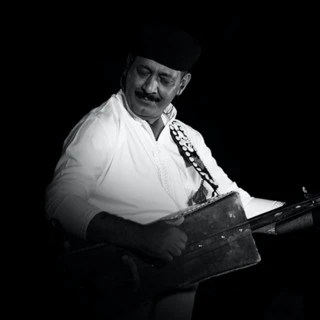
Formed in the late 60s, this Moroccan group’s repertoire contained self-composed poetry in the Melhoun style set to venerated musical forms, such as Sufi chants and Zaouias litanies. The band members sing and play various string and percussion instruments, including guembri, lute, bendir, derbouka, daadou’, ta’rija and tbila. Strikingly in post-colonial Morocco, the lyrics explored contemporary political chicanery and injustice. The founders of Nass El Ghiwane were Laarbi Batma (b. 1948, Oulad Bouziri, Chaouia, Morocco, d. 1998), Boujemaa Hagour, Omar Essayed and Allal Yaala, all of which had experience in music or theatre. Moulay Abdelaziz Tahiri was added to the line-up in the early 70s and Mahmoud Essaadi replaced Tahiri when he quit to form Jil Jilala, although he too would soon join that group. A strong if musically different replacement came with Abderrahmane ‘Paco’ Kirouj. Hagour died in 1974, the group continuing with Batma, Essayad, Yaala and Kirouj in their most stable line-up. The group was the subject of a documentary film, Al Hal (1981). In 1993 Kirouj left to be replaced by Redouane Arif. Laarbi died in 1998 from lung cancer and was replaced by his younger brother, Rachid Batma; later another brother, Hamid Batma, replaced Arif. In the mid-00s, Kirouj was paralysed and unable to continue but the band played on.
New Nass El Ghiwane dates land in the app first
Follow once and we’ll tell you when a new date is announced.
Nass El Ghiwane plays traditional Moroccan folk music blending Gnawa rhythms, Sufi chants, and Melhoun poetry with acoustic string and percussion instruments like the guembri and banjo.
Follow Nass El Ghiwane on Mood.
Nass El Ghiwane originated in the Hay el Mohammadi district of Casablanca, Morocco, in the late 1960s.