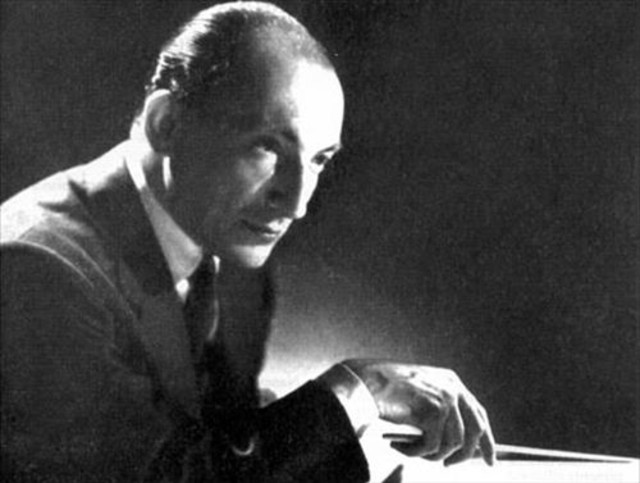
Even as critics and the public were beginning to complain that the elusive French style was waning, Pierre Dervaux was leading performances of grace, elegance, and meticulous detail. By his early 30s, the conductor/composer had demonstrated the ability to get the best from his musicians and singers while infusing works with compelling urgency. Dervaux presided over the premiere recording of one of the twentieth century's most enduring operas and was an accomplished composer in his own right. As a pedagogue at Montreal's Conservatory, the École Normale in Paris, and the summer academy at Nice, he exerted a positive influence on a succeeding generation of conductors. Dervaux's training was thorough: at the Paris Conservatoire, he studied counterpoint and harmony with Marcel Samuel-Rousseau and Jean and Noël Gallon and piano with Isidor Philipp, Armand Ferté, and Yves Nat. He began his career as an assistant conductor at the Opéra-Comique in Paris in 1945. His podium debut, however, took place with the Orchestre Pasdeloup in 1947, an occasion that won the young conductor considerable recognition. Subsequently, he was appointed vice president of the Concerts Pasdeloup and remained in that position until 1955. Meanwhile, the same year he first appeared as a full conductor, Dervaux was engaged as principal conductor by the Opéra de Paris, where he continued until 1970. During this time, Dervaux was entrusted with the June 21, 1957, Paris premiere of Poulenc's Dialogues des Carmélites. The following January, Dervaux conducted the first recording, a standard-setting studio performance with Denise Duval, Régine Crespin, and Rita Gorr. In 1968, Dervaux was engaged as musical director of Québec's Orchestre Symphonique and remained there until 1971, when he was appointed music director of the Orchestre Philharmonique de Pays de Loire. In 1978, coinciding with his teaching at the Nice Academy, he began a four-year engagement as music director of the Nice Opéra. During his career, Dervaux appeared as guest conductor with many orchestras in other parts of Europe, in America, and the Far East, but always devoted himself primarily to those institutions with which he was engaged. His compositions include several concertos, two symphonies, and various chamber and solo piano works.
Get notified the moment Pierre Dervaux announces a new show.

New Pierre Dervaux dates land in the app first
Follow once and we’ll tell you when a new date is announced.
Pierre Dervaux specialized in classical and operatic music, renowned for his interpretations of French repertoire with major orchestras. Follow Pierre Dervaux on Mood.
Pierre Dervaux served as principal conductor for the Opéra de Paris and the Opéra-Comique, and musical director for the Quebec Symphony Orchestra and Orchestre Philharmonique des Pays de Loire.
His notable recordings include Bizet's Les pêcheurs de perles and Berlioz's L'Enfance du Christ.