Next show: Amsterdam, Mon 28 Dec
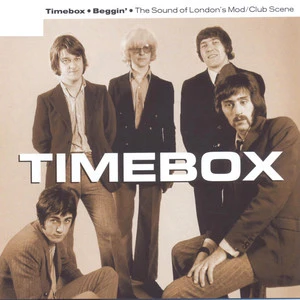
The roots of Timebox lay in local band Take 5 in 1965 in Southport, a small northern English coastal town (situated near Liverpool). After a succession of interpersonal incidents, which led to the vocalist quitting, the band was left in disorder. Fellow local act the Music Students (who featured 15-year-old drummer Peter Halsall, a great drummer who was also proving himself on a majesty of other instruments) were facing similar problems. Halsall, Chris Holmes (piano), and Kevan Foggerty (vocals) teamed up with Clive Griffiths as Take 5 and, very soon after, turned professional and headed towards London. Taken under the wing of the George Cooper agency, they were soon working on package tours with the Kinks, the Small Faces, Tommy Quickly, and Lou Christie, as well as striking up a residency at the legendary the Whiskey a Go Go. With two singers leaving (Liggett quit, then Frank Dixon unfortunately contracted tuberculosis) U.S. singer John Henry was drafted in and the band changed their name to Timebox -- an American term for a prison cell. Signed to Piccadilly in February 1967, their debut single, "I'll Always Love You" b/w "Save Your Love," produced by John Schroeder, was released and displayed an early jazz-tinged, soulful talent. Following this, more turns of fate occurred, with ex-G.I. Henry being whipped back off to the U.S.A by officials and Dean going down with tuberculosis (a spooky repeat). That April, the strictly instrumental 45 "Soul Sauce"/"I Wish I Could Jerk Like My Uncle Cyril" showed the band walking similar lines to Manfred Mann: airing competence but little imagination. Mike Patto, who had played with the Bo Street Runners and the Chicago Line (along with ex-Pretty Thing Viv Prince), joined Timebox after a few illustrious jams and took on a prominent role as vocalist and songwriter. When yet another drummer (Foggerty) quit, things once again went astray; luckily, however, the stool was soon filled by ex-Felder's Orioles' drummer John Halsey. Peter Halsall (now commonly known as "Ollie") was displaying a high degree of aptitude on guitar, as well as regular diversions into the vibes. His trademark sound of both searing guitar and mellow vibes was to the fore in the ensuing records. Timebox soon became a hot live act. Many who saw them claimed Timebox to be one of the first rock bands in London to really explore jazz in a rock context. A wonderful performance at the Windsor Jazz Festival on August 12, 1967, caught the eye of Decca producer Gus Dudgeon, who immediately signed them to the label's subsidiary Deram. The first 45, a fantastic version of Tim Hardin's "Don't Make Promises," was backed by the even better Ollie original "Walking Through the Streets of My Mind," which combined sharp blue-eyed soul harmonies with a psychedelic arrangement. The follow-up -- again a classic example of British soul -- was a cover of the Four Seasons' "Beggin" and reached number 38 in the charts. At the sessions that produced the hit, a slew of unreleased material -- some of the band's best -- was also recorded and airs the beginning of the Patto/Halsall songwriting partnership. All of these unreleased songs are compiled on The Deram Anthology and are essential listening for anyone with the slightest interest in quality late-'60s rock. The problem was that even Deram viewed Timebox as a pop band, and so the more experimental songs were left in the can while the silly sing-a-long tune "Baked Jam Roll in Your Eye," written for fun when the band members were drunk, was the next release in March 1969. It's styling was a little too late for the era of novelty psychedelia, and of no interest to the more rock-oriented record buyer; the flip-side, the tough "Poor Little Heartbreaker," would have been a far better choice. By the summer of 1969, things were turning sour. The final release, "Yellow Van," was a great record and polite enough for airplay, but was banned due to the nature of the lyrics. This really was the end of the road for Timebox who had had a hard time at the best of times. The nucleus of the band merged into Patto, who released three albums in the 1970s. ~ Jon "Mojo" Mills, Rovi
New Timebox dates land in the app first
Follow once and we’ll tell you when a new date is announced.
Timebox plays 1960s psychedelic pop and blue-eyed soul, blending mod sensibilities with jazz-rock arrangements on releases through Deram Records. Follow Timebox on Mood.
Timebox built a reputation as a fierce live act, notably exploring jazz within a rock context at venues like the Whiskey a Go Go and the Windsor Jazz Festival.
Timebox formed in October 1965 in Southport, Lancashire, evolving out of the local band Take 5 before relocating to London.