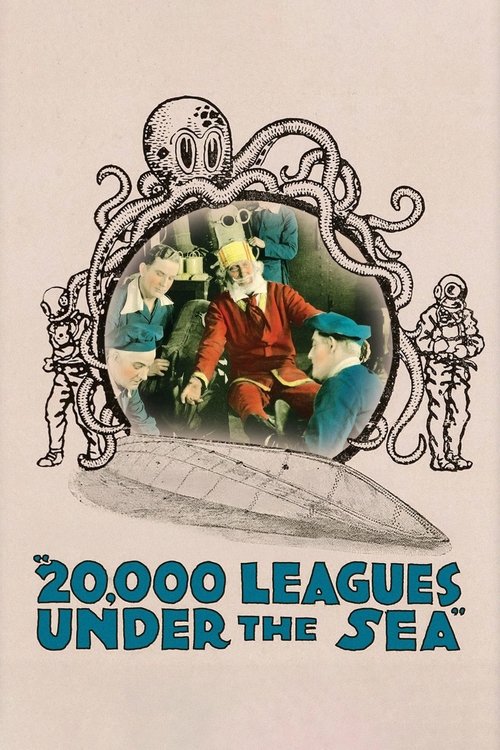
You can see that producer Carl Laemmle made a valiant attempt in his 1916 adaptation of Jules Verne’s 20,000 Leagues Under the Sea. It has a plot. There are interesting model and location shots. The story is linear. But the languid pace really drags it down. The interesting element of the film is the use of a complex system of tubes and mirrors to achieve underwater photography without submerging a camera. This was the first feature length film to include this kind of footage. It’s a highly innovative technique and results in legitimately interesting images. That said, there’s a limit to how long they can hold a viewer’s attention. So for a modern audience 20,000 Leagues Under the Sea is more of a historic artifact than a legitimate fantasy film.In the public domain, it streams on its Wikipedia page and elsewhere.
Where 'cinema of attractions' went to die -- this movie capitalizes fully on then-new developments in underwater photography to show 1916 audiences something that 99% of them had never seen.It also makes up a whole bunch of irrelevant plot points, including filling in all of Cpt. Nemo's backstory. I guess Verne's outline didn't leave room for any romance or suchlike boy/girl doings, so they throw in a bunch of stuff that vaguely reminded me of Melmoth The Wanderer.
A rumored sea monster has been wreaking havoc in oceans around the world, prompting an expedition by a United States naval ship. When the boat is sunk by the “monster”, actually a remarkably designed submarine called the Nautilus, Professor Aronnax, his daughter, and a famous harpooner, Ned Land, are taken prisoner by Captain Nemo, an enigmatic figure played by Allen Holubar. As Nemo takes his unwitting guests on an unforgettable voyage, showing them the wonders of the ocean floor, Union Army soldiers are marooned when their balloon lands on a mysterious island, where they encounter a woman who has been surviving in the wild for many years. When these two scenarios ultimately cross paths, the captain's tragic past is finally revealed in full.As one might ascertain from the above summary, the 1916 American silent film, 20,000 Leagues Under the Sea, directed by Stuart Paton (The Gray Ghost), combines source material from the 1870 Jules Verne novel of the same name with passages from Verne's 1875 follow-up, Mysterious Island, along with unrelated plot developments that are inexplicably ushered into the fold. The end result, the first movie to feature underwater photography, thanks to the clear waters of the Bahamas filming location, is a marvel of technological innovation from brothers George M. Williamson and J. Ernest Williamson. The undersea footage in question is a joy to watch, especially during a sequence featuring an octopus attack.The meandering script, which constantly introduces new characters without following through on their respective arcs, is notably less impressive than the visuals. I never became outright disinterested in the tale, thanks to the central submarine storyline, but I was left hanging a few times by the mostly unmemorable actors and by the prospects of a couple of romantic relationships that never come to fruition. Holubar's Nemo is portrayed in blackface, a practice sadly common for the era, as an East Indian character, further adding to the bewilderment factor, although the concluding battle scenes from his past are brilliantly depicted.If you are looking for a faithful adaptation of the Verne novel, then I recommend sticking with the still-breathtaking 1954 Walt Disney version of 20,000 Leagues Under the Sea. This 1916 predecessor succeeds as a visual effects milestone while bringing nothing more in particular to the table.