






"If you give a hungry man a loaf of bread, that's democracy. If you leave the wrapper on, that's imperialism!"
In occupied Berlin, an army captain is torn between an ex-Nazi café singer and the US congresswoman investigating her.
A Foreign Affair is showing in 1 cinema in Berlin - next screening Sunday 18 October at 11:00 at Delphi-Filmpalast am Zoo Kino.
Next screenings: Sunday 18 October.
Full schedule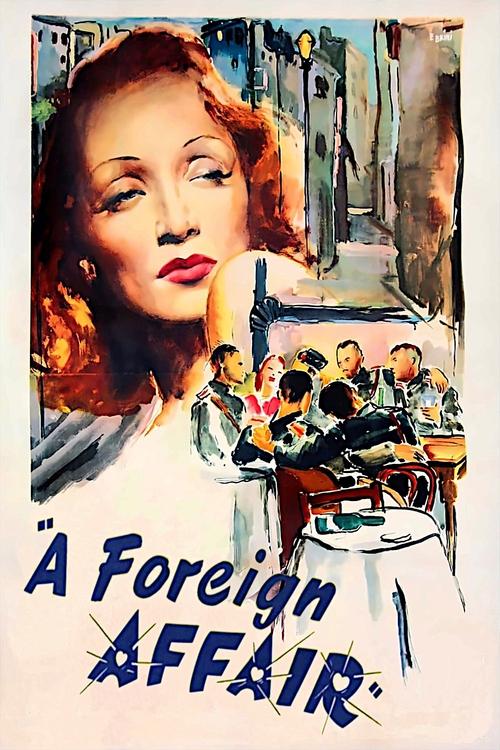
A Foreign Affair showtimes, refreshed every morning
Pick your cinema, get a nudge before it leaves screens.
"If you give a hungry man a loaf of bread, that's democracy. If you leave the wrapper on, that's imperialism!"

so a republican, a nazi, and some dude from iowa walk into a bar

A Foreign Affair is the rare Golden Age movie you cannot take at face value. It is nothing like what it appears to be on the outside, much less what the awful synopsis on Letterboxd indicates. Billy Wilder molded a wittily painful, comic-tragic story into one ingenious whole, fusing two genres seamlessly. He placed two actresses dissimilar in style (but definitely in a league of their own) at the symbolic gist of his two intertwining stories, and spread out his yarn according to the two mindsets, two outlooks on life they personified on the bilateral scale of post-WW2 reality: Jean Arthur epitomizing the American dream, the naive hopefulness and ever-blooming positivity of life, Marlene Dietrich the oh-so-European realism, tinged with heavy notes of dripping irony and a sense of nihilistic skepticism.Dietrich once again proved why she is my favorite actress as she made another precarious career choice and pulled it off flawlessly. Here she plays an ex-Nazi who lost everything after the war: her wealth, her position, her integrity; and who sacrifices every abstract value for the necessary, the most crude, the most real aspect left her in life: physical self-preservation. At the same time, she desperately tries to retain the last grain of her self-imposed dignity slipping away from her, chasing it endlessly like a bloodhound for one cardinal reason: it is the only thing she can still call her own. She uses sarcasm in her everyday conversations to hide her pain on the inside and to appear as a strong, impenetrable wall on the outside. She seems tough, hardened, and seasoned in dealing with the hardships of life, but suffers deep down.Dietrich's character is counterpoised by Jean Arthur, who seemingly plays her exact opposite but in truth shares her traits and is Dietrich's American counterpart: she is an unflappable, matter-of-fact congresswoman on the outside and a romantic dreamer on the inside. Her childlike playfulness and unsophisticated candor were like a dash of innocent enthusiasm after a bucket of ice cold water being poured on you. Billy Wilder is methodical in his approach, but A Foreign Affair would be nothing without its two female leads. Arthur and Dietrich breathe a terrifying authenticity into their respective roles, and since the bidirectional story springs from their symbolic roles, they make the whole post-WW2 environment the movie depicts incredibly authentic; and painfully real. (Also, I don't know if you guys noticed, but I could finally write a 'normal' review of a Jean Arthur movie. Milestone!)
In occupied post-war Berlin, an American army captain becomes romantically entangled with a suspected former Nazi nightclub singer while simultaneously trying to avoid a visiting US congresswoman who is investigating her.
It was directed by Billy Wilder in 1948, known for his sharp satirical comedies and dramas from Hollywood's golden age.