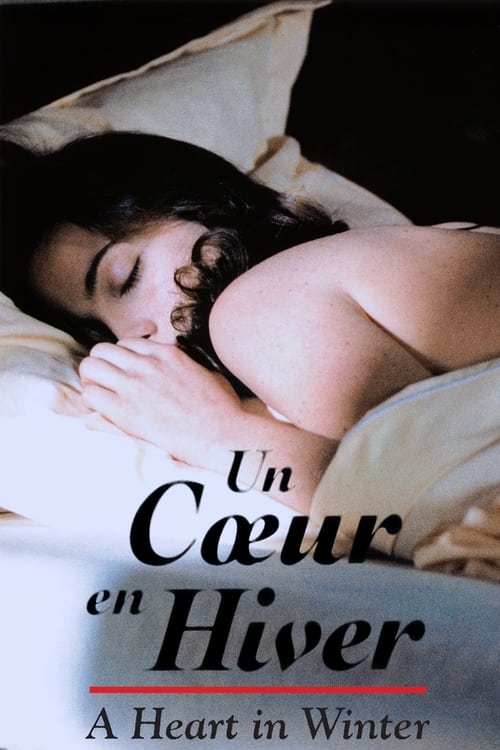
It's really hard for some people to feel things. They say, music has a certain quality to heal the soul but isn't music made from stuff from dreams? What if the music can't heal a soul that has already died from the inside long ago? Claude Sautet's A Heart in Winter is a terrific character study of a man who simply can't love. A well-crafted psychodrama that centers around a heart-shattering performance by Daniel Auteuil.
"In speaking, one risks sounding stupid. Not speaking, one may appear intelligent.""Maybe one is simply afraid.""Afraid of what?""Of yourself, perhaps.""That must be it."Women Film Editors #154: Jacqueline ThiédotAfter watching TÁR, I found myself sifting through memories of my past as a violinist. Years spent in orchestras, how I wished I could be invisible in concerts to curb the stage fright, the times when I brought my instrument to Gregory Singer (trivia that always delighted me: twin brother of the actress Lori Singer, younger brother of Beastmaster Marc Singer) for repairs. Forever infatuated with some fellow performer or another who surely never knew I was alive, while I tried to express my feelings in (probably pretty awful) poems and short stories. Violin always seemed a more sensual experience than I could ever articulate off the page - all a player ever thinks about is fingerings, the constant changing of positions, the right vibrato technique, etc., etc. - and I stop to wonder whether my life now is really any different. All reveries, no reality.There were so many of those habitual hundred-word stories that I scribbled on scraps of paper that I threw away out of frustration, but this one I kept (even back then, unable to resist a good semicolon):The rehearsal space is the size of the distance between us. No tape or ruler would say so, for it is only the dimension I imagine from section to section. Our duet for violin and viola reverberates, but the melody is only in my head. Time isn't counted in the hours passing; it's measured in each cut of maple, every caress of rosin, the strokes of bows against strings. What happens if our eyes meet? I look away. How easy it is to forget to breathe when the room starts spinning, held in place only by the music we play.Not unlike many a high school quarterback, I peaked as a violinist when I was a teenager. The best moment in my entire existence as a musician was when I played Massenet's Méditation from Thaïs (or as my grandfather liked to refer to it, Medication for Thighs) from memory at seventeen; there was a day when my English classroom was almost completely empty - everyone else was out at a yearbook-signing assembly - so my only audience was my teacher and a classmate, Nick, who'd walked in with a copy of The Metamorphosis tucked under this arm. (I remember this distinctly; he offered no applause, but started a conversation with our teacher about Kafka when I finally put my violin away.) But in those minutes, when I poured as much of my soul into the Massenet and a bonus bit of Rachmaninoff that I'd been working on too, I felt more like an artist than ever before or since. I won't pretend that I was even a fraction as brilliant as, say, this interpretation by Ray Chen - a prime example since I enjoyed seeing him live last year - but I can dream of it as true.All this to say that I reflected on many things as Claude Sautet's Un cœur en hiver glided by and a gentle rain tap-tap-tapped on my window. I could identify with Emmanuelle Béart as she marvels at the purer sound on her fixed-up violin with its newly carved bridge and adjusted fingerboard (note also that a lover remarks that she "reveals herself only when playing"), still able to recall the worst critique she ever received from an instructor ("Your bow scratches like a pumice stone rubbed on a parquet floor."); I also saw shades of myself in Daniel Auteuil, the luthier who believes that "music is the stuff of dreams" and for whom the idea of a relationship seems just as illusory. And more thought was given to Jacqueline Thiédot's editing in the first Ravel practice scene as, like the performance itself, a matter of pace, arranging the shots like music notes. Subtle, yet crucial. The tempo of emotions that can't be spoken aloud.What is it that warms a heart perpetually in winter, anyway?"I realize it can happen, loving someone."Women Film Editors: A Journey