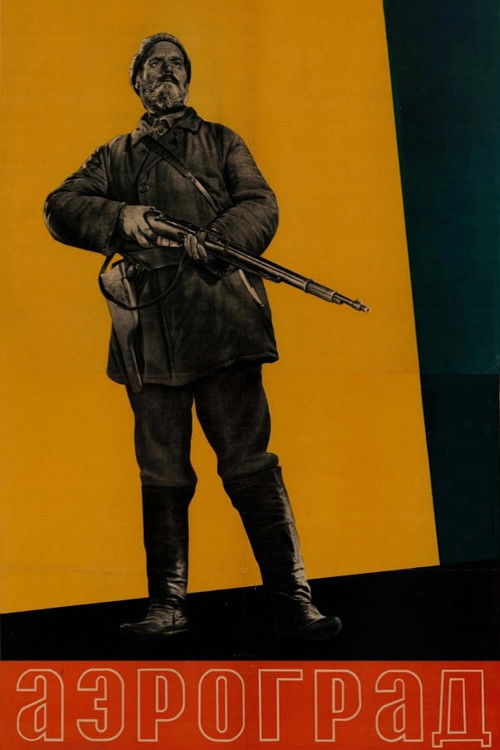
5th Alexander Dovzhenko (after Earth, Arsenal, Ivan and Ukraine in Flames)Sci-fi April #10, Pt. 7Science fiction only in terms of no-one has ever spoken like a character from Aerograd. I’m not even sure what genre this is; Western? Action film? Socialist Realism? It’s a series of long speeches delivered in the most emphatic tone possible, even if the subject is the absolute despair at modernity felt by the head of a religious sect. He’s probably the most interesting figure here, a man so absolutely horrified by what he sees as the Soviet threat that he’s willing to collaborate with the Japanese (two grotesque caricatures of Japanese, coming right up) to ensure that his sense of order is protected. The connection between him and his old buddy Stepan, who of course is a loyal Soviet partisan, is curiously articulated through fourth-wall breaks in borderline Andersonian framing that take the narrative past distanced and into absolute abstraction. Of course, it’s meant to be a dialectic, the clashing of two positions and a synthesis appearing (to whit: if your mate harbours fugitives, shoot the bugger) but there’s something to be said for narrative cohesion in what feels like an endless mass of loopy, gloopy scenes all squidged next to each other. Nevertheless, I do find myself strangely moved by Dovzhenko’s beautiful Taiga and the promise of an ethnically-integrated USSR, albeit with the caveat that anyone outside the USSR’s borders just seems to hate the game. An addendum: what with Dovzhenko, then Eistenstein, then Pasternak, did Stalin just enjoy taking artists in trouble and patronising them only to the extent that he had them wrapped around his finger?Alexander Dovzhenko in Order:1. Ivan2. Earth3. Arsenal4. Ukraine in Flames5. Aerograd
(The Soviet classics and obscurities marathon continues...)Alexander Dovzhenko's Aerograd (aka., Air City or Frontier) has had a tenuous hold in the international film canon. I've known about it for 40 years, back to a time when it was routinely listed in film books as a great classic, and in that time it has slipped into even greater obscurity among cinephiles, and all the while I've somehow managed to avoid watching it.Now that I've seen it, it's easy to see why it has been forgotten. It's a very strange, episodic work, quite viscerally beautiful throughout with a rugged sort of charm, sometimes approaching five-star masterpiece stature in brief moments before repeatedly deflating itself in utterly bizarre turns that have you scratching your head.Many of these moments seem to be comical, as if Dovzhenko is trying to subversively undercut the seriousness of the drama and the stridency of the propaganda, perhaps as a fuck-you to Stalin. Or, maybe it's just a Russian thing that I don't get.As a propaganda effort, Aerograd is fairly ambitious. It strives to promote the importance of the Eastern Siberian taiga (forests) region near the Pacific Ocean and that the enemy Japanese must never gain a foothold in it, that the Asians and Russians living in the region be considered patriotic adjuncts to the Red Army, that Russians and Asians in the region can intermarry to solidify the national bond, that "Old Believers" of Christians living in the region are enemies of the state colluding with the Japanese and must be fought, that the Soviet Air Force will be a major factor in securing the region, and that a futuristic air force base should be built there for said same purpose.The basic story of the film revolves around the impending construction of a gleaming airport city of the future on the Pacific coast called Aerograd, and the battle among pro- and anti-Soviet forces over the territory where the proposed project is to be built. Oddly, this utopian speculative fantasy aspect of Aerograd has caused it through the years to be classified, wrongly in my view, as a science fiction film, when in fact it's much closer to a western. The constant statements throughout the film that Aerograd is "something that SHOULD be built," sound like Stalin trying to sell such a project in reality to the Soviet people. But, why would he have have to do that? He could just do it if he wanted. The need to insist on it baffles me. Or maybe it was just a blank check for any future project, since I have no evidence such a project was ever really on the table. If it's a fictional film, wouldn't the characters say Aerograd "WILL" be built?In both setting and certain dramatic details, Aerograd bears some superficial resemblance to Akira Kurosawa's epic, Dersu Uzala. In its visualization of the Asiatic frontier, it evokes comparison to Pudovkin's (much superior) Storm Over Asia.The film's main character, Stepan, an old Russian tracker with the fearsome nickname "Tiger Death" because he once killed a big cat with his bare hands, is a legend in his neck of the woods; a man who can "read the taiga" like the back of his hand. The character has been compared to John Ford western heroes; not surprising, as Stalin himself was an enormous fan of westerns and of John Ford in particular.Stepan lives in a backwoods village with a nagging but loving wife and his daughter-in-law, an indigenous Asian Chukchi woman, and her child, the offspring of Stepan's son, Vladmir, a hotshot pilot in the Soviet Air Force who likes to buzz the area in his airplane. It all seems like a John Ford domestic scene set in Monument Valley, with the Soviet Air Force being the cavalry and the Japanese being the Indians.As the film opens, in the thick forests, Stepan encounters a Japanese scout force consisting of two diplomats and traitorous Russian guides from the Old Believers sect. Like some kind of invincible symbol of Soviet power, he stands in front of their fusillade of fire and somehow guns down most of them without suffering a scratch. He gives chase to the two surviving Japanese, who split up in the woods, and he corners one of the escapees, who insists on giving an anti-Soviet rant before Stepan calmly executes him.Stepan comes upon the cabin of his best friend, an old war and hunting buddy from 50 years back named Vasili Kudyakov. Sensing something is wrong, but unable to believe ill of his buddy, Stepan asks him, twice, if he's seen the other Japanese man. Vasili denies it, and Stepan leaves. We find out that Vasili is lying, and harboring the foreigner. It sets up the inevitable choice for Stepan to favor loyalty to the ideal over the life of his friend.The film alternates between scenes in the Old Believers outpost -- where a Rasputin-like religious nut rails against the encroaching Soviets (and many of his concerns don't sound so off-base), and Stepan's house, where a party is under way for the returning son, Vladimir, and from which the revelers are preparing to set out to locate and attack the enemy.Dovzhenko utilizes some odd, sometimes avant-garde narrative and editing techniques in the film, and whether they help the movie, or not, is debatable. I found some of them cool in a counter-intuitive way and some of them just distracting. In one scene he shows Stepan's singing band of warriors walking down the road and with a quick dissolve that works like a jump cut they are much farther down the road. I'm not familiar with such a jump-cut-style edit being used in many, if any, films of this period.Fourth-wall breaking happens at unexpected moments throughout the film, with characters talking to the audience, and in two cases characters just laugh off the movie itself like the story is all a big goof. In another instance, Stepan defends Vasili's honor during a dinner table argument and the scene shifts to a sort-of (but not really) flashback of something that never really happened: Stepan and Vasili talking to the audience, asserting their lifelong bond. It's just one of many such WTF moments in the movie.The good guys in the film tend to exhibit natural acting while the bad guys affect some fairly outrageous expressionism. The Japanese survivor, for instance, enters the Old Believers camp adorned in military regalia and strikes a laughably arrogant pose as he struts by the villagers in a sort of mock inspection. At another time, he swordfights invisible foes in the woods in slashing samurai fashion, for no apparent reason other than to make him seem unhinged and ridiculous.The movie uneasily straddles the line of stereotyping and demonizing some Asians while more rationally depicting others. Asians are only actual humans if they're pro-Soviet.A showdown between Stepan and Vasili is inevitable, of course, and, as poetic as most of that scene is, it too has to be undercut by a weird moment of humor. The film ends with a spectacular aerial display of the Soviet Air Force filling the skies and dropping masses of parachute troops. Aerograd is a curio, a product of the unrealized utopian aims of the communist state. At its best, it's an immersive visual feast with a flavor of Siberian multiculturalism. It is best seen in finer-grain prints with good English subtitles, and there are some of those out there on the net, much better than Youtube copies that do not show the film to best advantage, and which should be avoided.(-K-)