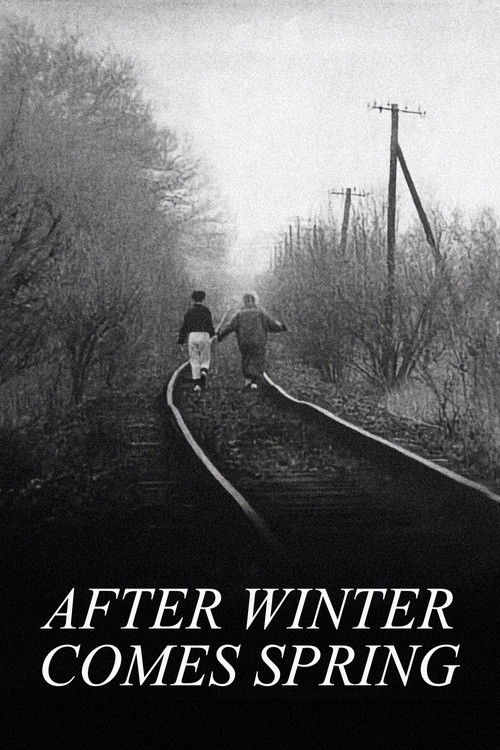
Misselwitz and Plenert go out to make a film about divorced women in the late days of the GDR. a woman in the beginning of the film, who realized as a lone parent she's better off looking for single dads, cause all the others run away. a woman at the end of the film who decided to raise her children without the husband (a decision she regrets, she/the film are that honest). Misselwitz doesn't make a secret out of the fact that she's divorced twice as well, fueling the urge to make this documentary. it's not all about men and women cannot making it work though, sometimes it's also just about to get away, break things off in this tight society of the GDR. for example they're also accompanying two girls who ran away from home for an extended period of time. all in all Winter Adé is an refreshing time capsule, talking about breaking up just a split second before the two Germanys would reunite. there's some fitting symbolism in this fact alone, knowing that this wishful, pseudo-harmonic process had massive problems - just as the human relationships Misselwitz and Plenert are depicting.
Made shortly before the fall of the Berlin Wall, Helke Misselwitz's After Winter Comes Spring is a sympathetic, moving snapshot of the lives of women in East Germany at the tail end of the nation's existence. Bookended by interviews with two single, middle-aged mothers with good educations, the film's subjects span ages from their teens to mid their 80s, and possess educations ranging from nothing to advanced degrees.Both of the film's bookend figures are spectacularly thoughtful and self-aware, examining their lives and choices with remarkable clarity and honesty. Hillu, the woman who opens the film, has been decorated by the state for her work in advertising, and talks primarily about her two marriages, her relationships with her children, and the differences between the marriages. She also, almost incidentally, questions the nation's expectations of reverence for its political figures, and expresses shock at how few women are celebrated the way she has been, and laments the shortage of women in advertising.The film's closing subject is Erika. She lives by the sea, running a house for troubled children and is also active in local politics. At 55, she is one of the oldest of Misselwitz's subjects, and is quiet and unassuming in her presence. It is only though conversation with the soft-spoken women that Misselwitz uncovers a life that has been fiercely, resolutely unconventional.Despite growing up during a time when pregnant women married and stayed that way, Erika had two children with the love of her life and refused to live with, let alone marry him. In her telling, the father of her children accepted her decision without question, because he knew her well enough to understand that arguing was pointless. Throughout her life, Erika prioritized independence, work, and her children, speaking with great clarity about the community she built around the kids, and telling Misselwitz that the two "felt safe," so there was no need to compromises her needs in order to bring a man into the home.Erika talks frankly about the challenges of simply navigating through the world, something she doesn't lament but simply accepts. Having fairly recently survived a severe illness, she's more passionate about her life at 55 than she expected, and continues to simply embrace whatever comes, even as she negotiates around the edges (at one point she, with a half-smile, refers to herself as "cunning") to make it work for her.Between Hillu and Erika, Misselwitz talks to a variety of people at different places in their lives, including: a pair of sixteen-year-old punks who have run away from home and, unbeknownst to them, will soon be sent to homes for delinquents; a divorced industrial worker living with her parents and raising two children, including a violent daughter with developmental difficulties; a vital, 85-year-old woman celebrating her 60th wedding anniversary surrounded by family who, in a private moment, describes her husband as serially unfaithful and "not much good," and laments having married him in the first place.After Winter Comes Spring is by turns sad and inspiring, featuring moments of genuine humor alongside quiet ones of deep suffering and regret. Regardless of the position and status of the women before her camera, though, Misselwitz is unflaggingly respectful and curious, treating all of the women as worthy of attention and regard. Even the most guarded and cynical eventually open up to her, like the women in a fish-canning plant who are suddenly seized with almost child-like excitement when one of them idly wishes she could be 20 again, and apply for a job on a fishing boat.⏩ ☭ Soviet (Bloc) Spring 🌷⏩ 52 Films by Women: watchlist | seen
"Wo wollt ihr denn hin?" "Ach irgenwohin. Raus aus Berlin. Berlin ist tot."Wieder eine starke Zeitkapsel der Gesellschaft aus den späten Tagen der DDR. Voller ganz unterschiedlicher, mal mehr mal weniger, nahegehenden Geschichten und Schicksalen von Frauen aus jener Zeit.Die schönen und ganz selten einmal dokumentarisch-trockenen Schwarz-Weiß-Bilder sind voller herrlichem Kolorit und wirken immer ehrlich. Egal ob aus der Bahn, der Kokerei, der Fischkonservenfabrik, dem Autokino oder von einer diamantenen Hochzeitsfeier; egal ob die Stimmung humorvoll, politisch, punkig, familiär-intim oder schmerzhaft-ehrlich ist. Wobei Helke Misselwitz mit ihrer Art des Interviewens auch entscheidend dazu beiträgt, sodass man hier immer glaubt echte Menschen mit Ecken und Kanten, und echten Träumen von der Zukunft vor sich zu haben.4 von 5 Doku-⭐(52) Filme von (52) Frauen – 2023 №22