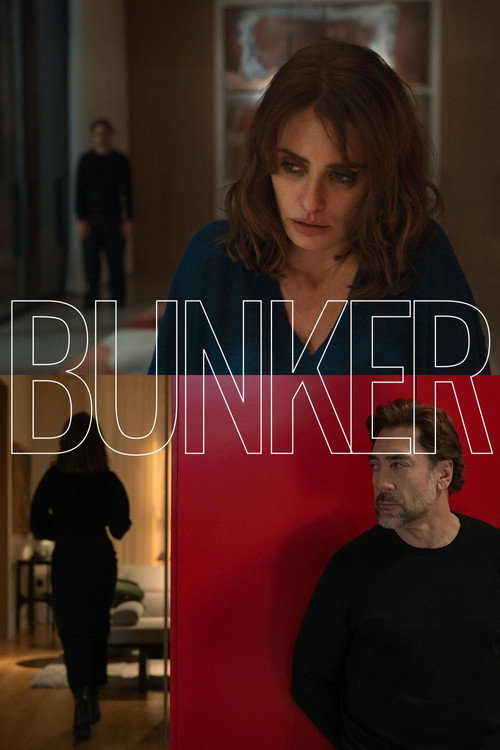






“If the rule you followed brought you to this, of what use was the rule?” It’s never a good thing when you spend most of a movie thinking about a line of dialogue its lead actor said in another, much better movie, but those words — the closest thing Anton Chigurh has to a credo in “No Country for Old Men” — came back to me like a bad case of déjà vu every time Javier Bardem’s character suffered another ponderous setback in Florian Zeller’s “Bunker.” A paranoid drama that’s as airless and unsatisfying as the dead marriage that it dissects, the film stars Bardem as Miguel, the hottest architect on Earth in more ways than one. His career has greatly benefited as a result of his decision to relocate his family from their home in Spain to the minimalist glass mansion he’s designed for them in the heart of a gentrified London neighborhood, but the more accomplished he gets, the more isolated he appears to become. His marriage to literary executive Sofia (a sorely under-written role played by Bardem’s real-life wife Penélope Cruz) has withered in the growing shadow of his celebrity profile. He can barely communicate with his phone-addicted teenage daughter, he doesn’t have any time to play with the younger one who’s nearing the end of her cutest years, and his every waking thought is consumed by the window-sized hole that his next-door neighbor (Stephen Graham) has just hammered into the wall that separates their properties. That’s when Miguel receives a heavily NDA-ed offer to design a doomsday bunker for a famous tech billionaire who’s even richer and more detached from the rest of humanity than he is (Paul Dano, whose deeply unnerving one-scene performance cuts to the core of Silicon Valley nihilism with a sharpness that makes him so much scarier than any of the other Zuckerberg-coded villains who’ve seeped into movies over the last 15 years). If the success they’ve achieved has brought them to this, of what use was the success? After “The Father” (extraordinary) and “The Son” (not), Zellner has returned with a characteristically bleak vision of the holy ghost; in this case, the invisible specter of fear that causes so many of the modern world’s richest and/or most accomplished people to isolate themselves from the rest of humanity in response to their good fortune. Similar to both of the writer-director’s previous films, the hermetically sealed “Bunker” hinges upon how the architecture of psychology is reflected by the psychology of architecture — it’s fascinated by how people express themselves through the spaces they inhabit and vice-versa. The “organic minimalism” of the mansion that Miguel has designed for his family reveals his utopian desire for light and transparency, but the house’s austere interior, hostile swatches of color, and walled-off garden betray the same closed-off severity that has started to distance Miguel from even his wife and kids. What do you get for the man who has everything? The impossible peace of mind that no one is going to take it away from him. In a movie that doesn’t leave enough oxygen for laughter, the fact that Miguel is confused why Dano’s character wants to build himself a giant hole in the ground — secure enough to inure him against social collapse, ecological devastation, and even his own bodyguards — is maybe the closest thing we get to a decent joke. ~this review continues on IndieWire~