

abolish prisons, abolish men, dames and broads and tramps and crones forever

A single mistake puts a 19-year old girl behind bars, where she experiences the terrors and torments of women in prison.
Caged is showing in 1 cinema in Bucharest - next screening Saturday 28 November at 20:00 at "Eforie" Cinematheque.
Next screenings: Saturday 28 November.
Full schedule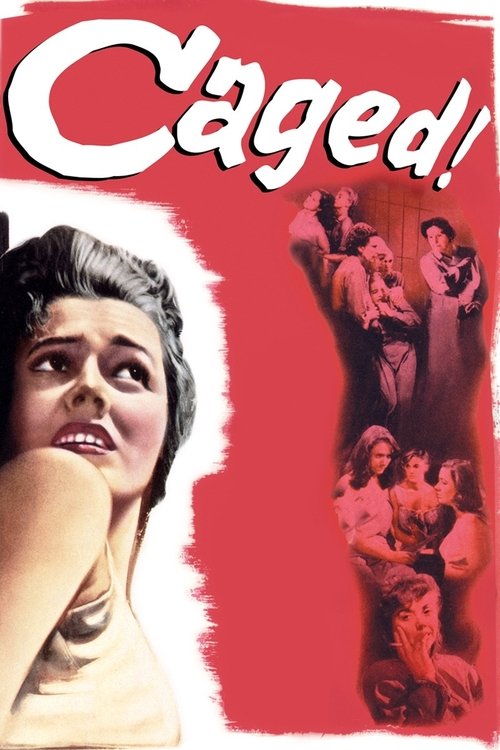
Caged showtimes, refreshed every morning
Pick your cinema, get a nudge before it leaves screens.
abolish prisons, abolish men, dames and broads and tramps and crones forever

Sometimes I wonder what got put into the drinking water of America between the mid-40s and 1950, that made audiences ready to accept and studios willing to make films like this all of a sudden. Across genres, movies just got harder, more explicit, more ambivalent about who exactly the good and the bad guys are. Think The Sniper (1952), The Prowler (1951), Ace in the Hole (1951), Kansas City Confidential (1952), etc etc. Still black and white but so much less black and white...Movies like those and like this hard-nosed prison drama would have been unthinkable even five years earlier. 1947's Brute Force showed the effects of prison's brutality on its inmates, but it didn't really question the basic punitive nature of the penitentiary system; get rid of the bad apples like Hume Cronyn and make the whole thing a little more humane, and that would be enough.Here though, we're taken inside a women's prison - and don't get any ideas about this being a fun exploitation romp, it's anything but - and shown just what life inside can do to people. I grant, our heroine (Eleanor Parker) is an almost comically young, innocent and fragile little bird, and the sadistic prison matron (Hope Emerson) who torments her is just as comically evil and one-dimensional. But John Cromwell's film dawdles on the suffering of secondary characters as well, some of them toughened lifers, and devotes a decent amount of time to exposition of the terrible institutional obstacles and corruption facing those like warden Ruth Benton (Agnes Moorehead, great here once again) who seek to reform the system, to make it more about rehabilitation and therapy and less about punishment.Imagine that, in a film made in 1950! I feel like a prison film that made that point today would get serious flak in certain corners of the U.S. and Canada.

Not me confusing Eleanor Parker with “The Bride of Frankenstein,” Elsa Lanchester.So this one started a little slow for me, but as it goes on, it becomes this fantastic character study on the lives of different women who see themselves tortured not only by the other inmates but also by the personnel of this women’s prison. To make matters worse, Parker’s character is allegedly innocent. While the writing can get a little silly and clearly stereotyped, everyone in the cast does a great job delivering some great, nuanced performances. Hope Emerson as the “Ratchet” of this film is brilliantly wicked, she’s a character that you grow to hate as she goes from the joke of the place to this sadistic matron.The staging, production design and especially the cinematography and camerawork both do an incredible job heightening the psychology of the characters—their anguish, their hopelessness, the shadow of their (mis)deeds that are cast over them—with some great use of low angles, closeups and lighting work. And while Max Steiner's score occasionally borders on overdramatic, I greatly like its blend of orchestral music and jazzy flourishes. All in all, while it gets a bit too melodramatic and unsubtle in its messaging, this is still a great prison drama worth checking out for its performances alone.TODAY SCHEDULECagedCollateral DamageGet CarterCopland
A naive nineteen-year-old girl is sent to a women's prison where she gradually loses her innocence and transforms under the pressure of a corrupt institution.
It was directed by John Cromwell, a prominent American filmmaker active during Hollywood's golden age.
It is rated 15 in Sweden.
It was released in the United States on June 10, 1950.