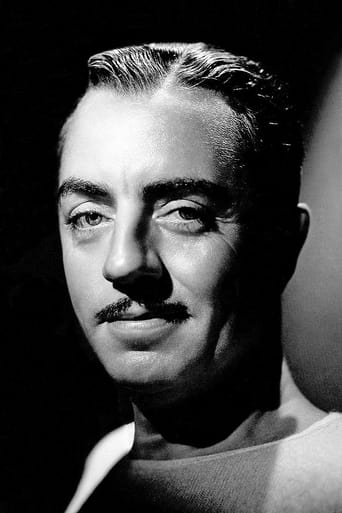


This really didn't have a lot going on but William Powell is so dreamy so that's all that matters 🤭
After tricking him into marriage, a woman tries to win the love of her philandering husband.
Double Harness is showing in 1 cinema in Los Angeles - next screening Thursday 5 November at 19:30 at New Beverly Cinema.
Next screenings: Thursday 5 November.
All 2 days & timesNot this day?
All 2 days & times
Double Harness showtimes, refreshed every morning
Pick your cinema, get a nudge before it leaves screens.
This really didn't have a lot going on but William Powell is so dreamy so that's all that matters 🤭

“Marriage doesn’t have anything to do with love. Marriage is a business.”Double Harness opens with some of the best dialogue I’ve ever heard at the beginning of a film. A fashion designer (Fred Santley) is presenting a wedding gown to a prospective buyer (Lucile Browne): “I designed that bridal number myself, Miss Valerie. And if I do say so, it is what I call lush. Your fiancé may have fallen in love with you for your singing voice or your kindness to dogs, but when he sees you come down the aisle in that, he’ll know you’ve got sex appeal, too.” And we’re off. While pre-code films are known for being more sophisticated than what followed after the hammer came down, Double Harness is especially sophisticated.Joan Colby (Ann Harding) and John Fletcher (William Powell) are both cynical about marriage but get hitched anyway and almost immediately regret it. The screenplay by Jane Murfin (Alice Adams, The Women), adapting a play by Edward Poor Montgomery, looks at how love and marriage are not always compatible, especially when money is involved. (Fletcher owns a shipping line.) The flawed Fletcher marriage is contrasted with that of Joan’s sister (the aforementioned Valerie), who risks ruining her husband (George Meeker) by reckless spending. We know how matters will end, but Joan and John have a wild ride getting there.Although the film can’t quite disguise its stage roots, director John Cromwell makes it fairly cinematic with more camera movement than I can recall from him. But the film’s main virtue is the performances. Harding, few of whose films I’ve seen, has a much more natural acting style than is usually seen in the 30s. Joan is uncertain about what she wants out of life, and Harding expresses her doubts with subtlety. She and Powell have more chemistry than their characters seem to have, with Bill also being unusually relaxed. When someone says Joan is clever, Powell’s “She is” somehow expresses admiration and resentment simultaneously. There are excellent supporting performances from Lilian Bond, as John’s former flame, the epitome of a minx, and Reginald Owen as a comic butler.One of the things I find most enjoyable about 30s films is how properly the actors pronounce such words as anniversary, chance, dinner, first, and were. To paraphrase Miss Norma, they had elegance then.Double Harness is thoroughly entertaining, much more than I expected. Beyond the classics, TCM seems to show some lesser films over and over. Is A Little Romance really that popular? Double Harness deserves being shown more often.“I like all the good things in life.”Random thought: Double Harness is one of several RKO films that were out of circulation for fifty years because producer Merian C. Cooper (the King Kong guy) owned them as a result of a legal settlement after he accused the studio of not paying him what his contract specified. The 1946 settlement gave him ownership of six films. TCM first broadcast these films in 2007 after my longtime cinepal Lee Tsiantis untangled the legal entanglements. You can more about this process here. Lee is the High Potentate of the North Georgia Center for Cinephilia mentioned here occasionally.Favorite Films of 1933.

William Powell and Ann Harding star in Double Harness, a light romantic comedy based on Edward Poor Montgomery’s stage play. The plot centers around the on-again off-again relationship between Joan Colby (Harding) and idle playboy John Fletcher (William Powell.) After her sister Valerie (Lucile Browne) heads to the alter Joan makes the pragmatic decision to land her own man for the sake of financial security. She sets her sights on John and after some machinations convinces him to marry her. But since her motives aren’t pure and John isn’t fully committed anyway they divorce. Of course by this time Joan has actually fallen in love with John and becomes desperate to remarry him. Powell and Harding are a solid team up and their respective dramatic/comedic skills are on full display. It’s a more sober story than your typical Thin Man installment and Harding is a less suitable match for Powell than Myrna Loy, but Double Harness, while notably dialogue heavy, is a worthy watch.
After tricking him into marriage, a woman attempts to win the affection of her philandering husband.
John Cromwell directed Double Harness in 1933 as a pre-code romantic comedy-drama for RKO Pictures.