




Though I am a staunch collectivist, I could not help thinking how funny it would be if, as the priest curses the collectivists in the name of God, the giant foot of Monty Python just smashed them all in a moment of holy wrath.
During the agrarian collectivization process in the Soviet Union, Vasyl, a peasant member of the youth division of the Communist Party, gets a tractor with the help of a local party organization and plows private boundaries on kulak fields. However, this enthusiasm will cost him dearly.
Earth is showing in 1 cinema in New York City - next screening Monday 26 October at 18:00 at Metrograph.
Next screenings: Monday 26 October.
Full schedule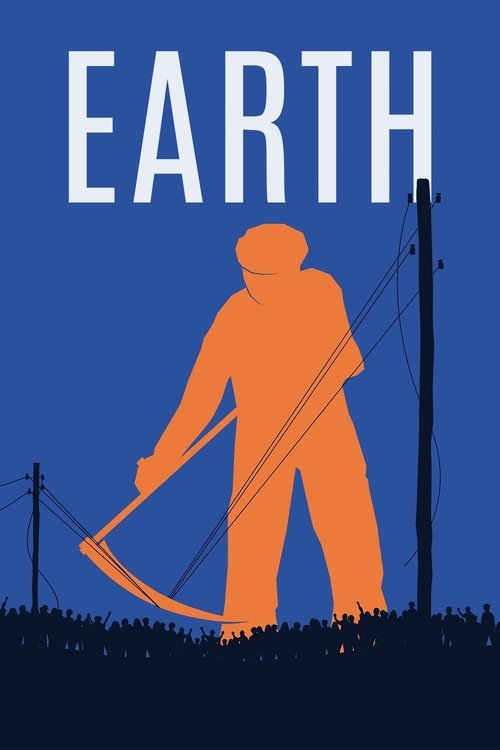
Earth showtimes, refreshed every morning
Pick your cinema, get a nudge before it leaves screens.
Though I am a staunch collectivist, I could not help thinking how funny it would be if, as the priest curses the collectivists in the name of God, the giant foot of Monty Python just smashed them all in a moment of holy wrath.

To view as a critique is quite tempting, but it's really just an incredibly beautiful work. But it's a film as much about montage and Kuleshov-ian dialectic as it is about the difficulties of collectivization and the process of turning grain into bread. Yet, what the hell, it's just one of the most poetic films of them all. What matters most are the faces of these "actors," the faces of these people. A Cinema of Portraiture: now I understand what P. Costa meant when he told me he was thinking more of the Soviets than John Ford when he made Horse Money.

There's an abstract quality to Dovzhenko's montage that seems to work against narrative rhythms; his story moves forward somehow or other, but at any given moment, he's likely to organize tableaus that illustrate his moment in a way that looks like folk art (tapestries, stained glass windows, Byzantine painting) while doing nothing to maintain narrative momentum. Best example of this is toward the end, when he crosscuts between 4 or 5 separate locations in a way that does none of the work of advancing a story, or even implying a sequence of events. The priest is denouncing, the widow is grieving, the pregnant woman is in labor, the murderer is going nuts, the funeral-goers are holding their service... Oh, and the way he chooses to illustrate his character-moments is often wildly expressionist-theatre inflected, sometimes to the point of looking like Artaud-le-momo performance choices, like the guy dancing around in a circle and trying to bury his head in the dirt to express his character's emotional reality at that moment. PS: Even though one of the plot-points is that the collective is renouncing Christianity, the remorse and guilt of the kulak-dude that killed the other dude is conveyed in a way that totally evokes Judas after the Crucifixion. Folk art.
During the Soviet collectivization campaign, a young peasant activist brings a tractor to his village and faces resistance from wealthy landowners.
Earth was directed by Ukrainian filmmaker Alexander Dovzhenko in 1930 as the final installment of his silent trilogy.
Earth is widely celebrated as one of the greatest silent films ever made and ranked highly in historic international film polls. Showtimes on Mood.