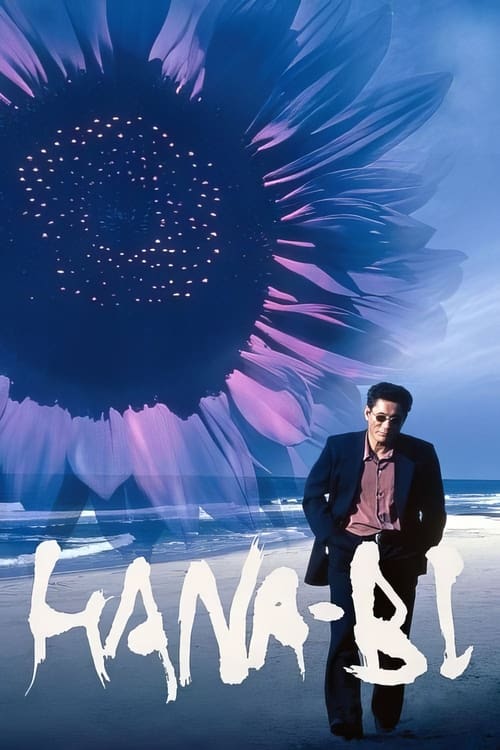
No other director understands the inevitable pain of fate better than Takeshi Kitano. In his masterpiece Fireworks, Kitano played an impassive police officer, Nishi, who is a superman capable of everything -- rob a bank, repaint a car, kill a bunch of gang members without hesitation, yet the only thing this superman couldn't do, is save his dying wife from cancer, or bring his long passed daughter back to life. In this pessimistic tale, everybody hurts, and everybody struggles to survive the cruelty of life, by relishing the scarce moments of happiness, even if they are as flitting as the fireworks in the sky.Despite its emotionally detached characters and an understated storyline, Fireworks boasts some of the most blindingly gorgeous cinematography, exquisite frame compositions, as well as trippy symbolism, from the breathtaking shots of the Japanese natural locations, to the lingering showings of Kitano's own paintings of flower-headed animals. Kitano masterfully injected elements of dark humor and spontaneous outbursts of gruesome violence into an otherwise meditative quiet storm, thus creating an odd contrast which wittily echoes the theme of the movie. Attempts were never made to elicit tears from the audience, until the last 10 minutes, which is for me THE best closer in the cinema history ever, as no other director has so triumphantly depicted the helplessness of individuals against the formidability of fate, with such precision and transcendental beauty. Highly recommended.
The more films I watch the less I understand about Takeshi Kitano. From the surface he looks just like a rock that occasionally explodes and blinks a lot but spend some time with him and it becomes very obvious that he is indeed a man capable of conveying emotions without having to utter a single word.No eye-contact required, his shades alone speak volumes. Was it telepathy? I knew those close-ups were suspicious -- and the way Kitano focuses on the most mundane scenes (fishing, tossing rocks) and rushes through exciting bits, too, somehow effectively brings forth Nishi's depression without so much as a twitch from the actor/director. This entire film is a conspiracy, and it's the little moments of shy laughter, glances between Nishi and his wife that makes it a wonderful one.Say cheese.
Next time I'll kill you.In just 3 films, Kitano for me has earned a sort of auteurship among other Japanese directors. The strange man whose face is lined with wrinkles and folds that hold thousands of stories is known for conceptualizing unique tales that simply would not work in a Western environment. Kitano's films don't really work in Japanese cinema either. In fact, Kitano's films almost belong on their own little island in the sea isolated from everyone else. An island where mobsters sit around on beaches playing Russian roulette, people play baseball games that erupt into violence, karaoke night has at least one beating, and the sky is always alive with the sights and sounds of fireworks. This is an island where emotions are muted, actions are always to the extreme, rarely anything makes sense and nothing ever goes your way. Kitano's universe is a place we never ever want to live in, but we are obsessively intrigued to observe. Hana-bi or Fireworks is another one of those Kitano gems that is rough around the edges but still pokes around into those deep dark thoughts your mind may drift to during a boring lecture, or while being bent over backwards at work. This film continues the trend of outside-looking-in, stripped down film making that allows Kitano's strange surreal world to take on a unique life force of its own. Like Sonatine and Jugatsu, Hana-bi focuses on characters off kilter or just before their boiling point. Hana-bi once again explores the nature of the soul when put under tremendous burdens and stressors. Its harsh and at times shockingly violent, but its actually a bloody elegy on the frailty of man. Its also the first time in a Kitano film that I've seen a loving relationship portrayed with feeling and meaning. Nishi, a cop, (Kitano) is dealing with an ill wife, a dead child, and a partner now paralyzed because of his actions on duty. Under these incredibly stressful parameters, he resorts to lashing out at mobsters he owes money, and virtually everyone who looks at him wrong. Kitano puts these burdens on his shoulders and gives us a character so stone faced you can't tell if the situation has made him numb, or he has always been like that. And as a director he intelligently avoids easy answers. The only thing alive and with heart in this cold world is his relationship with his ailing wife. They share little words but their body language tells us all we need to know. In films without much dialogue, actors have to rely on primitive skills. Microexpressions and small reactions tell us that this couple once shared a childlike love for one another, but life took its course and now they are trying desperately to reconnect. But something is lost. This world robbed them of something and they haven't got the energy to quite take it back. But they are still trying. These two performances are important, but a 3rd is also a silent powerhouse. Horribe was Nisnis partner; the one who was shot and paralyzed for life. As the film continues and Nishi gets deeper into shit, Horribe comes to grips with his new hermit life and picks up art as a hobby. The film is spliced with many close ups of his artwork and a running theme of the film is the display of the arts. In the face of adversity you have a man lashing out, and a man turning inwards to create something. Both paths are complicated with things like old love, suicide, and violence to make things more complicated than one path versus another path. In Kitano's universe nothing is black and white and its rarely easy to decipher anything. What he leaves us is a drama unlike anything you've seen. Matched only by his other films. Like fireworks in the blank night sky, Hana-bi is a stagnant film lit up with colorful explosions of violence. Expressionless people are imposed with cuts of violence either of days past or in moments to come. Its never in the now, like all big mistakes. When you've lost all will to continue, a man might close his eyes and the insides of his dark eyelids may be lit up with the moments that gave his life color. Are these things good or bad?In a Kitano film they are likely bad. But here little glimpses of love and beauty are found. Takeshi Kitano is a gift to this world.