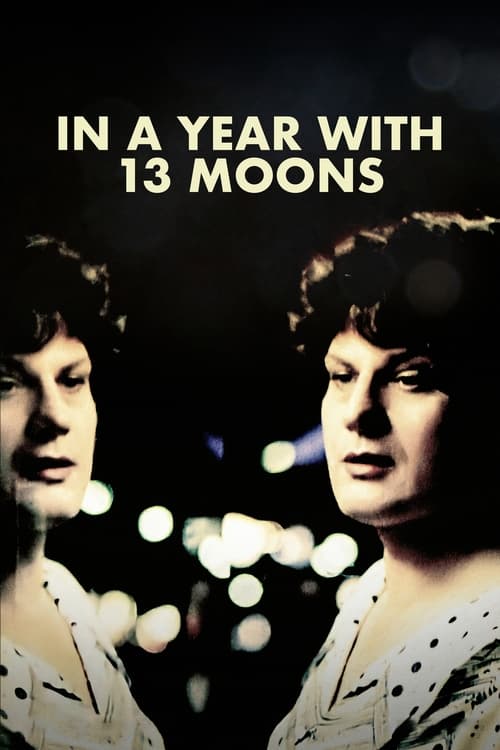




The unfortunate fact that Fassbinder chose to use a pseudo-trans woman as his vessel for exploring the agony of unrequited love mars this poetic trauma. That's what this is; not a film, not an expression, not an exploration, not a vivid image. It is the trauma itself projected onto the screen. I hesitate on most films to refer only to the director as the creator of a film, but it seems fair on this one, since Fassbinder did everything but the acting, to talk of it in terms of what Fassbinder intended. And he clearly intended this as a catharsis, a weapon against his pain, a confession, a desperate plea. This film is what it feels like to lose someone who loved you to suicide.It's as if he heard horror stories of trans lives and decided that only that could reflect the pain he felt, or the pain he projected onto or saw in or imagined in his lover that inspired this film. Myths of regret, of mutilation, of bodies present trans lives as bleak landscapes (though as Casey Plett has written, as I have referenced, that's not really so). Fassbinder took those myths and used them as stand-ins for his own pain, and though unfortunately, he created a textbook example of transphobic cinema, he also created a perfect distillation of loss, grief, anger, guilt, frustration, loneliness, regret, loathing, and fear that is the wake of a loved one's suicide (hell, even an acquaintance's suicide).To survive someone's suicide, to bear even remote witness to it, to be in the orbit of it is to be hit with emotional shrapnel. Those who commit suicide are not (usually) selfish or intending you harm; often, it is a feeling of no escape, of being trapped, that becomes the final straw. I know that's how I felt when during my abortive, failed attempts. (Remember that there is a way out, somehow, even if it's painful, that doesn't require your death. And that I love you.)What this film portrays, then, is the feeling of having your entire emotional being ripped apart by shrapnel. It walks you through Elvira's last days, showing each desperate grasp for love ripped away from her (the unfortunate choice rears its ugly head here as multiple times the film posits her status as pseudo-transsexual as a source of it, but) but the real source of that dramatic transformation is Elvira's obsession with a tyrant incapable of loving her. The superficial facets of Armin Meier's life that he includes fit neatly into Fassbinder's (not unjustified) obsession with the legacy of Nazism on those born in the ashes of post-war Germany. The far-too on-the-nose birthplace of Saitz mirroring Fassbinder's own post-war birth (in timing, not locale) and the rumored origins of both Meier and Elvira tie the principle players to an era of devastation, rebirth, and necromancy (West Germany was the undead resurrection of fascist Germany). And it positions Fassbinder as the tyrant, the monster who internalized the remnants of fascism and destroyed someone who loved him. It's hard to imagine a more clear expression of the self-loathing and guilt that losing someone to suicide often engenders. Fassbinder spent much of his film career crafting dire warnings of what it is to internalize the atrocities of oppression, and here, he takes his guilt and paints it as just that. The self-recrimination of the characterization of Saitz burns you when you understand it. It feels too familiar (why couldn't I love Kaylie the way she needed me to). The focus on Elvira's past, then, is a desperate investigation into Meier's perceived pain. As much fiction as fact, it's impossible to know what Fassbinder intended as tribute and what was intended as misdirection, if any. But woven into Elvira is pieces of Fassbinder as well (the nun who raised Elvira is played by Fassbinder's actual mother how much more psychologically heavy-handed can you get), which is so often how we come to terms with those we lose. We can only understand people through the moments they touched our lives, after all. We can only hope to make sense of losing them through the same. I have no idea if Fassbinder felt he had successfully paid tribute to or otherwise processed the loss of his lover through this film, though it is said he claimed this as one of his best (that could be as much ego as anything else). Every frame of this film is a meaningful construction of angle, blocking, set, and lighting. The infernal neon of the empty offices where Elvira emptily observes a man's suicide, the doorways and walls crafting pinholes through which we watch the dramas play out, the neat lines and boards that draw our focus, the careful framing and focus that provide us with human juxtapositions to reveal pain and loneliness, this is a visual masterpiece. What it took from Fassbinder to create this I cannot fathom. I only hope it gave him some respite from his own pain, in spite of the cruel choices he made to create it.