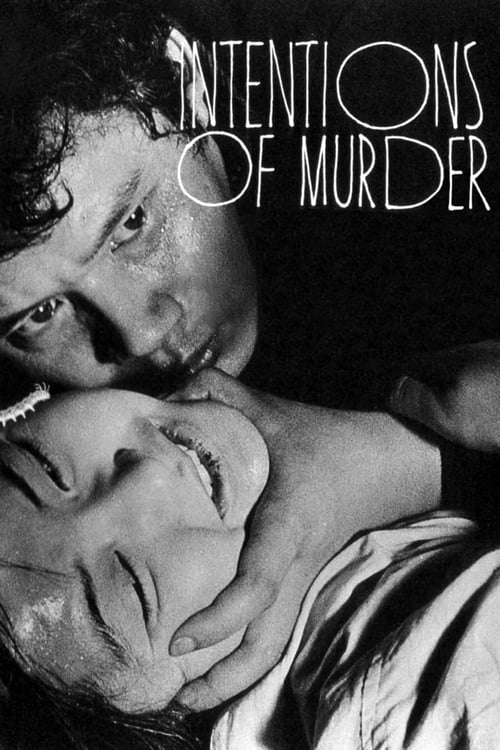
Describing the plot or characters in Intentions of Murder wouldn't really give you a good idea of what it's all about - Shohei Imamura directs the unholy hell out of this thing, with glowing trains, long takes, crazy camera angles, and more. And Masumi Harukawa is heartbreaking as a woman who lives in an almost total affection vacuum (by far the person who treats her with the most tenderness and affection is the guy who breaks into her house and rapes her at knife-point), and the movie works as a feverish examination of the kind of damage a vacuum like that can do to the people inside.Almost every shot is overcrowded with detail, either obtrusive or illuminating. This one is going to take a few more viewings to catch everything, but each one will be a dark and bracing pleasure.
The level of commitment Masumi Harukawa shows to her part in this is Adjani-level. Good thing too because before Shohei Imamura is done with her she has spent two and a half hours being treated like dirt by her husband and mother-in-law, repeatedly beaten and raped and then pestered by a pathetic burglar who becomes fixated on her, made to trudge through a snowstorm in socks, almost decapitated several times over whilst having her head held out the window of a moving train, threatened with having the child she's raised taken away from her and stalked by hubby's mistress.Insult to Injury Dep't: Mainichi Film Awards went to Ko Nishimura (her husband) and Yuko Kusunoki (his mistress), and NOT to Harukawa-as-Sadako, who delivers a gut-wrenching performance and is the heart and soul of this heavy drama.I'm not familiar with Imamura's films and I was kind of expecting a Nikkatsu noir, but this is a whole other grim ball of wax. Seriously, what Sadako goes through is brutal. Beyond the physical and sexual abuse, there's almost non-stop psychological and emotional abuse heaped on by those around her. Even the kindergarten-aged kid she's raised calls her a fatso! I paid attention and her husband literally has nothing anywhere close to nice to say to her for the first 2h25m of this. It's a hard watch. For all the abuse and trauma and degradation she goes through, however, Sadako is nothing if not resilient. There is virtually no respect shown this poor former maid, yet somehow she perseveres. I wouldn't call the ending triumphant exactly, but it does show her as a survivor and then some. Somehow many see humour in this story, including those scenes involving the sex foisted on Sadako, but somehow I never felt like laughing. The sex between the former maid and her librarian husband is mostly basically rape and involves them calling each other mama and papa (whatever works I guess), while our self-pitying burglar with a bum heart careens wildly between brutal, controlling violence and abject clinginess and then back again.Nope, for me this was downbeat all the way, with a small ray of sunshine at the very end.
I have admired select films from Japanese filmmaker Shohei Imamura even if there's still half more to his filmography I haven't caught yet. So consider me psyched when newly Academy Award winning director Bong Joon-ho was surveyed by indiewire.com and pronounced this one among his thirty favorite films.Intentions of Murder, though, is a misanthropic curio that I didn't quite buy. It's also gratuitously drawn-out. Sadako (Masumi Harukawa) is a plain and stifled housewife who is one night sexually assaulted by a burglar (Shigeru Tsuyuguchi) with such low self-esteem issues... that he returns repeatedly to accost this housewife in future settings to profess his love for her. Instead of phoning the police, this housewife takes pity on this lamentable young thief and with plenty of badgering, he works at convincing her to run away with him to begin a new life together. The story has a tiring airlessness about it, which is going to be inevitable when it's dealing with characters trapped in poverty and ignorance. Sure, I occasionally appreciated viewing the vérité naturalism of turbulent city life and ragged lowlifes circa the 60's. But keep in mind, this is a near-agonizing 150 minutes long. The primary reason to see it all at this point is if you take not Imamura, but Joon-ho as a cinematic deity, and you're dying to know what images and materials could have possibly paved its way into his 2019 masterpiece "Parasite." As for Joon-ho's list on indiewire, I ardently approve of most of his other picks.