
bro u think u had this meaningful ~before sunrise~ moment last year at marienbad but she don't remember u...let it go
At a weekend gathering, a man tells a woman that they had spent time there together a year prior. But, the woman has no recollection whatsoever and is convinced that he is simply fabricating the encounter. The more he speaks about their activities the previous year however, the more compelling he becomes. The question remains however – did they meet previously or not?
Last Year at Marienbad is showing in 1 cinema in Amsterdam - next screening Monday 23 November at 14:00 at LAB111.
Next screenings: Monday 23 November.
Full schedule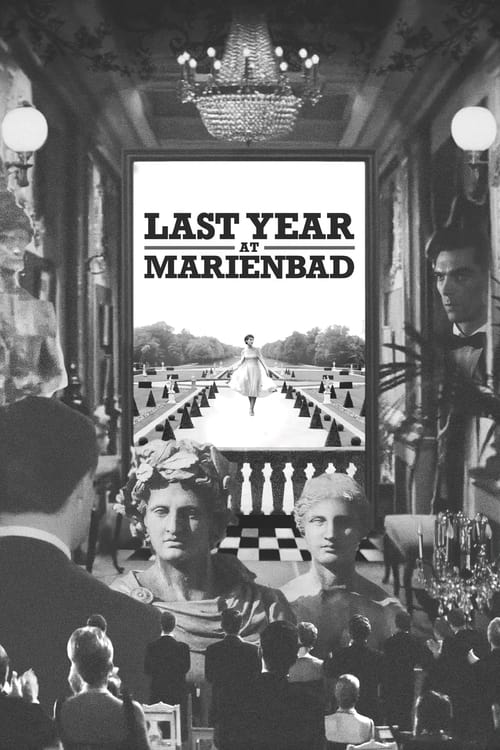
Last Year at Marienbad showtimes, refreshed every morning
Pick your cinema, get a nudge before it leaves screens.
bro u think u had this meaningful ~before sunrise~ moment last year at marienbad but she don't remember u...let it go

Deconstructing cinema much in the way Bresson wanted to do, but in a more grand fashion. It is akin to the Dadaist art movement of anti-art, breaking the rules and destroying the notion of what we perceive as true art. Perhaps not fully to that extent, but Resnais clearly experiments with the medium of cinema in a way majorly unaccepted, and ironically it becomes the focal point of where the film's greatness lies.Last Year at Marienbad begins with repetitive and poetic narration, ominously filling the air of the long empty corridors and parlors it softly speaks of. In the first few opening scenes alone, it is apparent Resnais is ready to deliver something entirely unique to the world of cinema. The narration spawns from a theater play that mirrors the forthcoming plot of the film. This is followed by a fluidly moving camera that puts the audience in a position to vaguely eavesdrop on the hotel guests conversations. What makes this even more compelling is how the action pauses midstream, sometimes mid conversation. We are only allowed for the staged visuals to sink in, and gain remnants of the actual spoken dialogue, before it resumes at its own leisure. This chaotic nature of filmmaking teases the audience with what normal film structure they may be accustomed to.Also with this elliptical opening, there is a realization later on in the film of how these myriad of artistic choices in fact lays the ground work as clues to the plot. The remnants of dialogue work in dual metaphors, more notably to serve as the foundations to the fractured memories of the man attempting to ignite remembrance in the woman who is amnesic to it all. The other function I personally interpreted, and fits into the dadaist criteria, is the dialogue spoken by the guests randomly and in segments, as fourth wall criticisms of the film itself. A man complaining to another of how there is no connection, followed by another sarcastically mocking someone else for taking rumored opinion as fact "So you only 'heard' about it?". I think in a way it's Resnais jumping the critics, in a subliminal manner, before they get a chance to do so to him.Like the majority of Resnais's other works, the main recurring theme is always that of memory. In his war oriented films of memory (Night and Fog, and Hiroshima Mon Amour), the theme focuses on the importance of remembering, and the crime and consequences of forgetting. In this film however, Resnais explores the realms of memory in an even more complex manner. It is essentially an examination on the deceptiveness of memory. Of how the past and time can cloud our memories to the point of corrosion, and what we may have perceived as factual events may not have ever occurred. However, the ambiguity presented keeps the film alive and unpredictable. We are never allowed to know what memories shown of the man or woman to be true. Hypothetically, even if Resnais would unmask the truth, we had been so fooled by deception up until that point, our disbelief would match that of the woman.The film keeps its ambiguous tone through a dreamy atmosphere, and a fantastical location that seems almost unreal in itself. How could one possibly decipher what is real and what is not? That is proof of how rich this film really is. It is certainly one I would suspect to require multiple viewings in order to ascertain any true grasp on the material. However, even without full comprehension, the film remains a wonder to behold. The elegance of the architecture, and the way Resnais captures it in a magically surreal way; entrapping us in a world of cold marble, dust white concrete, and indifferent luxury. It is visually some of the best cinematography I have ever seen, with shot placement doing more than just highlighting the frame. The famous shot of the overlook to the garden courtyard with fountains, and the handful of guest staged about in a real life reenactment, could easily pass as a classical renaissance era painting.Last Year at Marienbad is simply a marvel look at unorthodox filmmaking, and a test in style that turned into one of the best films that was ever made.

Bruh what if we kissed last year at Marienbad... Haha... Unless
At a remote European hotel, a man tries to convince an elusive woman that they met and shared a romantic affair the previous year, while she insists she has no memory of it.
Alain Resnais directed the 1961 film, a prominent French filmmaker known for his contributions to the Left Bank cinema group.
It is unrated (NR) in the United States.
It was released in France on September 29, 1961.
Yes, it won the Golden Lion at the Venice Film Festival.