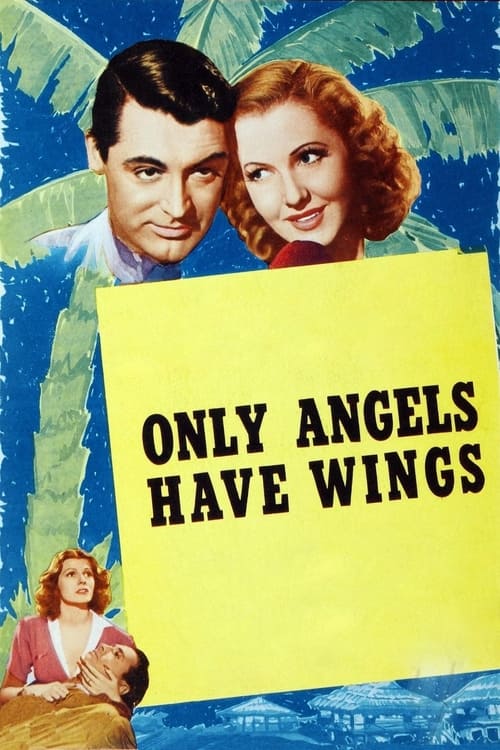
100/100My favorite film. The first half hour alone—focusing on Bonnie, from her disembarkment through "Who's Joe?"—constitutes a tour de force of shifting dynamics, as what appears to be a light comedy turns abruptly tragic, then pivots on most of the characters' refusal to acknowledge that upheaval. As it turns out, however, Bonnie is merely our point of entry into this offbeat community, and Dutchy's place thereafter becomes a stage upon which multiple dramas and crises play out, with the burgeoning love affair between Geoff and Bonnie forgotten for long stretches only to suddenly rush back in, full force. (The moment when Geoff, talking to Judy, suddenly walks over to a door and throws it open, causing an eavesdropping Bonnie to fall into the room, almost feels like a postmodern joke.) Is —Only Angels Have Wings* unapologetically, perhaps even aggressively masculine? Welcome to Hawks. But my own intense personal connection to it has less to do with gender than with the film's ethos, which celebrates pragmatism at the expense of emotional behavior without denying how powerful a pragmatist's emotions can be. The glorious ending, in which Geoff gives Bonnie what she needs while creating the impression that he hasn't—thereby protecting himself from a potentially disastrous surge of unaccustomed vulnerability—is the single most romantic gesture I've ever seen, which probably says more about me than years of therapy would unearth. (Note: Geoff handing Bonnie the coin is crucial. If she'd merely found it, altogether different.) I'm hard pressed to identify a moment that isn't glorious, though, even when I try to recalibrate for viewers who aren't wrecked by ardent-disguised-as-stoic. This is the Golden Age's zenith, making it pretty much the medium's zenith as well.* Yes, I'm officially adding the em dash. Which makes me want to follow the onscreen capitalization as well and call it —only Angels have wings, but that would create a minefield I don't want to navigate.
Cary Grant giving off big Han Solo vibes:-risk-taking pilot-wears cool jackets-constantly says “kid” -emotionally unavailable but tall and devastatingly handsome so girls still like him even though he treats them like shit he WAS the blueprint!
"A man can die but once. We owe God a debt. And if we pay it today, we don't owe it tomorrow."Before Howard Hawks was one of the great no-nonsense Hollywood genre filmmakers obsessed with pragmatic professionals (and screwball hangout camaraderie/fast-talking ladies who hold their own within his macho ensembles), he was first and foremost an aviator whose passion for the craft resulted in him seeing a lot of his friends die. A melancholy life experience that existentially infects this romantic adventure melodrama about a community of commercial airmail pilots who are asked to tensely risk their lives every time they clock in at work in one of their rickety steel flying machines, and the locals/passing travelers who get caught up in the allure of the macho death drive atmosphere and excitement of it all. There’s a lot of praise to go around here into making this film feel as effortlessly cool and pragmatic as it does while also frequently funny, harrowing and unbearably moving, but it starts with Hawks' choice of screenwriter Jules Furthman whose achingly romantic work for Josef Von Sternberg blends extremely beautifully with Hawks' proclivity for screwball romance dynamics but also men who try to remain cool and unfeeling in order to be good at their jobs. The sheer density of his overlapping ensemble dynamics, and how casually Hawks keeps everything moving and organized is so beautiful to watch in action. The opening 30-40 minutes of real-time introduction to this environment is spectacular—“Say, things move awful fast around here!” Tracing the foggy, musical, lived-in jungle of this South American port town, and the awe in which Jean Arthur’s outsider showgirl meets these handsome leather-jacket attired men (“it’s really a flying human being!”). Only to then immediately witness one die in a horrific crash (all the plane setpieces/FX are genuinely astonishing for 1939, and hold up today), and be baffled by the lack of respect or care over the sudden loss of life. Soon realizing this is a regular occurrence everyone including Cary Grant’s cynical prick airline boss tries to make themselves numb to as a coping mechanism, which makes it even more powerful when we do eventually see a tear on his face late in the film. “It’s like being in love with a buzzsaw!” The beauty of this introduction to this peculiar world is that it sets up this existential reckoning with work, death and love (and pragmatic professionalism vs. the emotions of friendship and community that make the pain and suffering of life bearable and meaningful) to linger behind what’s ultimately a series of warm rom-com hangouts and interpersonal melodrama with the people who live with this reality in the back of their minds every day and try to distract themselves from it. Old flames with new lovers, cowardly pilots with blood on their hands given the chance to redeem themselves through dangerous work, a pilot whose entire life has been flying has his body begin to betray him with age and is forced to be grounded, the new literally lovesick girl in town tries her best to adjust to this new fatalistic worldview but can’t bring herself to. Hawks and Furthman weave all this and more in such a casual and relaxed fashion that the power and weight of it honestly sneaks up on you. But then you get to the big finale where guns are going of in screwball comedy fashion, planes are being flown in stormy weather with a level of tension that feels proto-Sorcerer (not just because nitroglycerin on the plane either!), friends are dying, people you thought you hated are proving themselves to be brave and worthy, and a man who refuses to “ask anything” of a woman briefly lets his heart win. I don't think Hawks could've personified himself more than by having the ultimate pragmatic professional make an emotional decision by dressing it up like it’s not one, Grant performatively allowing him to quietly betray his principled self-image without appearing to do so, and as Arthur realizes it your heart just explodes and the water works start coming down. “I’m hard to get Geoff… All you have to do is ask me.” One of the best movies.Full discussion on ep 434 of my podcast SLEAZOIDS.